Choose the Odd One Out and Discover Something Interesting About Yourself!
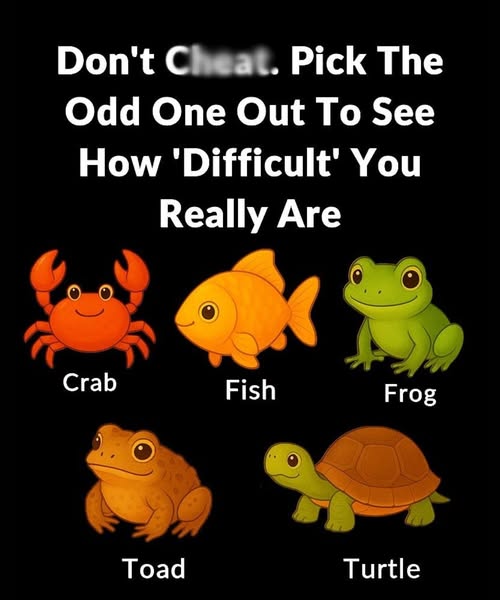
Online puzzles where you “choose the odd one out” seem simple at first glance, but the way people answer them reveals far more than they expect. One of the most shared versions features five animals lined up together: a crab, a fish, a frog, a toad, and a turtle. The task is straightforward—pick the one that feels different. There’s no timer, no trick, and no correct answer. Yet the moment someone points to a choice, they’re revealing something about how their mind sorts information, what they notice first, and how they instinctively make sense of the world.
At first, the puzzle looks like child’s play. Five common animals, nothing exotic or rare, nothing requiring deep biological knowledge. But as soon as people start explaining their reasoning, it becomes clear that this little exercise is a quiet study in human perception. What stands out to one person barely registers for another. What feels obvious to you might seem irrelevant to someone else. That’s the beauty of it.
A large number of people almost immediately point to the crab. Not because of where it lives or what category it belongs to, but because it simply looks different. It walks sideways, has a rigid shell, waves pincers instead of legs, and has a body shape unlike the others. For people who pick the crab, the decision usually happens in the first second. Their brains latch onto the most visually unusual element in the group. They’re the ones who notice design, structure, and silhouette before anything else. They trust their eyes first. They lean toward strong visual cues and like clear lines, crisp distinctions, and things that can be understood at a glance. Their minds spot difference in shape and form instinctively.
Another group chooses the fish. They glance at the list, ignore the visual details, and immediately think about environment. Four of the animals can survive outside the water for at least part of their lives. One cannot. The fish is fully aquatic, and that fact dominates the decision for people who think in terms of setting, surroundings, and context. These are the thinkers who notice where things belong, who they belong with, and how their world fits together. They’re sensitive to ecosystems, relationships, and the rules of environments. They tend to categorize based on function and habitat rather than looks.
Some puzzle-takers point to the frog with surprising confidence. Their reasoning has nothing to do with looks or habitat. Instead, they’re thinking about development and transformation. Frogs begin life as tadpoles, with gills and tails, then undergo a dramatic metamorphosis into adults. While other animals also have life stages, none of them transform in quite the same way. People who choose the frog often appreciate process, evolution, and the path an organism takes to become what it ultimately is. They are drawn to stories of change and growth. They notice journeys more than static traits. For them, the odd one out is the creature whose life simply isn’t straightforward.
Then there are the people who pick the toad. These individuals look at the frog and toad side by side and immediately start comparing the subtle differences: the drier, bumpier skin of the toad, its preference for land over water, its slightly different build. Many casual observers lump frog and toad together, but those who choose the toad usually have sharp eyes for nuance. They pick up on texture, behavior, and details that others might gloss over. This choice reveals a mind that values subtlety, that notices details the average person misses, and that enjoys distinguishing things that most people consider nearly identical.
And of course, there are those who confidently point to the turtle. Their logic is rooted in taxonomy and classification. The turtle is a reptile; the frog and toad are amphibians; the fish is, well, a fish; the crab is a crustacean. For people with this perspective, the odd one out isn’t about appearance, environment, or life cycle—it’s about biological categories. The turtle stands alone as the only reptile, and that unmistakable difference becomes the deciding factor. These individuals gravitate toward systems, structures, and scientific groupings. They think in terms of definitions, categories, and the larger frameworks that organize knowledge.
What makes this puzzle fascinating is that every single answer is valid depending on the angle from which a person approaches the comparison. The crab is visually unique. The fish is environmentally unique. The frog is developmentally unique. The toad is behaviorally unique. The turtle is taxonomically unique. Five animals, five different ways to separate one from the group, and each method reveals a different style of thinking.