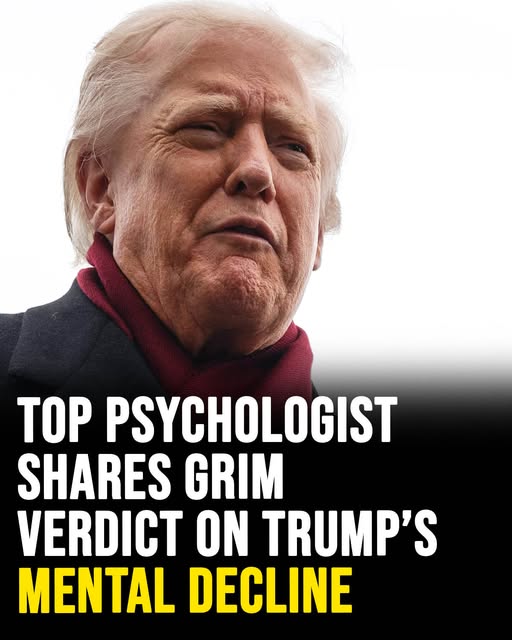
Top Psychologist Issues Stark Warning About Donald Trump’s Rapid Mental Decline After MRI Visit, Citing Dementia-Linked Behavioral Changes, Worsening Verbal Lapses, Disturbing Physical Symptoms, and a Dangerous Escalation of Traits Consistent with Malignant Narcissism
In Dr. John Gartner’s view, the recent missteps displayed by Donald Trump are not simply slips of the tongue or harmless quirks of age. He sees them as signs of a deeper pattern, a pattern that becomes visible when long standing personality traits meet the natural vulnerabilities that arrive with growing cognitive strain. Gartner describes this as a collision between a personality shaped by extreme self focus and a mind that may be losing some of the internal checks that once kept certain impulses somewhat controlled. In his interpretation, traits such as grandiosity, suspicion, and a readiness for confrontation do not soften with time. They grow sharper when memory weakens and when the mental systems that organize thought and behavior begin to falter.
He argues that as cognitive resilience declines, the need to assert dominance can rise. The fear of appearing weak becomes more intense. Emotional responses become quicker and more forceful. The tendency to lash out at critics or perceived enemies grows stronger. None of this requires a formal diagnosis to observe. It is a dynamic that many families have witnessed in relatives who once managed their tempers or insecurities with some degree of restraint, only to lose that ability as cognition changed. Gartner points to this overlap not to offer a medical conclusion, but to highlight what he sees as a recognizable human pattern.
For millions of people who have cared for loved ones with dementia or other cognitive illnesses, the emotional tone of this pattern feels painfully familiar. Moments of confusion mixed with defiance. Sudden outbursts where calm once existed. An insistence on personal infallibility even when evidence says otherwise. These echoes create a special kind of unease, because this time the behavior unfolds on television screens, in political rallies, and in the daily churn of national and international news. The scale is entirely different from a private living room, yet the emotional rhythms can feel eerily similar.
Gartner is careful to acknowledge the limitations of his position. He does not claim certainty, because no expert can make a formal medical judgment without complete records and an in person evaluation. He does not argue that any single behavior proves anything. His warning comes from accumulation rather than assumption. He believes that when long standing personality traits show signs of shifting into more extreme territory, especially in someone with enormous influence, the concern itself deserves attention.
If he is even partly correct, the question facing the public changes in shape and weight. It is no longer only a question about what may be happening inside Trump’s mind. It becomes a question about the country that continues to revolve around him. It becomes a question about how institutions respond when a powerful figure displays behavior that appears increasingly unpredictable. It becomes a question about how much risk a society can absorb when emotional volatility rises alongside political influence.
Even without firm conclusions, the discussion reveals something important. It shows that many people are trying to understand the moment we are living in. They sense a shift. They feel the stakes. They recognize that the behavior of one individual can ripple outward into decisions, movements, and consequences that touch millions of lives. In that sense, Gartner’s warning is less about diagnosis and more about vigilance. It asks the public to look carefully at what they are seeing and to consider what it may mean for the future.
