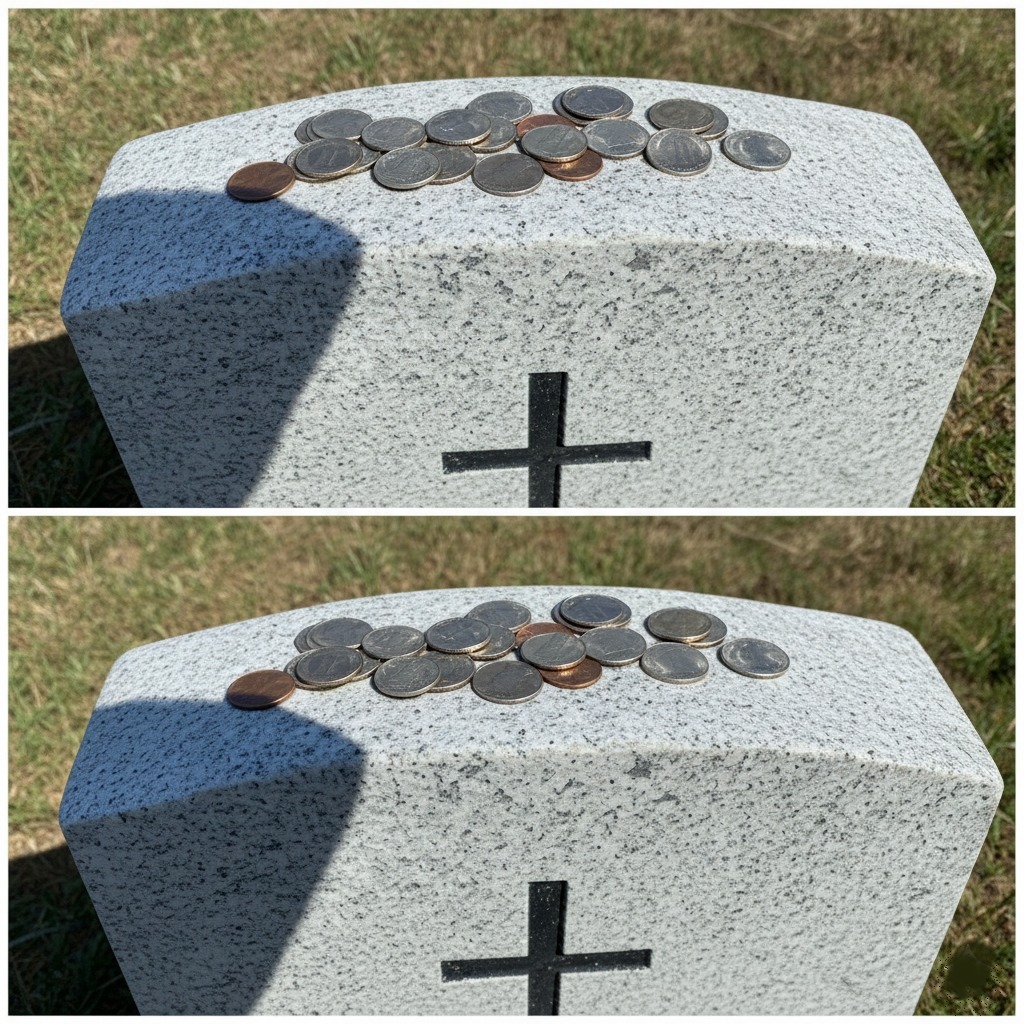
SOTD – Meaning Behind the Tradition of Coins on Gravestones!
The stillness of a military cemetery is often profound, a landscape of uniform white markers standing in silent formation across rolling green hills. To the casual observer, it is a place of somber beauty and historical weight. However, for those who look closely at the tops of these granite and marble headstones, a subtle, shimmering detail often emerges. A small glint of copper or silver—a stray penny, a nickel, a dime, or a quarter—rests gently on the edge of the stone. To the uninitiated, this might look like a forgotten pittance or a random act of littering. In reality, these coins are part of a deeply sacred, non-verbal dialogue. They are “challenge coins” for the departed, carrying a weight of meaning that far exceeds their monetary value.
This tradition, which has flourished within the United States military community for generations, serves as a bridge between the living and the dead. It is a quiet, powerful gesture of remembrance, respect, and enduring connection. While flowers are beautiful, they are inherently transient; they wither, fade, and eventually must be cleared away. Notes can be blurred by rain or carried off by the wind. Coins, however, are solid, enduring, and elemental. They are made of the same metals as the medals often pinned to a service member’s chest, and they withstand the elements just as the soldiers they honor were trained to do.
The logic behind the tradition is rooted in the “down-and-in” culture of the military, where specific symbols and tokens hold unique internal meanings. By leaving a coin, a visitor is notifying the deceased’s family that someone has come to pay their respects. In a digital age where communication is often loud and immediate, the silence of a coin on a gravestone is a striking contrast. It provides comfort to grieving families who may visit weeks later, offering them tangible proof that their loved one’s sacrifice continues to resonate with others. Each denomination of currency acts as a coded message, detailing the specific nature of the relationship between the visitor and the fallen hero.
The penny is the most frequently encountered token in these hallowed grounds. Its message is universal and foundational: “I was here.” It is an act of simple, pure recognition. It indicates that the visitor—be they a friend, a distant relative, or even a grateful stranger—took a moment out of their life to stand before the grave and reflect. In the context of military service, the penny says, “Your life mattered, and your name was spoken today.” For a gold-star family, seeing a collection of pennies on a headstone is a powerful reassurance that the world has not moved on as quickly as they feared.
When the silver begins to appear, the messages become more specific to the bonds forged in service. A nickel carries the weight of shared beginnings. It signifies that the person who placed it there was a comrade who attended basic training or boot camp with the deceased. Boot camp is the crucible of military life; it is where individuals are stripped of their civilian identities and forged into a unit through shared hardship, exhaustion, and discipline. To leave a nickel is to honor the “Class of” or the “Platoon of” their youth. It is a way of saying, “We began this journey together, and I am still here to carry the memory of our start.”
The dime represents an even deeper level of shared experience. This coin indicates that the visitor served in the same unit or was deployed alongside the fallen service member. This is the coin of the brothers-and-sisters-in-arms who shared the same dirt, the same rations, and the same dangers. A dime speaks of long nights on watch, the boredom of deployment, and the terrifying moments of kinetic action. It is a symbol of absolute trust. By placing a dime, a veteran is telling their fallen friend, “I stood beside you then, and I stand beside you now.” It is a tribute to a bond that was tested by fire and found to be unbreakable.