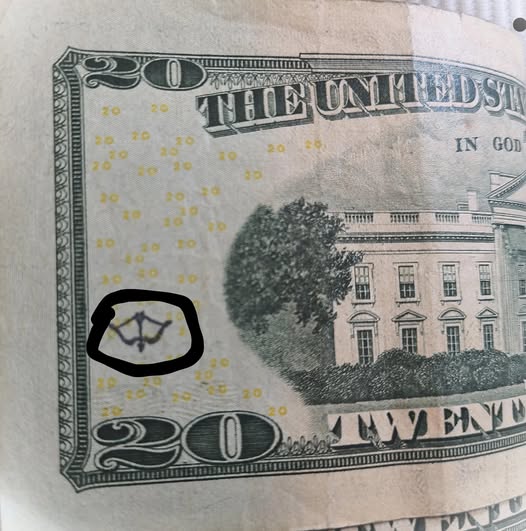
The Real Meaning Behind Arrow Symbols on U.S. Money
Have you ever noticed a United States dollar bill with small stamps or inked markings that seem out of place or mysterious. At first glance, these marks can look like random doodles or damage. In reality, they often tell a detailed story about where that bill has traveled and whose hands it has passed through. These markings are known as chop marks, and they are added by money changers, traders, shopkeepers, and currency handlers to confirm that a bill was examined and accepted as genuine. Each stamp becomes a record of trust, a quiet agreement between strangers who may never share a language but still need to exchange value.
Chop marks appear most frequently on United States dollars that circulate outside the United States. They are especially common in parts of Asia, Africa, and Latin America, where the dollar is widely used alongside local currencies for everyday transactions, savings, and international trade. In these regions, physical cash still plays a major role in commerce, and verifying the authenticity of each bill is essential. A small ink mark becomes proof that someone with experience already inspected it.
The practice has deep historical roots. In China centuries ago, merchants relied on silver coins as their primary medium of exchange. To protect themselves from fraud, they tested each coin’s weight and purity. Once satisfied, they stamped the metal with their personal seal. Over time, a single coin could carry dozens of these stamps, each one showing that another merchant had confirmed its value. When paper money eventually replaced much of the metal currency, the habit of marking money carried over. The medium changed, but the purpose remained the same.
For modern traders, chop marks still serve important practical functions. They reduce arguments during transactions by showing that a bill was already checked. They build confidence between people who may never meet again. They also help in environments where advanced counterfeit detection tools are unavailable or unreliable. The stamps are usually applied lightly and placed in unobtrusive areas so the bill remains easy to handle and widely acceptable.
In most cases, lightly marked bills remain legal tender and can still be spent without issue. However, heavily stamped or damaged bills may be rejected by banks, vending machines, or automated counting systems. Despite this, such bills often continue circulating in local markets where personal trust matters more than machine approval. In those settings, a well stamped bill can even be seen as safer than a clean one.
Collectors and historians find chop marked currency especially fascinating. Each bill becomes a miniature travel journal, carrying visible evidence of global movement. The size, shape, color, and language of the stamps can sometimes reveal which regions the bill passed through and what type of business once relied on it. For those interested in economic history or numismatics, these marks transform ordinary money into something far more meaningful.
Ultimately, chop marks are more than ink on paper. They are physical traces of human cooperation, negotiation, and survival. They connect modern currency to ancient trading practices and reveal how deeply trust and verification are woven into the story of money. A single marked bill can quietly carry the memory of many lives, many hands, and many journeys across the world.