Why Everyone Moved Away From a Biker on the Subway — and What Changed Their Minds

The subway car carried the familiar tension of a New York afternoon—metal shrieking against rails, lights buzzing overhead, and a shared, practiced indifference among strangers. But just after the train pulled away from Atlantic Avenue, something shifted. The noise faded into an uneasy quiet, the kind that settles when people sense something is wrong but don’t yet understand why.

It was because of the man sitting near the center of the car.

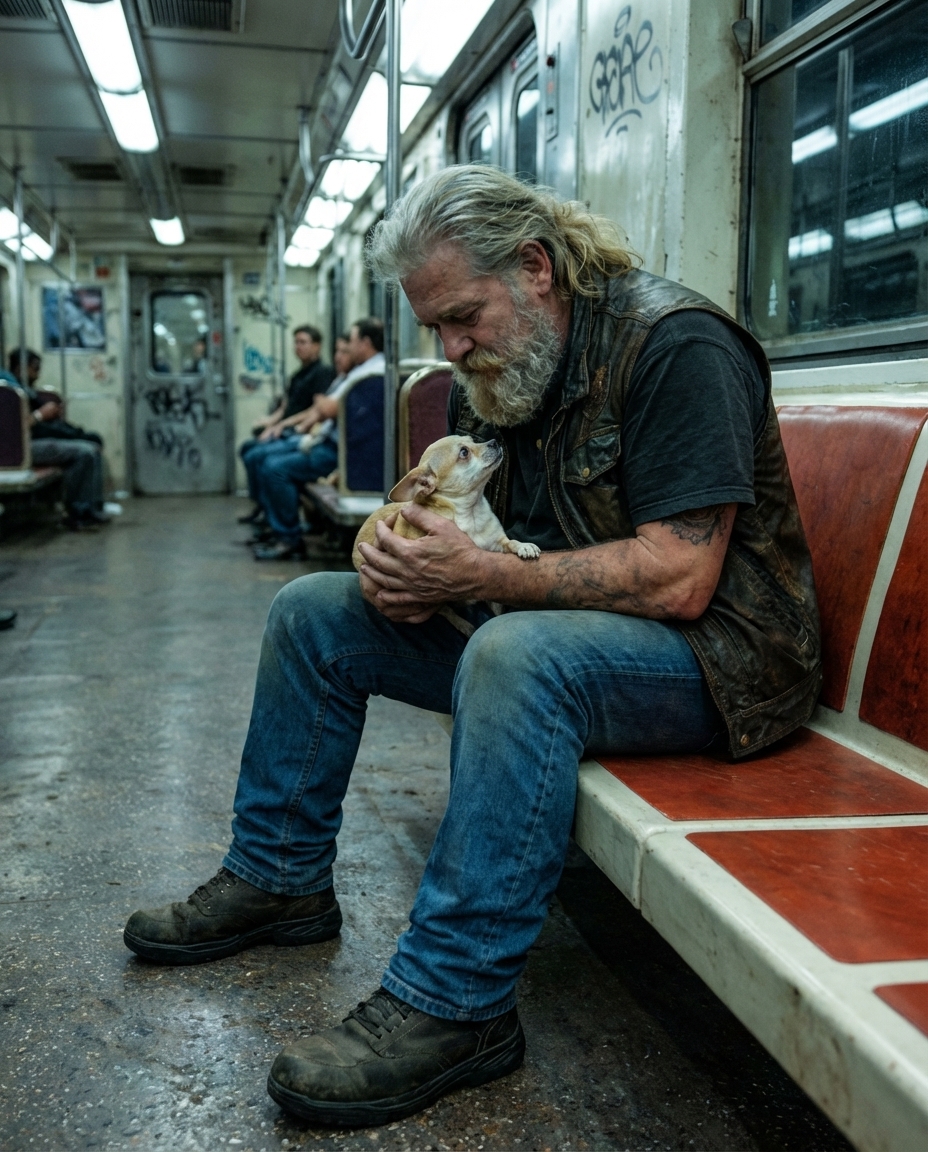
He was large, wrapped in worn black leather, his broad arms marked with faded tattoos. At a glance, he looked like someone people instinctively avoided. But it wasn’t his appearance that unsettled the car—it was the sound of him crying.

Not quietly. Not discreetly. He was openly sobbing, shoulders shaking, tears falling freely as he cradled a small terrier in his arms. The dog was wrapped in an old wool blanket, its frail body pressed close to his chest. The contrast was impossible to ignore: a man who looked unbreakable holding something fragile with extraordinary care.

Passengers reacted the way people often do when confronted with raw emotion from someone they don’t know how to categorize. They shifted away. Bags were pulled closer. A few whispered, others stared and quickly looked down. To them, a large man grieving in public felt unpredictable, even threatening.

I stayed seated.

What held my attention wasn’t the scene itself, but the way he held the dog. His hands—thick, scarred, clearly built for hard work—moved with a gentleness that felt deliberate and protective. This wasn’t chaos or danger. It was love at the edge of loss.

The dog was clearly nearing the end of its life. Its breathing was shallow and uneven, its body tired in a way that spoke of long years. Every so often, its tail gave a weak tap against the man’s sleeve. The man leaned down, whispering softly, repeating promises that sounded less like words and more like vows.

When someone a few seats away muttered about calling security, the man didn’t react. His world had narrowed to the small life resting in his arms.

The distance between him and the rest of the car felt enormous—built entirely from fear and assumption. Something about that felt wrong. I stood, crossed the aisle, and sat beside him.

“He looks like he’s been a good friend,” I said quietly.

The man looked up. His eyes were red and exhausted, the kind of tired that comes from loving something for a long time. “He’s my best one,” he said. “Cancer. They said it’s time. I just couldn’t let it end in a clinic. He deserves more than that.”

The dog’s name was Buster.

He told me they were heading to Coney Island. Years ago, he had found Buster under the boardwalk on a cold morning. Back then, he had just returned from military service, struggling to adjust, barely holding himself together. The dog didn’t care about any of that. He stayed. For twelve years, Buster gave him reason—reason to wake up, to stay steady, to trust again.

As the train moved south, the mood in the car changed. People stopped backing away. They started watching—not with fear, but with recognition. The biker was no longer a stranger to avoid. He was someone saying goodbye.

A teenager removed his headphones and sat quietly nearby. An older woman passed him a tissue without saying a word. No one offered advice. No one tried to fix anything. They simply stayed.

By the time the train reached its final stop, something remarkable happened. When the man stood, a few passengers stood too. Without discussion, a small group followed him out onto the platform, then across the boardwalk, where the air smelled of salt and winter waves.

The beach was quiet. The man knelt near the shoreline, unwrapping the blanket just enough so Buster could feel the breeze. We stood back, strangers bound together by a moment none of us would forget. The ocean rolled steadily in front of them as the man whispered his final goodbye.

It was heartbreaking—but it was also deeply respectful.

In a city often described as distant or cold, a temporary community had formed around compassion. When we eventually drifted away, returning to our separate lives, something lingered.

That morning reminded us how easily fear dissolves when we choose to move closer. It reminded us that tenderness often lives beneath the hardest exteriors, and that shared humanity doesn’t require words—only presence.

The man left the beach without his companion, but he didn’t leave unseen. And the rest of us walked away carrying a quiet reminder: sometimes the most meaningful thing you can do for a stranger is simply to sit down and stay.


Similar Posts