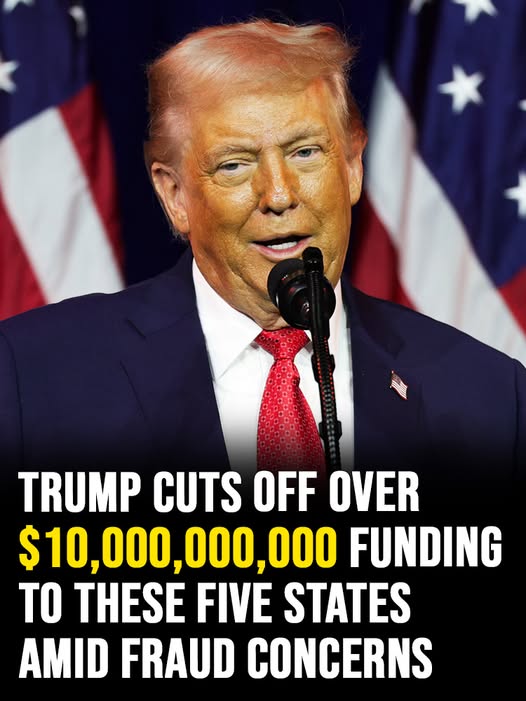
Over $10 Billion in State Funding Frozen by Trump Amid Fraud Investigations
In a move that has sent immediate shockwaves through the U.S. political landscape, the Trump administration has announced a sweeping freeze of more than $10 billion in federal funding earmarked for five states governed by Democrats. The decision, which targets California, Colorado, Illinois, Minnesota, and New York, marks a dramatic escalation in the ongoing tension between the executive branch and state capitals. The funding suspension specifically hits three pillars of the American social safety net: Temporary Assistance for Needy Families (TANF), the Child Care Development Fund (CCDF), and the Social Services Block Grant (SSBG). According to the Department of Health and Human Services (HHS), the freeze is a proactive measure intended to curb alleged widespread fraud and ensure that taxpayer dollars are being utilized strictly for their legal and intended purposes.
Andrew Nixon, a spokesperson for HHS, framed the decision as a necessary intervention against local mismanagement.
“For too long, Democrat-led states and governors have been complicit in allowing massive amounts of fraud to occur under their watch,” Nixon stated. “Under the Trump administration, we are ensuring that federal taxpayer dollars are being used for legitimate purposes. We will ensure these states are following the law and protecting hard-earned taxpayer money.”
The Massive Scope of the Funding Cuts
The financial implications of this freeze are substantial, threatening to leave a multi-billion-dollar hole in state budgets. The breakdown of the withheld funds reveals a significant impact on the nation’s most vulnerable:
-
TANF: Set to lose over $7.3 billion, affecting cash assistance, job training, and food programs for low-income families.
-
CCDF: $2.4 billion is being withheld, jeopardizing the ability of working parents to afford safe and reliable childcare.
-
SSBG: An additional $869 million is at risk, targeting programs that support seniors, foster children, and mental health services.
In total, the freeze impacts more than $10 billion in federal support. For millions of Americans, this represents a potential disruption to essential needs, including housing assistance, nutrition, and early childhood education.
In formal letters sent to the affected governors, ACF Assistant Secretary Alex Adams justified the action by citing “recent federal prosecutions and additional allegations that substantial portions of federal resources were fraudulently diverted away from the American families they were intended to assist.” The letters underscore the administration’s stated commitment to investigating and preventing the misuse of federal funds before they are disbursed.
Programs in the Crosshairs
The programs targeted by this freeze are foundational to low-income households. TANF provides a critical lifeline, particularly for single-parent households, covering basic costs like food and utilities. Experts warn that a prolonged suspension of these funds could push thousands of families into deeper financial instability.
Similarly, the CCDF is vital for economic mobility, allowing parents to remain in the workforce or pursue education by subsidizing high-quality childcare. Organizations like the National Association for the Education of Young Children (NAEYC) emphasize that such disruptions disproportionately harm rural and low-income communities where access to licensed providers is already scarce.
Finally, the SSBG gives states the flexibility to manage delicate services, including adult protective services and disability support. HHS officials argue these programs have been susceptible to mismanagement, citing improper payments to ineligible recipients. While the administration has not yet provided specific instances of fraud for each state, it maintains that the freeze is a necessary “preventive measure.”
Immediate Political Backlash
The announcement has ignited a firestorm of criticism from Democratic leaders, who have characterized the move as a form of political retaliation rather than a legitimate oversight action.
New York Senator Kirsten Gillibrand has emerged as a leading voice against the freeze, calling it “immoral and indefensible.”
“Trump is threatening to freeze child care funding in New York and targeting our children for political retribution,” Gillibrand stated in a post on X. “To use the power of the government to harm the neediest Americans is immoral and indefensible. This has nothing to do with fraud and everything to do with political retribution that punishes poor children in need of assistance.”
In a broader public statement, Gillibrand added: “My faith guides my life and public service. It is our job to serve the people most in need and most at risk, no matter what state they live in… I demand that President Trump unfreeze this funding and stop this brazen attack on our children.”
State-Level Defiance
Across the country, governors of the affected states have condemned the freeze:
-
California Gov. Gavin Newsom called it a “direct attack on vulnerable families,” highlighting that millions depend on these funds for basic survival.
-
Illinois Gov. J.B. Pritzker described the decision as “reckless and harmful” to seniors and single parents.
-
Minnesota Gov. Tim Walz warned of “devastating consequences” for the state’s social safety net.
-
Colorado Gov. Jared Polis argued that these programs already have strict oversight, making the fraud allegations appear “politically motivated rather than evidence-based.”
Legal experts and policy analysts suggest that this battle is likely headed to the courts. As the freeze threatens to increase poverty rates and widen economic disparities—especially in high-cost urban centers—Democratic lawmakers are already preparing to seek judicial review to overturn what they deem an unprecedented and punitive use of federal power.
The abrupt freezing of $10 billion in federal assistance is more than a budgetary line item; it is a direct threat to the daily stability of millions of American families. As state agencies in California, Colorado, Illinois, Minnesota, and New York grapple with the sudden halt of funds, the ripple effects are already being felt in community-based organizations that operate as the final line of defense for the vulnerable.
Nonprofits and community groups—which rely on the Social Services Block Grant (SSBG) to fund everything from domestic violence shelters to elder care and mental health counseling—now face a grim reality. Without the immediate release of these funds, many may be forced to implement emergency staffing reductions, slash program availability, or, in the most extreme cases, shutter their doors entirely.
The Fraud Debate: Pretext vs. Precaution
The Trump administration’s central justification for this historic move is the prevention of systemic fraud. However, historical data and oversight experts suggest a more nuanced picture. While large-scale federal programs are never entirely immune to error, independent audits have consistently shown that the rate of intentional fraud is statistically low relative to the total billions distributed.
A 2022 federal audit of TANF (Temporary Assistance for Needy Families) serves as a key case in point: while it identified isolated improper payments, the audit concluded that the vast majority of states maintained robust oversight and were in full compliance with federal law.
Policy analysts argue that a “blanket freeze” is an extreme and highly unusual response. Typically, federal concerns regarding mismanagement result in targeted audits or financial penalties. By freezing funds across five states simultaneously, critics contend the administration is risking the well-being of millions of families to address isolated incidents.
Expert Warnings and the “Human Cost”
Nonpartisan research organizations, including the Center for Budget and Policy Priorities (CBPP), have been quick to sound the alarm. They warn that withholding poverty-relief funds will have immediate, cascading effects on children’s health and educational outcomes.
The child advocacy community is equally concerned. Groups like the NAEYC (National Association for the Education of Young Children) and First Five California have warned that the freeze could trigger a childcare crisis.
“Families already struggling to secure affordable, quality child care will have even fewer options,” a representative from NAEYC noted. “Children may be placed in unlicensed or unsafe care settings, which can have long-term consequences for their development and safety.”
A Constitutional and Economic Crossroads
The legal battle is already intensifying. Just days after the freeze was announced, a coalition of Attorneys General—led by New York’s Letitia James and California’s Rob Bonta—filed suit. On Friday, U.S. District Judge Arun Subramanian granted a temporary restraining order, effectively blocking the freeze for at least 14 days to preserve the “status quo” while the court evaluates the legality of the administration’s actions.
Beyond the courtroom, economists warn of a potential “ripple effect” on local economies:
-
Workforce Participation: If parents lose childcare subsidies, many will be forced to leave the workforce, lowering household incomes and reducing consumer spending.
-
Increased Dependency: A lack of proactive social support often leads to higher reliance on more expensive emergency public assistance programs down the road.
-
Marginalized Communities: Marginalized and rural areas, where services are already thin, are expected to bear a disproportionate share of the burden.
The Path Forward: Accountability or Retribution?
The administration remains firm, with Assistant Secretary Alex J. Adams maintaining that the freeze is a vital tool for “protecting taxpayer dollars” and ensuring resources reach only eligible citizens. Supporters view this as a long-overdue demand for accountability in state-run programs.
However, for the governors of the affected states, the move is viewed as a “political vendetta.” As families, advocacy groups, and policymakers watch the 14-day judicial window closely, the national debate has shifted toward a fundamental question: Should the federal government’s power to audit be used as a lever that can instantly disrupt the lives of the nation’s neediest citizens?
The coming weeks will likely set a precedent for federal-state relations and the administration of the American welfare system for years to come.