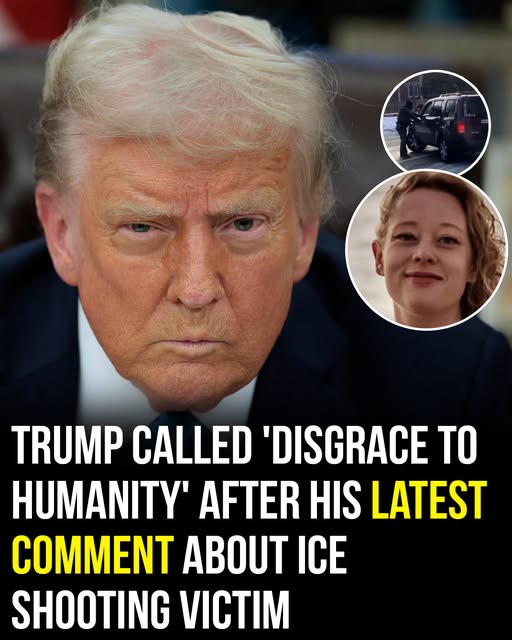
Trump dubbed a disgrace to humanity after latest comment about ICE shooting victim Renee Nicole Good!
The winter air in Minneapolis, typically frozen into a quiet stillness, shattered under the echo of gunfire on a Tuesday afternoon that would soon become a national scar. The death of 37-year-old Renee Nicole Good has not only ignited the streets of the Twin Cities but has ripped open the jagged seams of American political discourse, pitting local governance against federal authority and turning a grieving family’s private agony into a polarized battlefield. The facts of the case, while still under the cold lens of investigation, describe a confrontation that ended in a fatal hail of bullets just blocks from the victim’s home, leaving a community in mourning and a nation in a state of volatile unrest.
According to preliminary reports and bystander video footage that has since gone viral, the incident began when agents from Immigration and Customs Enforcement (ICE) attempted to intercept a vehicle driven by Good. The footage, shaky and punctuated by the screams of witnesses, shows a chaotic scene of tactical vehicles and flashing lights. As the agents moved to box in the car, a sequence of events unfolded with lethal speed. Shots were fired into the vehicle, and within moments, Renee Nicole Good—a daughter, a neighbor, and a lifelong resident of the city—lay dead.1
In the immediate aftermath, the human cost of the shooting was voiced by her mother, Donna Ganger. Standing before a bank of microphones with a face etched in the hollow exhaustion of grief, Ganger sought to reclaim her daughter’s identity from the political machinery already grinding it into powder. She described Renee as a woman defined by kindness and a deep, abiding compassion for others.2 Most pointedly, Ganger addressed the burgeoning rumors surrounding her daughter’s presence at the scene, stating unequivocally that Renee was not an activist nor a participant in the ongoing anti-ICE protests that had been simmering in the region. She was, according to her mother, simply a woman trying to navigate her city, a person who found herself caught in the crosshairs of an agency that has become a symbol of terror for many and a bastion of order for others.
The political response was instantaneous and incendiary. Representative Alexandria Ocasio-Cortez was among the first to offer a scathing rebuke of the federal response, bypassing the usual calls for “patience during an investigation” to label the event a “public murder.” Her words served as a catalyst for a broader progressive outcry, framing the shooting not as an isolated tactical failure but as the inevitable conclusion of a militarized immigration enforcement strategy that views civilians as combatants. This sentiment was echoed with localized fury by Minneapolis Mayor Jacob Frey. In a press conference that vibrated with barely contained anger, Frey demanded that ICE immediately cease operations within the city limits.3 He accused the agency of operating as a rogue force, sowing seeds of chaos and deep-seated distrust in a community that was already struggling to heal from years of tension with law enforcement.
However, as the sun set over the protests in Minneapolis, a very different narrative was being broadcast from the highest levels of federal power. President Donald Trump, speaking with his characteristic defiance, took to the airwaves and social media to offer a full-throated defense of the ICE agents involved. Rather than offering condolences, the President redirected the blame toward the deceased, labeling Good a “professional agitator” and a threat to national security.4 In his view, the shooting was a textbook case of self-defense against a person who had allegedly sought to obstruct the vital work of federal officers. By framing Good as a willing participant in a broader movement of “domestic terrorism,” the President effectively signaled that his administration would offer no apologies for the lethal use of force in the pursuit of border and interior enforcement.
This rhetoric was swiftly reinforced by the Department of Homeland Security (DHS), which issued a formal statement characterizing the driver’s actions as an act of domestic terrorism. The department’s narrative suggested that the vehicle was being used as a weapon, justifying the agents’ decision to open fire. This official stance provided the legal and administrative shield for the officers involved, ensuring that the federal government would stand as a monolith against local prosecution or civil unrest.
Joining the chorus of defense was Vice President JD Vance, who adopted a tone of grim pragmatism.5 While acknowledging the loss of life as “tragic,” Vance placed the moral weight of the event squarely on Good’s shoulders. He described the incident as “a tragedy of her own making,” a phrase that resonated deeply with the administration’s base while horrifying civil rights advocates.6 Vance’s message was a stern warning to the American public: do not interfere with the machinery of law enforcement. He reaffirmed the administration’s unwavering support for ICE, suggesting that any attempt to hinder their operations would be met with the full force of the law, and perhaps, as in this case, lethal consequences.+1
The divide in the country has rarely felt so physical. In Minneapolis, the streets are filled with the smell of woodsmoke and the sound of chanting, as protesters demand accountability and the expulsion of federal agents. Online, the digital landscape is a mirror of this fractured reality. One side sees Renee Nicole Good as a martyr—a victim of a “disgrace to humanity” who was gunned down in her own neighborhood by an agency that operates without oversight. The other side views the incident as a necessary assertion of law and order, a victory for the “brave men and women” who put their lives on the line to enforce the nation’s borders against those they deem “agitators.”
The investigation into the shooting continues, but many fear that the truth has already been buried under the weight of the partisan war. With the city government and the federal government in an open state of hostility, the prospects for a transparent and impartial inquiry seem dim. Mayor Frey’s demand for ICE to leave has set up a potential constitutional showdown over the limits of federal authority within a “sanctuary” or resistant city. Meanwhile, the rhetoric from the White House has ensured that the agents involved will likely be treated as heroes by one half of the country and villains by the other.
As the nation watches the smoke rise from Minneapolis, the story of Renee Nicole Good has become much larger than the woman herself. It is now a grim case study in the state of the American union in 2026—a place where even a fatal shooting just blocks from home is not enough to bridge the chasm between two irreconcilable visions of what it means to be a citizen, what it means to be a criminal, and what it means to be a human being. In the end, as the politicians trade barbs and the agencies issue their defenses, a mother is left to mourn a daughter she describes as kind and compassionate, caught in a world that seems to have very little room left for either of those qualities.
The legacy of this moment will likely be felt in the upcoming legislative sessions and on the campaign trail, but for the people of Minneapolis, the impact is immediate and visceral. Every time a federal vehicle is spotted on their streets, the memory of that Tuesday afternoon will flicker to life. The debate over immigration and police accountability has found its newest, most painful flashpoint, and as the country remains deeply divided, the healing that Donna Ganger and her community so desperately need remains out of reach, obscured by the very people sworn to protect and serve the nation.