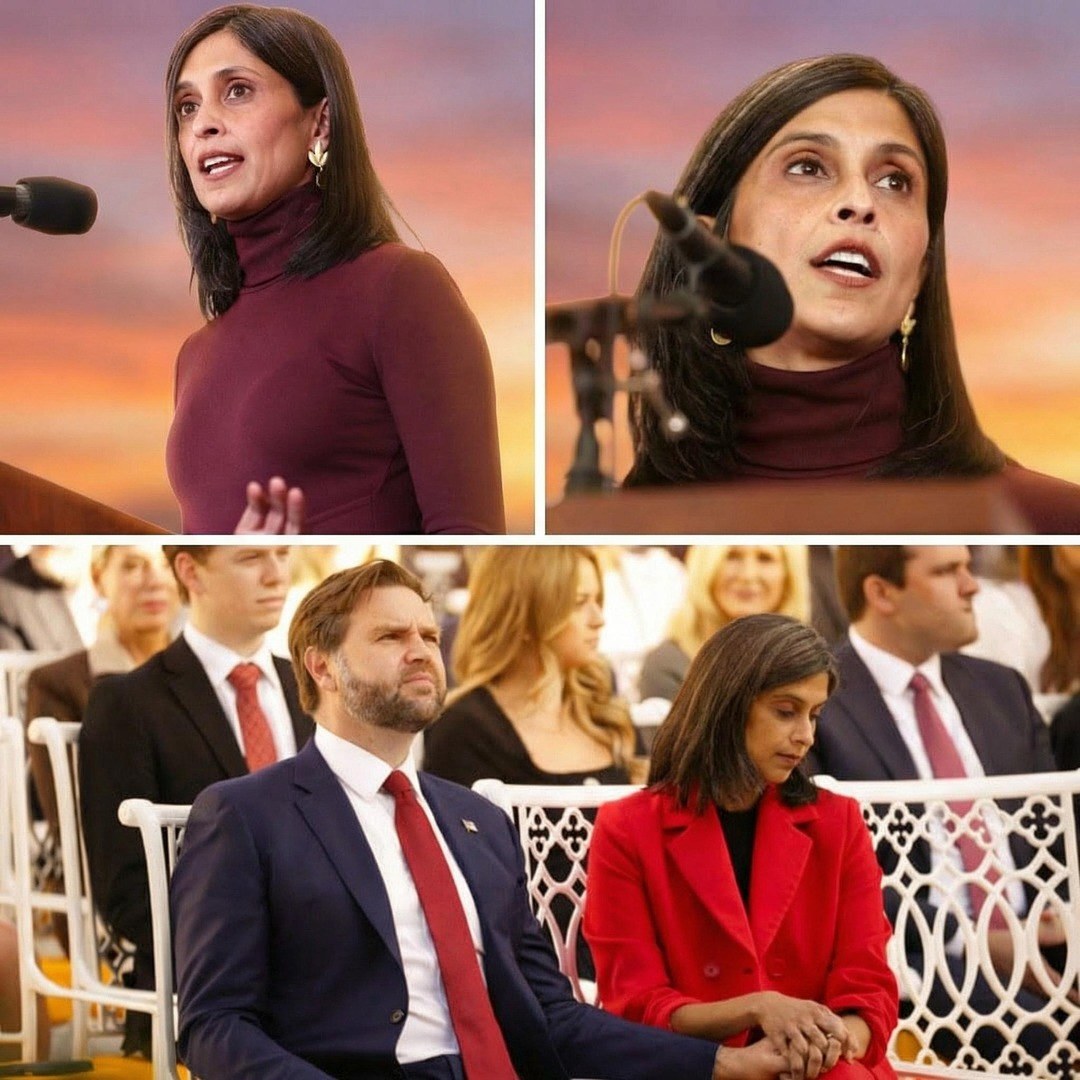
“Usha Vance Addresses Online Talk About JD Vance and Erika Kirk”
In my decade of covering the intersection of political power and personal identity, I have observed that the most revealing moments often come from the figures who seek the spotlight the least. Second Lady Usha Vance has carved out a distinct niche in Washington by maintaining a fiercely guarded private life. It was this very reserve that made her recent comments in a December 2025 interview with USA Today so striking.
As the wife of Vice President JD Vance, Usha has historically prioritized her professional legal background and family responsibilities over the traditional media-courting role of a political spouse. However, a late-2025 surge in digital speculation regarding her marriage forced a rare departure from her silence. She met the noise not with a defensive posture, but with a measured, pragmatic clarity that effectively re-established her personal boundaries.
The Anatomy of a Digital Rumor
The firestorm began with something as mundane as an accessory—or the lack thereof. High-resolution photographs from several official functions, including a high-profile November 2025 visit to Camp Lejeune alongside First Lady Melania Trump, showed Usha without her wedding ring. In the hyper-analytical world of social media, this small detail was quickly weaponized into a narrative of marital instability.
Rather than allowing the conjecture to harden into “fact,” Usha Vance chose to address the discourse with a refreshingly practical explanation during her USA Today sit-down.
A Practical Response to Public Scrutiny
In a direct rebuke to the “tea-leaf reading” culture of the internet, she characterized the missing ring as a “practical matter.” Her explanation was grounded in the reality of a busy mother of three: rings are often left on a counter after exercising, showering, or simply managing the routine chores that define everyday life.
“I wear it when I wear it, and I don’t when I don’t,” she told the outlet matter-of-factly.
The response was a masterclass in defusing tension. By treating the “mystery” as a family joke rather than a crisis, she highlighted the staggering disconnect between the “fever dreams” of online commentary and the lived experience of those in the public eye.
Navigating the “Industry of Stories”
Beyond the ring itself, Vance offered a broader critique of modern political life. She noted that an entire “industry” now exists to build elaborate stories out of the smallest visual cues. Her composure suggested a woman who refuses to allow unfounded assumptions to disrupt her peace of mind or distract her from her primary objectives.
Her approach served as a potent reminder: in an era of 24/7 surveillance, a personal moment is not always a public statement. While some observers viewed her brevity as a sign of strength, others argued the ambiguity of her “limited remarks” would only fuel the rumor mill’s hunger for narrative. Regardless, Usha’s refusal to perform an elaborate public defense reinforced her commitment to dignity over publicity.
Looking Ahead: Balancing the Private and the Political
The interview also provided a rare glimpse into her adjustment to life as Second Lady. While she admitted to missing certain aspects of her former life—most notably the anonymity of her legal career—she expressed fulfillment in the unique opportunities for service her current role affords.
Ultimately, Usha Vance’s December interview was a case study in grounded communication. By staying true to her identity and values, she provided a model for how public figures can navigate the invasive lens of the digital age with grace, integrity, and a necessary sense of humor.
In my decade of covering the intersection of political power and digital culture, I’ve seen how quickly a minor detail can be weaponized into a national narrative. Usha Vance’s measured response to recent online speculation regarding her wedding ring did more than simply clarify a personal choice; it launched a necessary conversation about the survival of privacy in an age defined by unrelenting social media scrutiny.
As Second Lady, Vance’s calm and concise remarks stood in stark contrast to the sensationalized “micro-analysis” common on platforms like TikTok and X (formerly Twitter). In late 2025, rumors regarding her marriage reached a fever pitch, with some posts garnering tens of thousands of views within hours. Her subsequent interview with USA Today served as a critical counterbalance, highlighting the strategic importance of factual communication for public figures today.
The Historical Lens: Spouses Under the Microscope
The scrutiny directed at Usha Vance is part of a grueling American tradition. For a century, the spouses of high-ranking officials have lived under a magnifying glass.
-
The Precedent: Figures from Jacqueline Kennedy and Eleanor Roosevelt to Jill Biden and Karen Pence have seen their every move—from hemlines to hand gestures—interpreted as a coded political statement.
-
The Digital Shift: What distinguishes this era is the speed and democratization of the critique. In previous decades, traditional media acted as gatekeepers; today, any user with a smartphone can broadcast a global interpretation of a “ringless hand” in seconds.
Strategic Silence and Professionalism
Public reaction to Vance’s comments has been telling. While some critics argued her response was too brief, leaving a “void” for further theorizing, media analysts largely praised her non-defensive tone. By framing the absence of her ring as a “practical matter” related to routine chores and parenting, she positioned herself as a grounded figure who refuses to internalize digital noise.
This approach reveals a sophisticated media strategy for the modern political spouse:
-
Conciseness: Providing just enough information to extinguish the rumor.
-
Non-Defensiveness: Avoiding a “counter-attack” on speculators.
-
Humanity: Using a touch of humor to signal that she does not view the internet’s obsession as a crisis.
A Unified Front
While Usha spoke directly to the media, Vice President JD Vance has played a supporting role through consistent public alignment. By maintaining firm personal boundaries and prioritizing family privacy alongside official duties, the Vances are signaling a new model for political life—one where public service does not necessitate the total surrender of individual autonomy.
Ultimately, Usha Vance’s legacy may be defined by this commitment to dignity. By selectively engaging with the press to reinforce her personal integrity, she is setting a precedent for how high-profile figures can fulfill their public roles without compromising their mental well-being or their right to a private life.