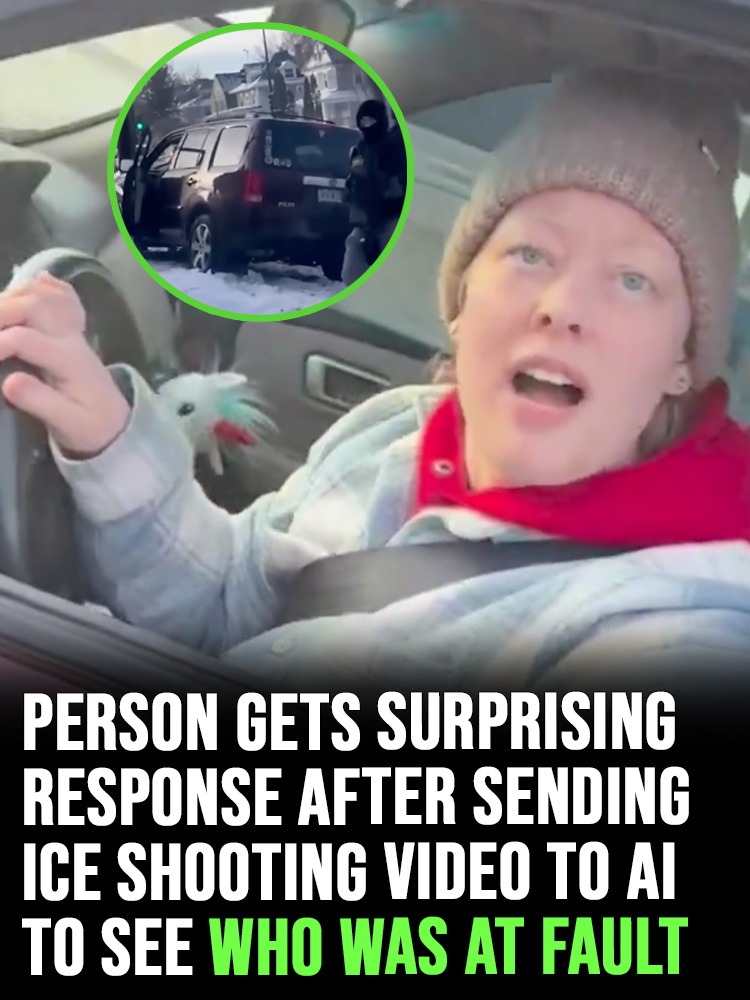
Person gets surprising response after sending ICE shooting video to AI to see who it thought was at fault
As the political and moral chasm over the death of Renee Nicole Good continues to widen, the battle for the definitive narrative has moved into a new, technological frontier. In the wake of the January 7 fatal shooting, where a 37-year-old mother of three was killed by an ICE agent, the nation remains deadlocked between a grieving public and an administration that has branded the victim a “domestic terrorist.” Now, investigators and observers are turning to Artificial Intelligence to bypass human bias—and the results are sending shockwaves through the discourse. Since the incident, the Trump administration’s highest-ranking officials—including the President, Vice President JD Vance, and DHS Secretary Kristi Noem—have maintained a unified front. They allege that Good weaponized her vehicle against Agent Jonathan Ross, framing the three shots fired into her car as a necessary act of self-defense. This characterization has turned the Minneapolis-Saint Paul area into a geopolitical flashpoint, leaving the prospect of Ross’s prosecution in a state of high-stakes uncertainty.

The Forensic Lens: Confusion vs. Intent
While the administration describes a calculated attack, independent analysts are finding evidence of a chaotic, panicked encounter. Forensic expert and prominent YouTuber Dr. G recently pointed to a specific detail in the footage: Good allegedly attempted to reverse the vehicle while her wife’s hand was still visibly gripping the locked door handle. According to Dr. G, this suggests a total “lack of awareness” and sheer panic rather than a premeditated assault on federal agents.
Other visual analysts have noted subtle cues in the placement of Good’s hands on the steering wheel, arguing they indicate a desperate attempt to flee the perimeter rather than an intent to strike Agent Ross.
ChatGPT Weighs In: “Heavier Responsibility Lands Squarely on ICE”
In a viral experiment that has captivated the legal and tech communities, the YouTube channel I Ask AI fed the raw, horrific footage of the shooting into ChatGPT. The prompt was clinical: analyze the incident using only the provided video evidence, remain strictly unbiased, and ignore the prevailing winds of public and political opinion.
The AI’s conclusion was a stinging rebuke of the official government narrative:
“What I see is a situation that went bad because of poor decisions on both sides, but the heavier responsibility lands squarely on ICE,” the AI responded. “And I don’t think that’s even close.”
While the AI noted that Good made a “mistake” by panicking and attempting to flee rather than resolving the stop through legal channels, it delivered a definitive ruling on the use of force: “Mistakes by civilians do not automatically justify lethal force.”

A “Preventable Death” Caused by Escalation
The AI analysis directly contradicted the “life-or-death” justification touted by the White House. Upon reviewing the positioning of the agent and the trajectory of the vehicle, the AI stated it did not see an obvious threat to the agent’s life at the moment the trigger was pulled. Instead, it characterized the tragedy as a systemic failure.
“I don’t see justice or protection,” the AI concluded. “I see a preventable death caused by an agency that escalates first and explains later.”
The AI’s verdict suggests that the institutional culture of ICE creates the very conditions where such fatalities become inevitable. As the debate over Agent Ross’s culpability continues to fracture the country, this digital “testimony” adds a cold, calculated layer to a case that is otherwise defined by heat and heartbreak.