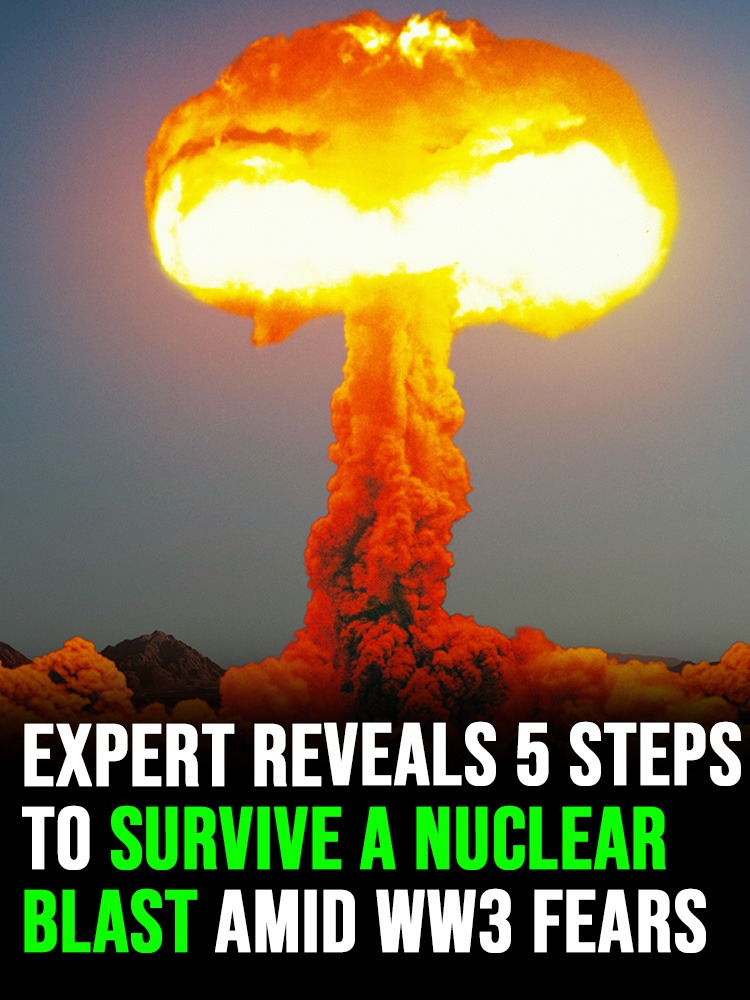
Expert reveals 5 steps to survive a nuclear blast amid WW3 fears
In an era where the term “World War III” has migrated from the dusty shelves of Cold War history into the daily global discourse, the specter of nuclear escalation has reached its highest visibility in decades. Between the entrenched conflicts in Eastern Europe and the Middle East, and the unpredictable nature of modern geopolitics—including recent administrative rhetoric regarding territorial acquisitions like Greenland—national anxiety is palpable. While the “Doomsday Clock” ticks closer to midnight, military analysts warn that modern warfare has evolved beyond simple troop movements. We now reside in a landscape dominated by autonomous drones, hypersonic missiles, and the ever-present threat of a nuclear exchange. However, defense experts and survivalists alike maintain that while the threat is grave, panic is the enemy of survival. Derrick, a prominent survivalist known to millions on TikTok as PrepperPress, has released a clinical, five-step breakdown for surviving a nuclear detonation. His advice focuses on the 300-to-800 kiloton range—the standard yield of a modern intercontinental ballistic missile (ICBM). To put that in perspective, the Hiroshima bomb of 1945 was approximately 15 kilotons; today’s warheads are exponentially more devastating.

Step 1: The Immediate Reaction
If you see the flash, you have seconds to act. The first rule is absolute: do not look at the light. The thermal radiation can cause immediate permanent blindness.
“Hit the ground, face down, with your feet facing toward the blast, and cover your head,” Derrick advises. He highlights a crucial, often overlooked physiological tip: Keep your mouth open. This helps equalize pressure within the body, preventing your lungs from bursting when the supersonic pressure wave hits.
Step 2: The Race Against Fallout
Survival is a game of geometry and time. If you are within a mile of ground zero, the chances of survival are statistically near zero. At three miles, structural collapse is nearly certain. However, for those in the 10-mile radius and beyond, the danger shifts from the blast to the fallout.
“You have about 10 to 30 minutes before radioactive dust starts falling to the ground,” Derrick warns. This is the window to seek the most “dense” shelter possible. Basements, subways, or purpose-built fallout shelters are ideal. In their absence, a brick or concrete building offers the best protection. Move to the dead center of the structure, as far from windows and doorways as possible.
Step 3: The 72-Hour Lockdown
The first 24 hours are the most lethal in terms of radiation intensity. Derrick emphasizes a “72-hour minimum” stay within your shelter.
“Don’t go outside and try to play hero; you’ll end up dead,” he states bluntly. He recommends sealing windows and doorways with plastic or tape and disabling any HVAC systems to prevent outside air from circulating radioactive particles into your clean zone. During this time, a hand-crank or battery-powered radio is your only reliable link to what remains of government communications.
Step 4: Decontamination Protocols
If you are forced to move or were exposed during the initial fallout, decontamination is non-negotiable. If you must go outside, every inch of skin should be covered with masks, goggles, and gloves.
When returning to a shelter:
-
Remove all outer clothing: Place them in a heavy-duty bag and store them as far away as possible (ideally outside).
-
The Shower Rule: Wash thoroughly with soap and water.
-
Crucial Tip: Do not use hair conditioner. The oils and compounds in conditioner act as a binding agent that can “glue” radioactive isotopes to your hair follicles, making them impossible to wash out.

Step 5: Strategic Movement
If you must travel, Derrick advises moving perpendicular to the wind direction. Radioactive fallout travels with the wind; moving across the wind’s path is the fastest way to exit the “hot zone” and reach cleaner air.
Ultimately, the survivalist concludes that while the hardware of war is terrifying, the software of survival is preparation. Having a cache of water (one gallon per person per day) and non-perishable food is the baseline. In the shadow of a nuclear flash, the difference between a victim and a survivor often comes down to the refusal to succumb to panic.