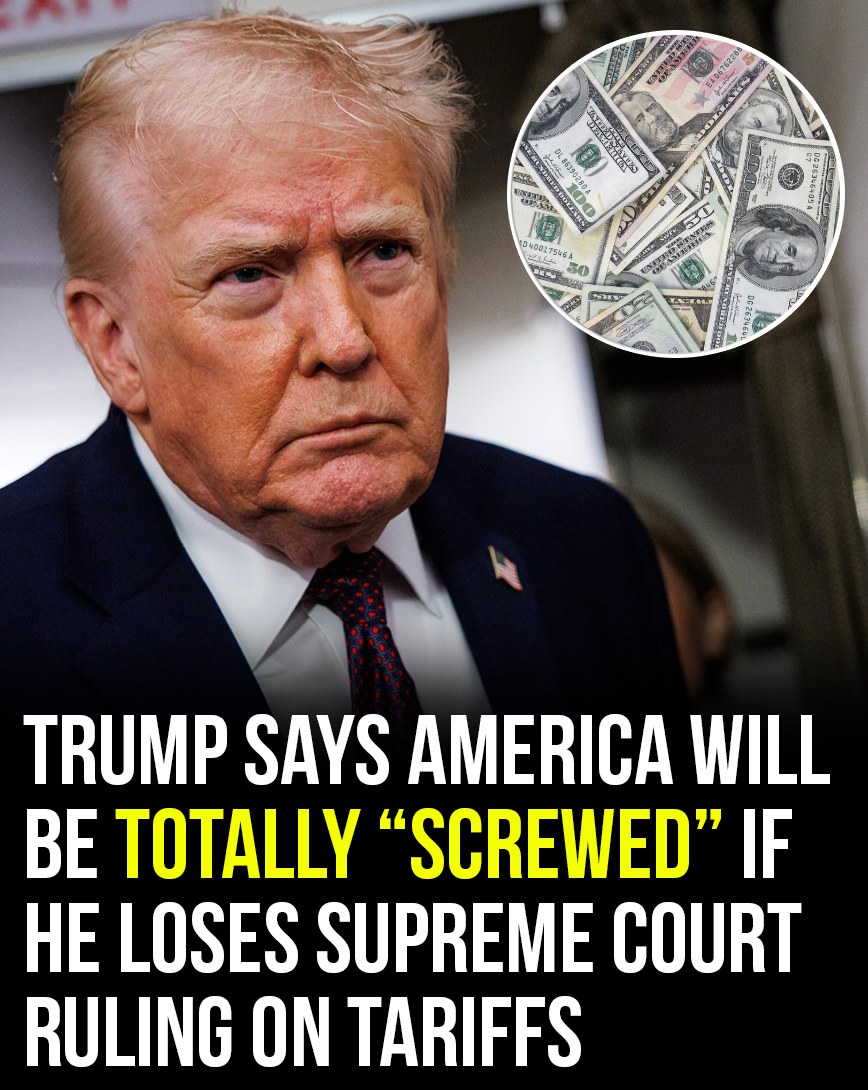
Trump Says Supreme Court Ruling on Tariffs Could Harm the U.S. Economy
President Donald Trump has issued his most ominous warning to date, cautioning that the United States is staring down a “complete mess” should the Supreme Court dismantle his signature global tariff regime. The President’s comments, delivered via a series of emphatic social media dispatches, highlight the existential stakes of a legal battle that has paralyzed supply chains and redefined American economic policy. For Trump, tariffs are no longer just a negotiating lever; they are the bedrock of a second-term vision aimed at forcibly repatriating manufacturing and correcting what he views as a decades-long “hollowing out” of the American industrial heartland.
The Cornerstone of “Trump-nomics”
Since his return to the Oval Office, the President has treated tariffs as a universal solvent for the nation’s economic woes. He argues they serve a four-fold mission:
-
Diplomatic Pressure: Forcing foreign capitals to the bargaining table.
-
Industrial Resurgence: Creating a financial incentive for factories to relocate to the U.S.
-
Revenue Generation: Filling federal coffers with hundreds of billions in import duties.
-
National Security: Shielding critical supply chains from foreign adversaries.
In Trump’s view, the removal of these barriers wouldn’t just be a policy reversal—it would be the systematic dismantling of a carefully insulated economic engine.
The $2,000 Promise: Raising the Political Stakes
The tension has been further electrified by a bold, populist promise. The administration has floated the idea of a “Tariff Dividend”—direct payments of at least $2,000 per person for low- and middle-income Americans, funded entirely by the revenue from these trade duties.
While the logistics of such a payout remain opaque, the political reality is clear: Trump has tethered the financial expectations of millions of Americans directly to the legality of his trade war. A Supreme Court ruling against the administration would not just be a legal defeat; it would be a direct blow to the pocketbooks of the voters who carried him back to power.
The Constitutional Standoff: IEEPA at the Center
At the heart of the legal drama is the International Emergency Economic Powers Act (IEEPA) of 1977. Traditionally used to freeze the assets of terrorists or rogue states, the administration has repurposed this national security tool to impose broad, global tariffs.
By declaring a national emergency over U.S. trade deficits and border security—including the flow of fentanyl—Trump has bypassed the traditional “power of the purse” held by Congress. Critics and legal scholars argue this is a radical overreach, transforming a targeted emergency statute into a blank check for executive control over the entire global economy.
A String of Legal Setbacks
The path to the Supreme Court has been rocky. Last year, the U.S. Court of International Trade struck down the tariffs, a decision later affirmed by the Federal Circuit Court of Appeals. Those courts ruled that “regulating” trade during an emergency does not grant the President the power to unilaterally rewrite the nation’s tariff schedules for an unlimited duration.
While a final ruling was expected early in January 2026, the high court’s delay has only heightened the anxiety in boardrooms from Detroit to Shanghai.
“Trillions of Dollars”: The Cost of Reversal
In his latest Truth Social broadsides, the President painted a apocalyptic picture of the financial fallout. He contends that an adverse ruling would force the Treasury to refund hundreds of billions of dollars already collected from importers—a process he described as “virtually impossible” and a “complete mess.”
“When these investments are added,” Trump wrote, “we are talking about trillions of dollars.”
His argument is simple: the policy is now “too big to fail.” Undoing it would trigger a wave of compensation claims and administrative chaos that would, in his words, leave the country “screwed.”
The New Front: The 25% “Iran Tax”
Proving that he has no intention of slowing down while the Court deliberates, Trump recently opened a new front in his trade offensive. He announced an immediate 25% tariff on any country “doing business” with the Islamic Republic of Iran.
This move marks a significant escalation into secondary tariffs, targeting third-party nations like China, India, Turkey, and the UAE. It forces the world’s largest economies into a binary choice: trade with Tehran or trade with Washington. This “final and conclusive” order underscores the President’s belief that the U.S. consumer market is his most potent weapon in global geopolitics.
Institutional Implications
Beyond the sheer scale of the money involved, the Supreme Court’s decision will serve as a landmark for the separation of powers. A victory for Trump would cement the presidency as the supreme arbiter of American trade. A loss would not only trigger a fiscal nightmare of refunds and lawsuits but would also re-establish Congress as the sole constitutional authority over the nation’s commerce.
As the nation waits, the uncertainty itself has become a tax on the economy. For businesses, investors, and the millions of Americans waiting for their $2,000 checks, the outcome is nothing less than a generational shift in how the United States interacts with the world.
In what has become a defining characteristic of his second term, President Donald Trump has issued a series of blunt warnings, cautioning that the United States is staring down a “complete mess” should the Supreme Court dismantle his signature global tariff regime.
The President’s remarks, delivered with characteristic emphasis via social media, highlight the existential stakes of a legal battle that has paralyzed global supply chains and redefined American economic policy. For Trump, tariffs are no longer just a negotiating lever; they are the bedrock of a vision aimed at forcibly repatriating manufacturing and isolating geopolitical rivals. By imposing levies on goods connected to Iran-linked commerce, the administration seeks to further squeeze Tehran while simultaneously amplifying U.S. leverage in broader global trade negotiations.
A Global Backlash and Domestic Anxiety
The scale of this strategy has triggered a massive counter-offensive from economists, foreign governments, and business leaders. Critics argue that smaller nations—those for whom maintaining trade ties with both the U.S. and Iran is an economic necessity rather than a political choice—are being disproportionately crushed.
Domestically, the “Trump-nomics” of 2026 has created a climate of profound uncertainty:
-
Importers are grappling with higher costs and Byzantine compliance requirements.
-
Manufacturers are forced to scrap long-term sourcing strategies at significant expense.
-
Consumers are feeling the bite through spiked prices and shrinking product availability.
This friction has manifested in a historic legal surge, with more than 1,000 lawsuits now filed against the federal government. These challengers, including some of the nation’s largest importers, argue that the administration has bypassed the constitutional “power of the purse” held by Congress, imposing unfair burdens without proper legislative oversight.
The Constitutional Clash
At the heart of the dispute is the President’s use of emergency powers to enact sweeping economic measures. Lawmakers from both parties have raised alarms, warning that an unchecked executive branch could permanently weaken democratic accountability.
Supporters, however, maintain that Congress has long delegated this authority to the President in matters of national security. They argue that persistent trade deficits constitute a legitimate threat, requiring a speed of response that the legislative branch simply cannot match in a hyper-competitive global environment. This tension—between executive speed and legislative oversight—is the core question now before the Supreme Court.
The Legal Road to the High Court
The path to this moment has been paved with judicial skepticism. In May 2025, the U.S. Court of International Trade (CIT) ruled the tariffs unlawful, concluding the administration had stretched its emergency powers beyond their breaking point. That decision was later upheld by the Federal Circuit Court of Appeals, intensifying the pressure on the White House.
When the Supreme Court declined to issue an immediate ruling, it left the global economy in a state of “strategic suspended animation.” Markets have watched closely for signs of disruption, while Trump has doubled down on his warning that reversing course would be a logistical nightmare.
“WE’RE SCREWED!”: The Stakes of a Rollback
The President has been uncharacteristically candid about the potential fallout of a negative ruling. In one of his most blunt dispatches, he dismissed the idea that the tariffs could be easily unwound.
“Anybody who says that it can be quickly and easily done would be making a false, inaccurate, or totally misunderstood answer to this very large and complex question,” he wrote.
According to Trump, the financial calculations alone—determining who is owed a refund, the amounts involved, and the conditions for repayment—could take years. He concluded with a stark assessment of the geopolitical consequences: “If the Supreme Court rules against the United States of America on this National Security bonanza, WE’RE SCREWED!”
Revenue vs. Economic Reality
Central to the administration’s defense is the claim that tariffs generate enough revenue to fund massive deficit reduction or even direct “Tariff Dividend” payments of $2,000 to American citizens. While Trump asserts these revenues could reach the trillions, independent analysts and Treasury officials remain skeptical, with estimates closer to tens of billions.
Economists continue to warn that these tariffs function as a de facto tax on American businesses and consumers. There is also a mounting fear that distributing large sums of money—whether through tax cuts or direct checks—could reignite inflation at a time when the economy is exceptionally sensitive to price shocks.
The Path Forward
The Supreme Court’s decision will serve as a generational benchmark.
-
If upheld: Trump’s trade strategy receives a judicial “green light,” cementing a new era of executive authority over the national economy.
-
If struck down: The administration faces the monumental task of unwinding years of policy, refunding billions in duties, and rebuilding a shattered trade architecture.
As the nation waits, the tariff battle stands as a defining moment for the intersection of law, economics, and global power—one that will dictate the limits of presidential authority for decades to come.