Maxim Naumov Skates Toward Olympic Dreams After Losing Both Parents in a Plane Crash
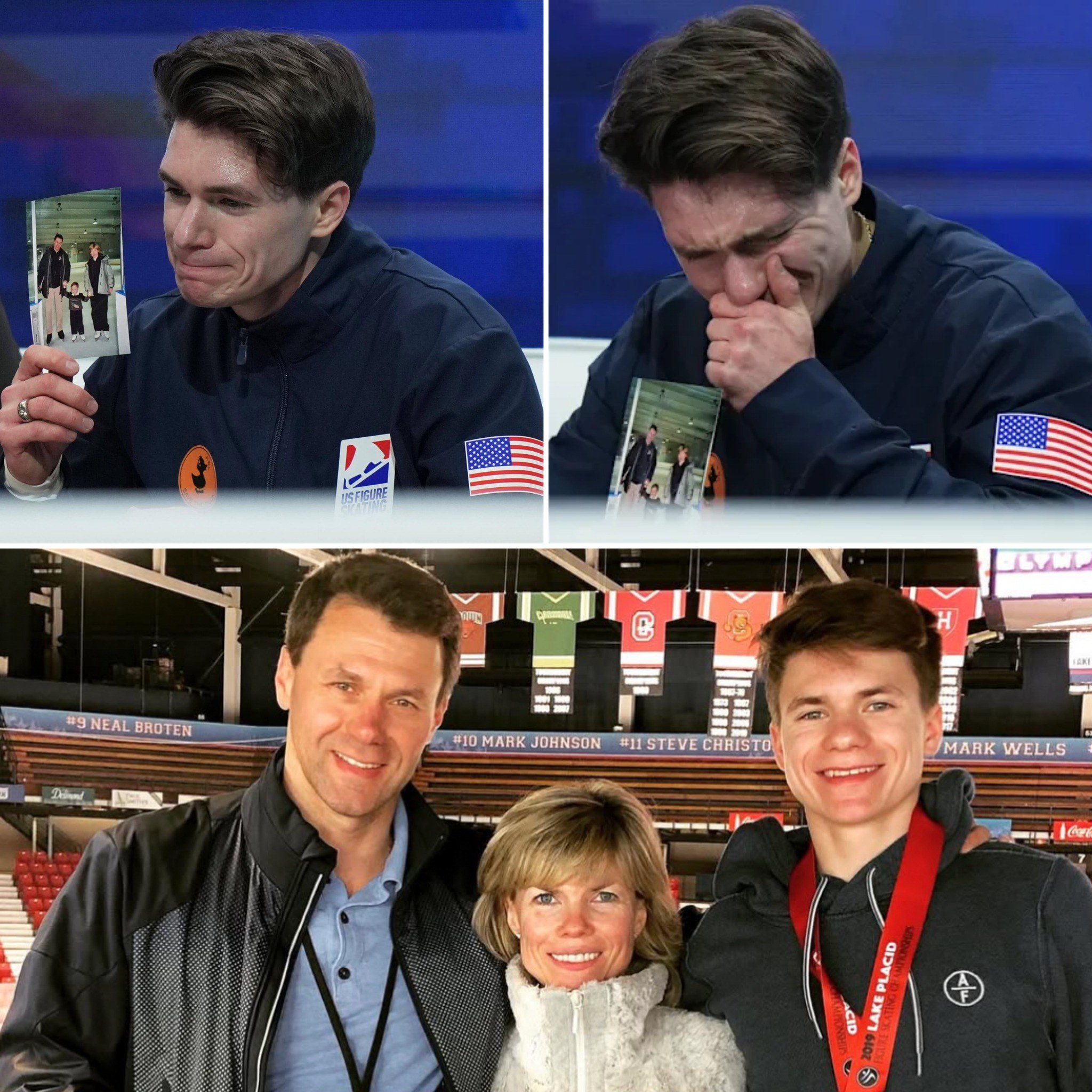
On the surface, it is merely a faded snapshot of a simpler time: a toddler balanced on tiny white ice skates, his face a mask of pure delight as he grips the hands of two beaming adults on a nondescript Connecticut rink.
In the world of figure skating, such images are a dime a dozen—timeless, hopeful, and entirely unremarkable. Yet, more than two decades after that moment was captured, the boy in the photo sat in a St. Louis arena, staring at the image with a weight behind his eyes that no young athlete should have to carry.
For 24-year-old Maxim Naumov, that photograph is no longer just a family memento. It is a testament to survival. Minutes after looking at it, Naumov took to the ice at the 2026 U.S. Figure Skating Championships to deliver a performance that transcended the technicalities of the sport, offering a raw, public masterclass in resilience.
A Mid-Air Tragedy and a Community in Mourning
The shadow hanging over Naumov’s season was cast just under a year ago in one of the most harrowing aviation disasters in recent memory. On January 29, 2025, American Eagle Flight 5342, en route from Wichita to Washington, D.C., collided mid-air with a U.S. Army helicopter over the Potomac River. The disaster claimed 67 lives.
Among the fallen were Evgenia “Zhenya” Shishkova and Vadim Naumov—Maxim’s parents, his lifelong coaches, and 1994 World Champion pair skaters.
The couple had been returning from a developmental camp, a routine trip that followed the U.S. Championships in Wichita. Maxim had flown home on an earlier flight, a twist of fate that spared his life but left him to navigate a shattered world. The crash decimated a cross-section of the skating community, taking coaches, young athletes, and parents, leaving a permanent scar on the sport’s national fabric.
Legends on the Ice, Parents in the Rink
Vadim and Zhenya were more than just Maxim’s support system; they were icons of the “traditional Russian method.” After winning world titles and competing in multiple Olympic Games, they moved to Connecticut in the late 1990s, where they became architects of elite programs at the Skating Club of Boston.
Colleagues remember them as a rare breed: coaches who demanded the rigor of the East but tempered it with a warmth and encouragement that was distinctly personal. For Maxim, skating was never just a career path—it was the family language. The childhood photo he carries shows him cradled between them, a small boy unaware that his parents’ professional legacy would eventually become his personal life raft.
A Year of “Legacy on Ice”
In the year since the Potomac disaster, Naumov has found himself thrust into roles he never anticipated. Beyond the grueling training schedule of an elite skater, he assumed leadership of the Skating Club of Boston’s Youth Academy Program—a project his parents poured their souls into.
He also became the face of a grieving sport. At the “Legacy on Ice” tribute in Washington, Naumov performed for a standing-room-only crowd, receiving an ovation that felt less like an appraisal of his jumps and more like a collective embrace. He has remained candid about his motivation, often citing his parents’ final words of pride and love as the fuel that kept him on the ice when the grief felt heavy enough to sink him.

St. Louis: The Return and the Olympic Dream
The 2026 U.S. Championships at the Enterprise Center were never going to be just another qualifying event. When Naumov took center ice for the men’s short program, the atmosphere was electric with shared memory. Before the first note of Chopin’s Nocturne No. 20 played, Maxim paused, raising a single hand toward the rafters.
It was a wordless declaration.
What followed was a performance of searing emotional depth. Despite the pressure, Naumov skated with a surgical precision that earned him a score of 85.72. In the “Kiss and Cry” area, as plush toys rained down, Naumov held the old photo of his parents to the cameras and kissed it.
By the end of the competition, Naumov secured the bronze medal and, more importantly, a seat on the plane to the 2026 Winter Olympics in Milan-Cortina. He will join a powerhouse U.S. men’s squad alongside Ilia Malinin and Andrew Torgashev. Malinin, the gold medalist, underscored the brotherhood in the locker room, stating simply, “We all support him. Whatever he needs.”
Transforming Heartbreak into Purpose
As he prepares for the world stage in Italy, Naumov’s choice of music for his long program—the haunting “In This Shirt” by The Irrepressibles—serves as a poignant soundtrack to his journey. It is a piece that speaks to longing and the presence of those who are gone.
“In moments of real emotional strain,” Naumov reflected in a post-event interview, “you ask yourself, what if I can still do this? That’s where strength comes from. That’s how you grow.”
For Maxim Naumov, the Olympic rings represent the fulfillment of the last conversation he ever had with his parents. When he learned he had made the team, he didn’t say “I did it.” He whispered, “We did it.”
In Milan, he won’t be skating alone. He carries with him the discipline of the Russian masters, the heart of a grieving community, and the memory of a toddler in tiny white skates who was taught to glide by the best in the world.