A Homeless Marine Corps Veteran Saves a Dangerous Military Working Dog from Euthanasia by Using a Forgotten Classified Command!
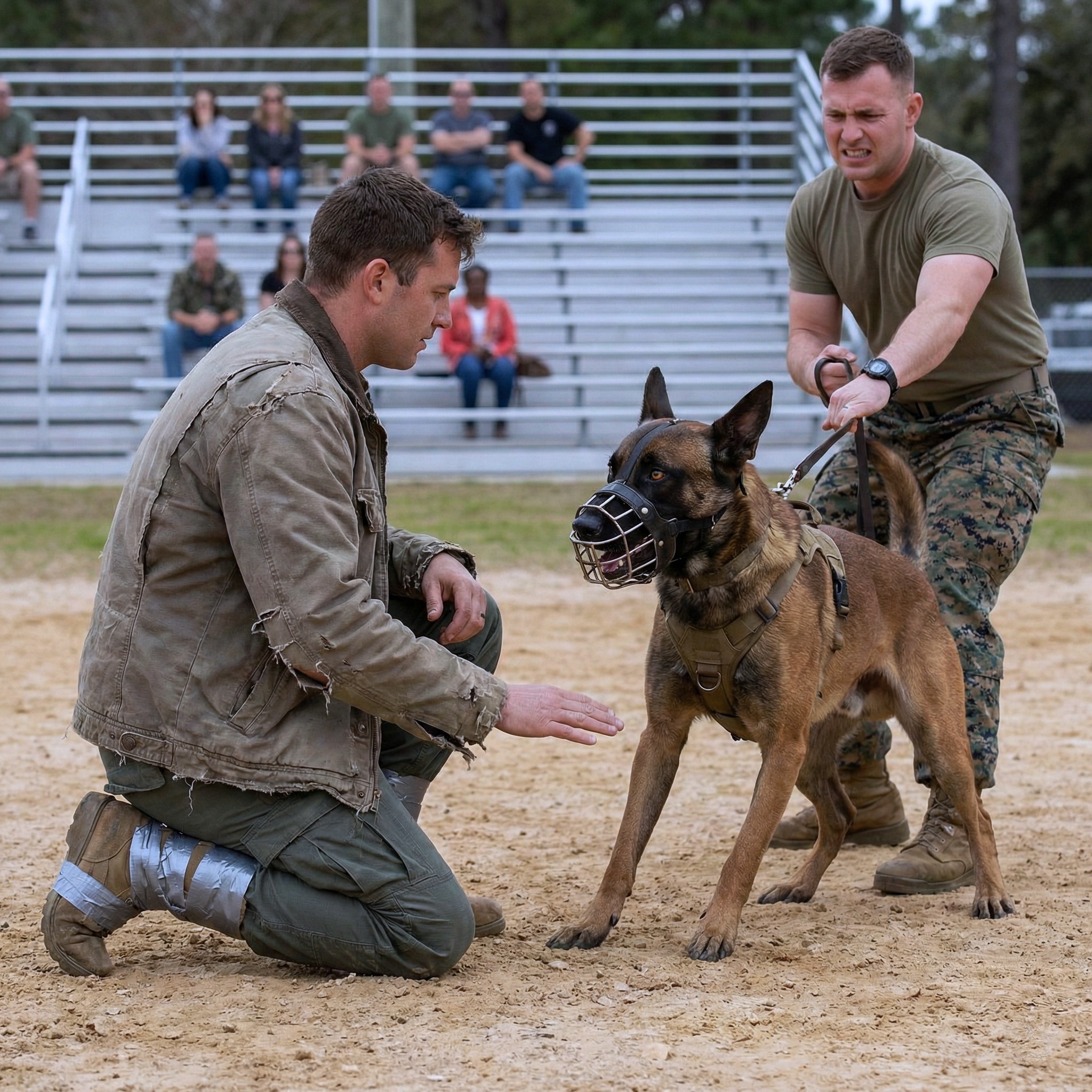
Staff Sergeant Derek Pullman gripped the reinforced leash with both hands, his knuckles white against the nylon. On the other end, Ajax, an eighty-pound Belgian Malinois, lunged forward with a primal snarl. He was a creature of pure muscle and concentrated rage, his teeth clashing against the steel of his training muzzle. At four years old, Ajax was a combat veteran rescued from a hostile conflict zone, but his transition to the states had been a disaster. Three handlers had been attacked, eighteen stitches had been sewn, and zero progress had been made.
“This is Ajax’s final evaluation,” Pullman announced, his voice amplified by a microphone and carrying across the Camp Lejeune training field. In the bleachers, families and veterans watched with bated breath. The air was thick with the scent of diesel and cut grass, but the mood was somber. “If he cannot be controlled today, he will be humanely euthanized this evening.” A collective murmur rippled through the crowd; parents instinctively pulled their children closer as the dog thrashed against his restraints.
In the third row of the bleachers, a man in a torn jacket stood up. His boots were held together by silver ribbons of duct tape, and his face was etched with the weary lines of a life lived on the margins. Cole Reeves, once known by the call sign “Nomad,” hadn’t focused on much besides survival for four years. But as his amber eyes locked onto the struggling Malinois, the fog of homelessness seemed to lift. He stepped over the barrier fence and began to walk onto the gravel.
Three weeks prior, Cole had been huddled under the Jefferson Bridge, protecting a backpack that held the only remnants of his former life: a K-9 manual, a photo of his old partner Titan, and an ultrasonic whistle. He was a ghost in his own city until his friend Miguel, a former army medic, convinced him to head to Lejeune for the veteran demonstration—mostly for the promise of a hot meal. Cole hadn’t heard his call sign in years; he didn’t think he deserved to hear it ever again.
Now, as he approached the center of the arena, the crowd went silent. A young corporal shouted for him to stop, but Cole kept moving. Pullman stepped into his path, blocking his advance. “You need to leave now,” the Sergeant warned. “This is a military working dog, not a pet. He’s dangerous.”
“I know,” Cole replied, his voice raspy from disuse. “Do you?”
Pullman looked at the disheveled man before him—the dirt under the fingernails, the hollowed cheeks, the smell of the street. “Are you qualified?”
“I was. Marine Corps canine handler. Fifteen years.”
From the stands, Miguel began to shout, “That’s Nomad! Check his file!” The radio on Pullman’s belt crackled. On the other end was Colonel Andrea Finch, watching from the command office. She had already pulled up Cole’s classified service record: three Purple Hearts, a Combat Action Ribbon, and a specialty in high-risk K-9 rehabilitation. She also saw the note regarding his 2012 medical discharge following the “Sangin Incident,” where two Marines and a dog were killed after a commander overrode the handler’s instincts.
“Let him try,” Finch ordered over the radio.
Pullman stepped back, signaling the handler to release Ajax’s leash. The dog didn’t charge. He stood frozen, trembling with a lethal tension. Cole didn’t stay standing. In a move that defied every modern safety protocol, he lowered himself to his knees, making himself vulnerable in the dirt. He pulled out Titan’s old, faded collar and the tarnished whistle. He blew into the metal; to the humans, it was silent, but Ajax’s ears shot forward.
Then, Cole spoke a language the trainers hadn’t considered. “Bia lor,” he whispered in Pashto. “Come, son.” He followed it with a mission code: “Kabul. Sector 7.”