SOTD – I Was Baking Pies for Hospice Patients – Then One Arrived for Me, and I Nearly Passed Out!
Grief didn’t arrive in my life like a wave I could see coming. It came like smoke—silent at first, then everywhere, filling my lungs until I couldn’t tell where the pain ended and I began.
I was sixteen when my entire world burned down on a January night so cold the windows looked like they were crying. I remember lying in bed with my earbuds in, letting music drown out the familiar sound of my parents laughing at something on TV downstairs. It was normal. Warm. Ordinary. The kind of ordinary you don’t appreciate until it’s gone.
Then I smelled it.
Smoke doesn’t smell like fire at first. It smells sharp and wrong, like something electrical and bitter, like winter air mixed with metal. I pulled out my earbuds just as the alarm screamed. My dad burst through my door, boots pounding the floor, eyes wide in a way I’d never seen. He didn’t waste a second on explanations. He grabbed my arm and hauled me down the stairs so fast my feet barely touched the steps.
I didn’t even have time to put on shoes. I was barefoot in pajamas, stumbling into the snow while the house behind me began to glow.
At the front door, my dad shoved me outside and turned back.
He ran in to get my mom and my grandpa.
And that’s where the story split into two lives: the one where they should have come back out, and the one where they didn’t.
They said later it was an electrical problem in the kitchen. That’s what the report concluded, as if that sentence could possibly contain what I lost. The house went first, then everything inside it: family photos, savings, the smell of my mom’s perfume lingering in hallways, the ceramic horse she gave me when I turned ten. Fire doesn’t just take people. It takes proof they were ever there.
Everything was gone.
Except me.
In the weeks after, people told me I was lucky, as if surviving made you fortunate. I didn’t feel lucky. I felt misplaced. Like I’d been spared by mistake.
I drifted through the days until a local volunteer service helped place me in a community program for displaced youth. They called it dorm-style housing. To me, it felt like a waiting room for a life I didn’t know how to re-enter. Two bathrooms per floor. One shared kitchen for too many people. A roommate who barely spoke. But it was warm. It was safe. And it was mine, in the thin, temporary way shelter can be.
I had one living relative—my aunt Denise, my mother’s older sister. I called her once, hoping she’d say, “Come here. We’ll figure it out.”
Instead, she sighed like I’d asked for too much.
“I’m sorry, sweetie,” she said. “There’s no space. Your uncle uses the spare room for work. And I’m not giving up my reading nook for a teenager. I’m grieving too.”
She might have been grieving, but it didn’t stop her from taking a chunk of the insurance money that was meant for me. She promised it would go toward clothes, therapy, support—anything I needed to rebuild. What it actually went toward was a wine fridge, a new car, and enough new outfits to show up at her book club looking “expensive but in mourning,” as she liked to joke.
I didn’t fight her. I was too hollow to care about money. I told myself I’d already lost what mattered. At least I had a bed. A small desk. Quiet hours from eleven to six. I learned to be grateful for the bare minimum because anger required energy I didn’t have.
During the day, I became a machine. School, scholarships, forms, deadlines. I studied like my life depended on it because it did. I needed a plan. I needed momentum. I needed to believe that a future version of me existed and wasn’t just a myth.
At night, when the dorm buzzed with other people’s distractions—phones, laughter, TV in the common room—I went to the kitchen.
That kitchen was scratched up and imperfect. The oven ran hot. The counters were worn. The utensils didn’t match. But it had one thing my life didn’t: a process. A beginning and an end. You mix, you knead, you roll, you wait, you bake. And at the end there’s something you made with your own hands.
I started baking pies.
At first it was just one or two—whatever my monthly aid could afford. Blueberry when it was cheap. Apple when it was in season. Cherry when I managed to find a sale. Peach when someone donated fruit that was nearly overripe. Strawberry rhubarb when I felt brave enough to try something that reminded me of summer.
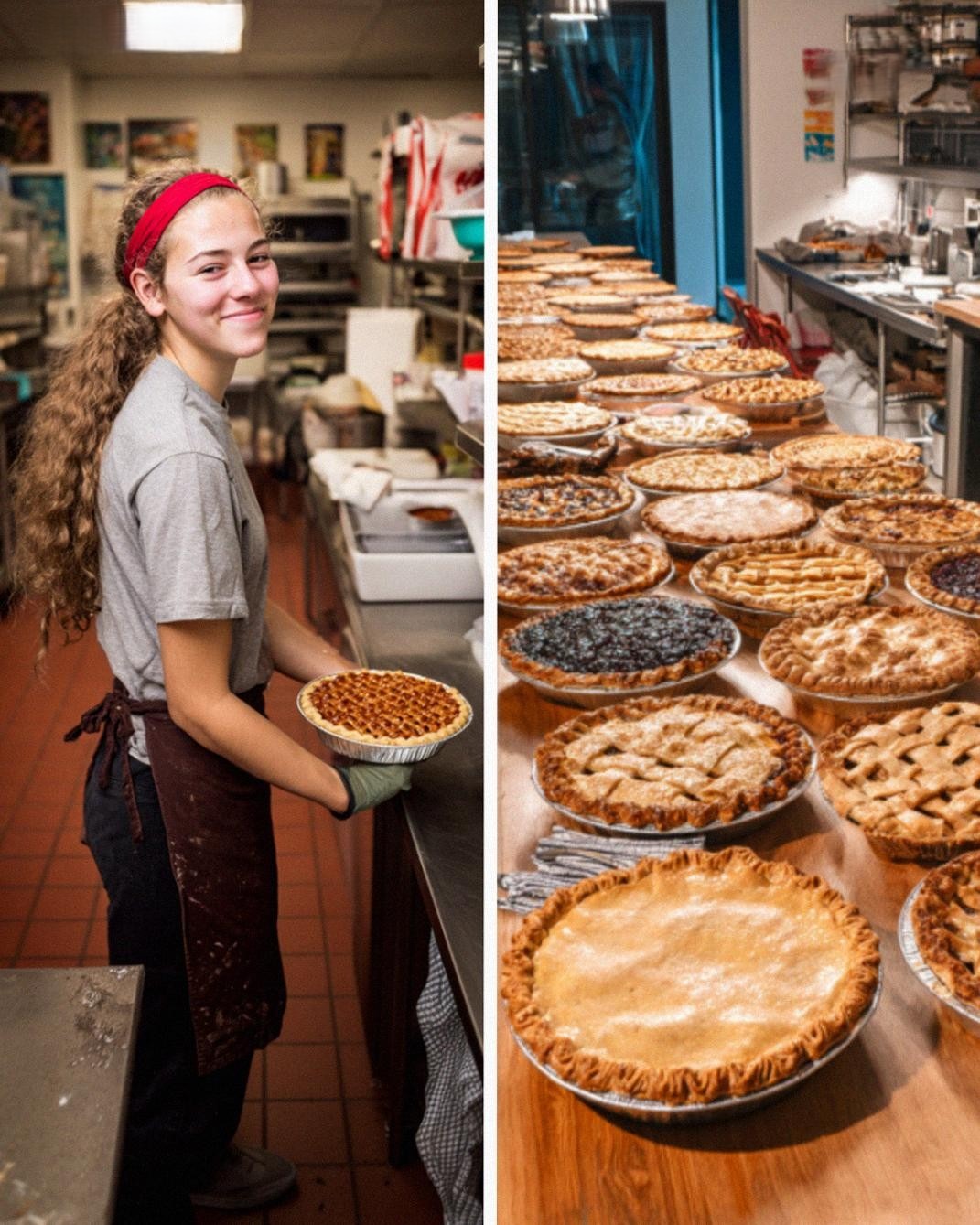
I didn’t have a rolling pin, so I used a wine bottle I found in the trash. I kneaded dough on a Formica counter that wobbled. I chopped fruit with a donated paring knife. Some nights I baked ten pies. Once, I made twenty, moving like I was possessed, hands steady for the first time in months.
Then I boxed them up and delivered them.
Not to friends. Not to neighbors. To strangers.
I took them to the homeless shelter downtown and the hospice center down the street. Always at night, quietly, without my name. I would hand a box to a nurse or volunteer, nod, and leave. I didn’t want gratitude. I didn’t want recognition. I needed the opposite, actually: the relief of doing something good without it becoming a performance.
I never met the people who ate them. That part was too hard. If I looked into their faces, I might see the same grief I carried, and I wasn’t sure I could survive that reflection.
My aunt Denise found out eventually and hated it.
“You’re wasting money,” she snapped over the phone. “They don’t even know who you are. That money should be going to me. I lost your mother too!”
She didn’t sound heartbroken. She sounded irritated, like my kindness was an inconvenience.
I kept baking anyway. Grief had made me feel powerless, but baking gave me one thing back: purpose. When my hands were in flour, my mind quieted. When the timer beeped, I had proof that time still moved forward, even if my heart didn’t want it to.
Two weeks after I turned eighteen, a box arrived for me.
The receptionist handed it over during lunch. Brown cardboard. My name written in delicate cursive. No return address. My stomach tightened immediately, the way it does when something feels too unexpected to be safe.
I opened it right there at the desk.
Inside was a pecan pie so beautiful it looked unreal—golden crust, braided edge, dusted lightly with powdered sugar like fresh snow. The smell hit me like a memory I didn’t recognize. Warm, buttery, almost unreal in its comfort. I suddenly felt lightheaded, as if the air had changed density.
I cut into it with the receptionist’s drawer knife.
That’s when I saw the plastic-wrapped note tucked inside, folded neatly, like someone had hidden a secret in sweetness.
The paper was thick and cream-colored, the ink slightly smudged at the edges. It read:
To the young woman with the kind heart and golden hands,
Your pies made my final months feel warm and full of love.
I never saw your face, but I felt your soul.
I don’t have family left.
But I’d like to leave my home and my blessings to someone who knows what love tastes like.
I cut into it with the receptionist’s drawer knife.
That’s when I saw the plastic-wrapped note tucked inside, folded neatly, like someone had hidden a secret in sweetness.
The paper was thick and cream-colored, the ink slightly smudged at the edges. It read:
To the young woman with the kind heart and golden hands,
Your pies made my final months feel warm and full of love.
I never saw your face, but I felt your soul.
I don’t have family left.
But I’d like to leave my home and my blessings to someone who knows what love tastes like.
My fingers went numb. The note slipped from my hand. The box tilted. I slid to the floor beside the mail desk, staring at the pie like it might disappear if I blinked too hard.
Three days later, a lawyer called.
His name was Paul. Calm voice, precise words. He asked if I had been delivering baked goods to the local hospice for months.
“Yes,” I whispered.
“Then you may want to sit down,” he said. “Margaret Hendley passed away last week. She named you as the sole beneficiary of her estate.”
I thought he’d called the wrong person. That kind of thing didn’t happen to people like me. People like me got forms and waiting lists and lectures about resilience.
“What estate?” I managed.
“Her home, her car, personal belongings,” he said. “And a trust fund left by her late husband. She never used it. It accrued interest for nearly twenty years. The current value is five point three million dollars.”
I laughed out loud on a bus bench outside the library, surrounded by scholarship paperwork and my own disbelief. The sound was sharp, almost ugly—like my body didn’t know how to react to hope.
“But she didn’t even know me,” I said.
“She did,” Paul replied. “She asked staff to help find you. A night nurse recognized your red coat with the missing button and the gray knit hat. She followed you at a distance, saw you enter the shelter, and discreetly confirmed your name with the receptionist.”
I felt my throat close.
Paul told me Margaret had gone blind. She couldn’t see the pies, but she could smell them. She asked nurses to describe them in detail every time they arrived. She guessed flavors by scent. She saved slices to share with other patients. And she kept a journal—each pie recorded like it mattered, like it was proof that kindness still existed.
“She barely spoke to anyone until your pies started arriving,” Paul said. “The staff said you brought her back to life in the only way she had left—through comfort, memory, and taste.”
She called me and didn’t bother with hello.
“You owe me,” she said. “I raised you after the fire. I gave you everything. I’m your family.”
“You gave me nothing,” I said, and my voice didn’t shake this time.
“You don’t deserve it,” she hissed. “That should have gone to me. To family!”
I hung up and blocked her number.
Margaret’s house sits in a quiet neighborhood with wide streets and deep porches. It smells like cedar and old books. There’s a porch swing that creaks softly in the wind, and a greenhouse out back filled with roses and orchids her husband built for their thirtieth anniversary.
I moved in, and for a while I didn’t touch a cent. Not because I didn’t need it, but because it felt like touching it would break the spell.
Then I started baking in her kitchen.
Her wooden spoons. Her rolling pin. Her mixer. A handwritten note taped above the oven that reads, The best ingredient is time.
I still deliver pies to the hospice and the shelter. I still go at night. But now I leave a small note with my name.
Baked with love. From someone who’s been where you are.
A stranger’s pie changed my life, yes. But it wasn’t the money that did the real work. It was the fact that somewhere in my darkest years, without ever meeting me, someone tasted what I made and recognized what I was trying to do with my grief.
For the first time since the fire, I didn’t just feel like a survivor.
I felt like a person who still belonged in the world.