
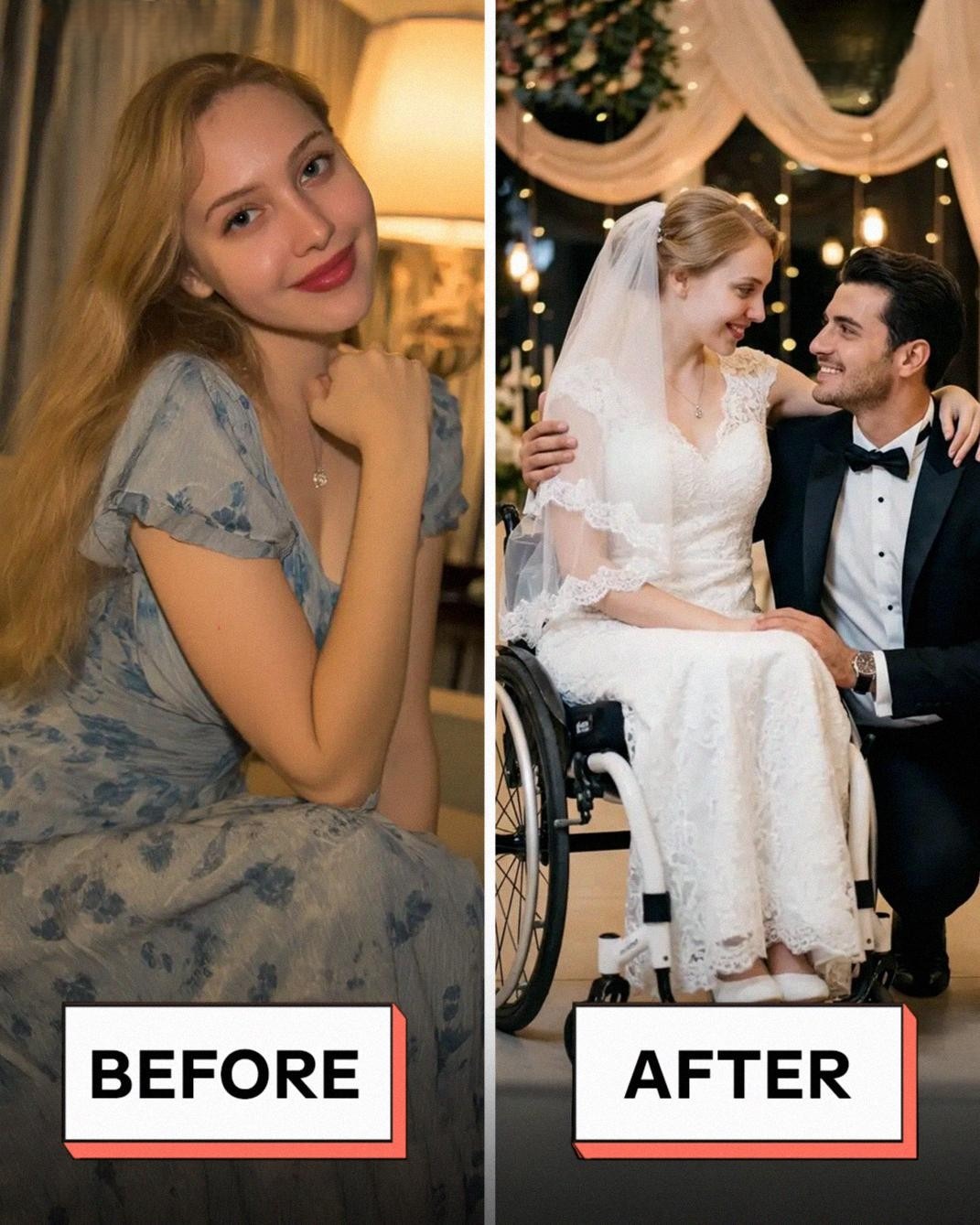
I Married the Man Who Saved Me After a Car Crash – on Our Wedding Night, He Whispered, Its Time for You to Know the Truth!
Five years ago, my life ended on a stretch of road I barely remember.
I’d been driving home after a late shift, exhausted but alert enough to keep the radio low and my hands steady on the wheel. The night was damp and cold, the kind that makes headlights smear into long, watery streaks. I remember thinking I should’ve taken the earlier route, the one with more streetlights.
Then came the impact—violent, sudden, like the world had been picked up and shaken until it broke.
A drunk driver ran a light and slammed into my side. Metal folded. Glass exploded. The air filled with that sharp, electrical smell of deployed airbags and leaking fluid. I felt my body whip, then nothing but a roaring in my ears and a pressure in my chest that made it hard to breathe.
I would’ve died there if a young man hadn’t stopped.
Ryan.
He was the one who called the ambulance. The one who climbed into the wreckage far enough to find my hand and hold it. He spoke to me while I drifted in and out, telling me my name like it mattered, telling me to stay with him, telling me help was coming even though the night looked like it had swallowed us whole.
When I woke up, I learned the part nobody prepares you for: surviving isn’t the same as being saved.
The doctors did what they could, but my right leg was gone below the knee. I stared at the blanket in the hospital bed for a long time before I had the courage to lift it. When I finally did, I felt something inside me crack clean in half.
I grieved in silence at first. Then loudly. Then quietly again, in that exhausted way grief does when it moves in and decides to live with you.
Ryan came back the next day.
Then the day after that.
He wasn’t family. He wasn’t obligated. He wasn’t even a friend yet. He was just the man who had seen me broken on the side of the road and decided I deserved company.
He showed up every day through the surgeries, the infections, the physical therapy that made my body feel like an enemy I couldn’t negotiate with. He sat through the ugly parts. The rage. The sobbing. The weeks where I didn’t want to be touched, didn’t want to be seen, didn’t want to believe the rest of my life had to happen in this new shape.
He never pushed. He never pitied me. He just stayed.
And slowly, that did something to me.
Rehab taught my muscles how to work again, but Ryan taught my spirit how to stop flinching. He made me laugh at the exact moments I thought laughter was illegal. He held my wheelchair steady when my hands shook too hard to lock the brakes. He celebrated tiny victories like they were fireworks: my first time standing with the bars, my first time using my prosthetic without crying, my first solo trip to the grocery store.
Eventually, the story we told ourselves became simple. Tragic beginning. Unexpected hero. Love born in the wreckage.
So when Ryan proposed, I said yes without hesitation.
Our wedding was small, the kind you plan when you don’t want a show—you want witnesses. String lights. Soft music. A few people who knew us well enough to understand how hard we’d fought to get to that day. I wore a simple white dress. Ryan wore a navy suit that made his eyes look bright and gentle, the same way they had looked when he first leaned into that mangled car and promised me I wouldn’t be alone.
During his vows, he cried.
He told me I was the strongest person he’d ever known. That loving me had taught him what resilience actually looked like. That he wanted to spend the rest of his life giving me back the joy the accident tried to steal.
I believed him. I believed every word.
By the time we got home, I was still floating. The kind of happy that feels unreal, like you could wake up and find out it was just a coping dream your brain invented to survive.
I wheeled into the bathroom, took off my makeup, stared at my own face in the mirror, and whispered, “We did it.”
When I came back into the bedroom, Ryan was sitting on the edge of the bed with his tie loosened and his hands locked together so tightly his knuckles were pale.
He wasn’t smiling.
He didn’t look nervous. He looked haunted.
“Ryan?” I asked. “What’s wrong?”
His eyes stayed on the floor for a long moment, as if he couldn’t risk seeing my face while he spoke.
Then he swallowed hard and said, almost like a confession to a priest, “It’s time for you to know the truth.”
The words turned my stomach cold.
“About what?” I asked, trying to keep my voice steady.
He lifted his head. His eyes were glassy, and the pain in them didn’t match the night we were supposed to be having.
“I’m the reason you’re disabled,” he said.
For a second, I didn’t understand the sentence. It made no sense. Like hearing someone say water burns.
“What are you talking about?” I whispered.
He stood abruptly and started pacing, stopping, starting, like his body couldn’t decide whether to run or collapse. “I should’ve told you years ago,” he said. “I wanted to. But I was scared. I thought if you knew, you’d hate me.”
“Ryan,” I said, sharper now, “you saved my life.”
“I know,” he said, voice cracking. “I did. But it’s not that simple.”
“Then make it simple,” I demanded. “Stop talking around it and tell me.”
He looked at me like he wanted to, like he was trying to force the truth out through something hard lodged in his throat. Then he shook his head, grabbed his jacket, and headed for the door.
“I need air,” he said.
“Ryan, don’t walk away from me.”
But he did.
The front door closed, and the silence that followed felt cruel. I sat there in my wedding dress, the room still smelling faintly of flowers and hairspray and joy, and tried to understand how a love story could change shape in one sentence.
He came back an hour later, red-eyed and exhausted. He apologized for dropping it on me like that. He promised he’d explain soon.
But he still didn’t explain.
I told him I needed to sleep alone. He agreed, reluctantly, like a man swallowing his own punishment.
The next day, a thin wall stood between us. He tried to act normal, but his normal felt staged. He started coming home late. He took phone calls outside. His screen was always locked. His answers sounded rehearsed, too neat.
Fear has a way of filling empty spaces. My mind ran through every possibility: cheating, debt, crime, some twisted secret that meant I didn’t actually know the man I’d married.
I called my sister, Marie, and told her the truth in pieces because saying it all at once made me feel ridiculous.
“Something’s off,” I said. “He told me he’s the reason I’m disabled. Then he refused to explain.”
Marie went quiet for a moment. “That’s not a normal thing to say,” she finally replied. “Do you want me to help you figure out what’s going on?”
I did. I hated that I did, but I did.
Two nights later, Marie picked me up, and we drove to Ryan’s office. We waited across the street with the heater running, watching employees leave in small groups. At 5:30, Ryan walked out, got in his car, and drove the opposite direction of home.
“Follow him,” I said.
We kept a careful distance. He drove for half an hour, into a neighborhood I didn’t recognize—older homes, dim streetlights, the kind of quiet that makes you lower your voice without thinking. He pulled up in front of a small house with peeling paint and a sagging porch.
He went inside.
Marie and I looked at each other. My heartbeat felt too loud in my ears.
We approached the door. It was unlocked.
Inside, the living room had been turned into something that didn’t belong in a home: a hospital bed, an oxygen tank, medical supplies stacked against the wall like the house was pretending to be a clinic.
Ryan stood beside the bed.
In it lay an elderly man—thin, pale, eyes wet with exhaustion.
Ryan spun when he saw me. His face drained of color.
“Andrea—what are you doing here?”
I didn’t let him steer the conversation. “Who is he?” I demanded. “Who is that man?”
The old man turned his head toward me. His eyes filled with tears.
Ryan’s shoulders caved, as if the fight had finally left him. “Andrea,” he said, voice shaking, “this is my uncle. Cody.”
I stared. “Your uncle? Why is he here? Why did you hide him from me?”
Ryan’s lips trembled. “Because he’s the one who hit you.”
The room tilted.
For a moment, all I could hear was the oxygen machine’s steady hiss and the blood pounding in my head.
“You’re lying,” I said, but my voice didn’t carry conviction. It sounded like a wish.
“I’m not,” Ryan whispered. He knelt in front of my wheelchair, eyes burning with tears. “Five years ago, he called me. He was drunk. He’d just come from the cemetery. He was falling apart. He made a choice he should never have made. And he hit you.”
Cody choked out a sound that might’ve been a sob. “I’m sorry,” he rasped. “I’ve wanted to say it for years. I was too much of a coward.”
My throat tightened until speaking felt like pushing words through a closed fist. “You destroyed my life,” I said softly.
“I know,” Cody whispered. “I know I did.”
Ryan swallowed hard. “When he called me, I drove to the scene. When I got there, you were already unconscious. I called the ambulance. I stayed with you.”
I stared at him, trying to fit the pieces together without cutting myself on them. “So you weren’t just… passing by.”
“No,” he admitted. “I wasn’t.”
Marie’s hand rested on my shoulder, steady, silent.
Ryan looked down, ashamed. “I didn’t tell you because I was terrified. Terrified you’d hate me. Terrified you’d leave. And then the years passed, and the lie got heavier.”
Cody’s breathing rattled. Ryan glanced toward him and said quietly, “He’s dying, Andrea. Stage four cancer. I’ve been taking care of him.”
“Why?” I asked, voice sharp now, because anger was easier than heartbreak. “Why protect him?”
Ryan’s face crumpled. “My parents died when I was six,” he said. “He raised me. Him and my aunt. He was the only stable thing I had. And then he did something unforgivable. I didn’t know how to be loyal and honest at the same time. So I chose secrecy. I chose the coward’s way.”
I stared at Cody. Then at Ryan. My hands shook in my lap.
“I’m angry,” I said finally. “I’m furious that you lied. I’m furious that you let me build my life around a story that wasn’t true. I’m furious that you waited until after the wedding to drop this on me like a bomb.”
Ryan nodded, tears falling. “I deserve that.”
I looked at Cody again. He was crying quietly, his body too weak to do it loudly.
“What you did is unforgivable,” I told him. “You took something from me I will never get back.”
He nodded, breaking down. “I know.”
I closed my eyes, took a breath, and felt the truth settle in a brutal, complicated way: this wasn’t a fairy tale. It never had been. It was a wreckage that had grown a garden on top of it.
When I opened my eyes, my voice was low and steady. “I forgive you,” I said to Cody.
His face collapsed in relief and grief.
Ryan looked at me like he couldn’t breathe. “And me?” he asked, barely audible.
I held his gaze. “I can forgive you,” I said. “But not if we keep doing secrets. Not ever again. If we’re going to be married, I get the whole truth, not the parts you think I can handle.”
Ryan gripped my hand like a lifeline. “You will,” he promised. “I swear.”
We went home later with the night stripped of its shine, but not stripped of its meaning. Love didn’t disappear. It just got real—messy, bruised, human.
Some truths don’t just break your heart. They break the story you’ve been using to survive.
And then they force you to decide what you’ll build next.