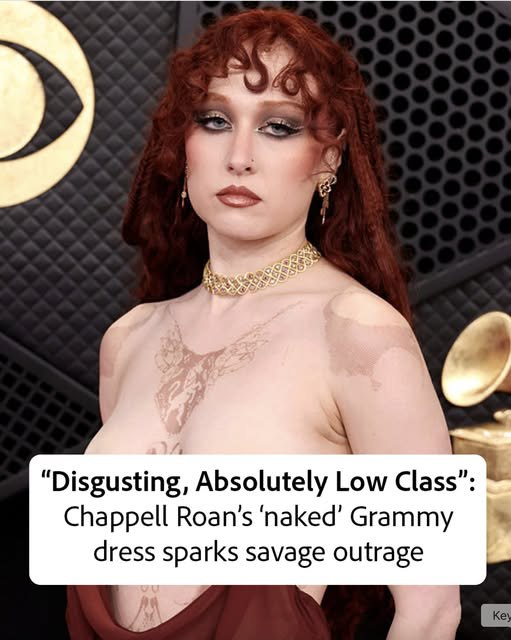
Chappell Roans Grammy dress sparks savage outrage!
At the 2026 Grammy Awards in Los Angeles, Chappell Roan once again proved that she knows how to command attention. Fresh off her reign as Best New Artist, Roan didn’t just arrive at music’s biggest night—she detonated a cultural argument that quickly spread beyond the red carpet and into comment sections, fashion circles, and broader conversations about celebrity, femininity, and provocation.
The Grammys are always a collision point between art, politics, and spectacle, and this year was no exception. As winners took the stage, several artists used their acceptance speeches to address issues far beyond music. Performers such as Bad Bunny, Olivia Dean, Shaboozey, and Gloria Estefan referenced immigration enforcement policies and the broader political climate in the United States. But while speeches unfolded inside the venue, another kind of drama was playing out just outside—stitched, sheer, and unapologetically visible.
Roan arrived wearing a maroon Mugler gown that left little to the imagination. The dress, sheer and body-hugging, was structured with metal chest rings and minimal fabric, deliberately echoing designs from Manfred Thierry Mugler’s iconic 1998 Jeu de Paume collection. The updated interpretation was created by designer Miguel Castro Freitas for Mugler’s Spring/Summer 2026 line, making the look as referential as it was confrontational.
Fashion insiders immediately recognized the historical callback and praised the technical execution. To them, the dress was not random shock value but a direct nod to Mugler’s legacy of sculptural, confrontational glamour. Online, however, the response was far less charitable.
Criticism poured in within minutes. Some viewers labeled the look “low class” and “disgusting,” while others argued that award shows had crossed a line into exhibitionism. A recurring sentiment was exhaustion—fatigue with what critics see as an escalating competition to bare more skin with each high-profile appearance. “We don’t need to see everything,” one commenter wrote, echoing thousands of similar reactions.
Roan’s outfit became a lightning rod not only because of its design, but because it arrived amid a broader trend. Since 2025, sheer, skin-forward fashion has dominated red carpets, particularly among women. The aesthetic has been embraced by figures such as Julia Fox, Florence Pugh, Bianca Censori, Teyana Taylor, Kristen Stewart, and Dakota Johnson. For supporters, the trend represents autonomy and rejection of outdated norms. For critics, it signals desperation masquerading as empowerment.
That divide was on full display in reactions to Roan. Detractors argued that such outfits are less about artistic expression and more about staying relevant in an attention economy that rewards controversy. Some accused Roan of prioritizing shock over substance, suggesting the look overshadowed her musical achievements rather than amplifying them.
Supporters fired back just as forcefully. Fans pointed out that Roan has never positioned herself as subtle or conventional. Her entire artistic identity is rooted in theatricality, exaggeration, and performance. From her stage personas to her visual aesthetics, provocation has always been part of the package. To them, the outrage felt selective, even moralizing—especially when male artists rarely face comparable scrutiny for pushing boundaries.
This was not Roan’s first encounter with controversy over fashion. At the 2025 Rock & Roll Hall of Fame Induction Ceremony, she appeared in an elaborate look inspired by Cyndi Lauper, packed with visual references that only longtime fans immediately recognized. That outfit, like her Grammy gown, blurred the line between costume and couture, homage and reinvention.
For the Grammys, Roan worked with Los Angeles-based stylist Genesis Webb, crafting a look that fused Mugler’s archival daring with Roan’s own maximalist sensibility. Earlier in the week, she had appeared in another ensemble inspired by Lauper’s True Colors era—complete with a newspaper-style skirt cut into Rococo hips, a glittering bustier, vintage jewelry, and a custom headpiece. The message was clear: Roan is building a visual language, not chasing random headlines.
Still, the backlash was loud. Some commenters dismissed her appearance as attention-seeking, mocking her talent and framing the dress as a distraction tactic. Others expressed discomfort with how normalized extreme exposure has become on major cultural stages. The criticism often blended aesthetic judgment with moral commentary, turning a fashion choice into a referendum on values.
At the same time, many fans celebrated the look precisely because it was divisive. They argued that memorability is currency in pop culture and that Roan understands this better than most. In their view, the dress did exactly what fashion at the Grammys has always done at its best: spark conversation, provoke reaction, and refuse neutrality.
Importantly, Roan’s fashion moment did not occur in a vacuum. Musically, she remains one of the most talked-about artists of the year. She entered the ceremony as a strong contender for Record of the Year and Best Pop Solo Performance for “The Subway.” The previous year, she won Best New Artist for her debut album The Rise and Fall of a Midwest Princess, which earned widespread acclaim and multiple nominations, including three for her breakout hit “Good Luck, Babe!”
Whether critics like it or not, Roan’s red carpet appearance succeeded in one undeniable way: it made her impossible to ignore. In an era where visibility is fractured and attention fleeting, she forced a collective pause. People argued. People reposted. People took sides.
That, arguably, is the point.
Chappell Roan’s Mugler gown did not ask for consensus. It challenged comfort, taste, and expectation all at once. Some saw bold artistry. Others saw hollow provocation. What no one saw was forgettable. And in the modern pop landscape, that distinction may matter more than approval.