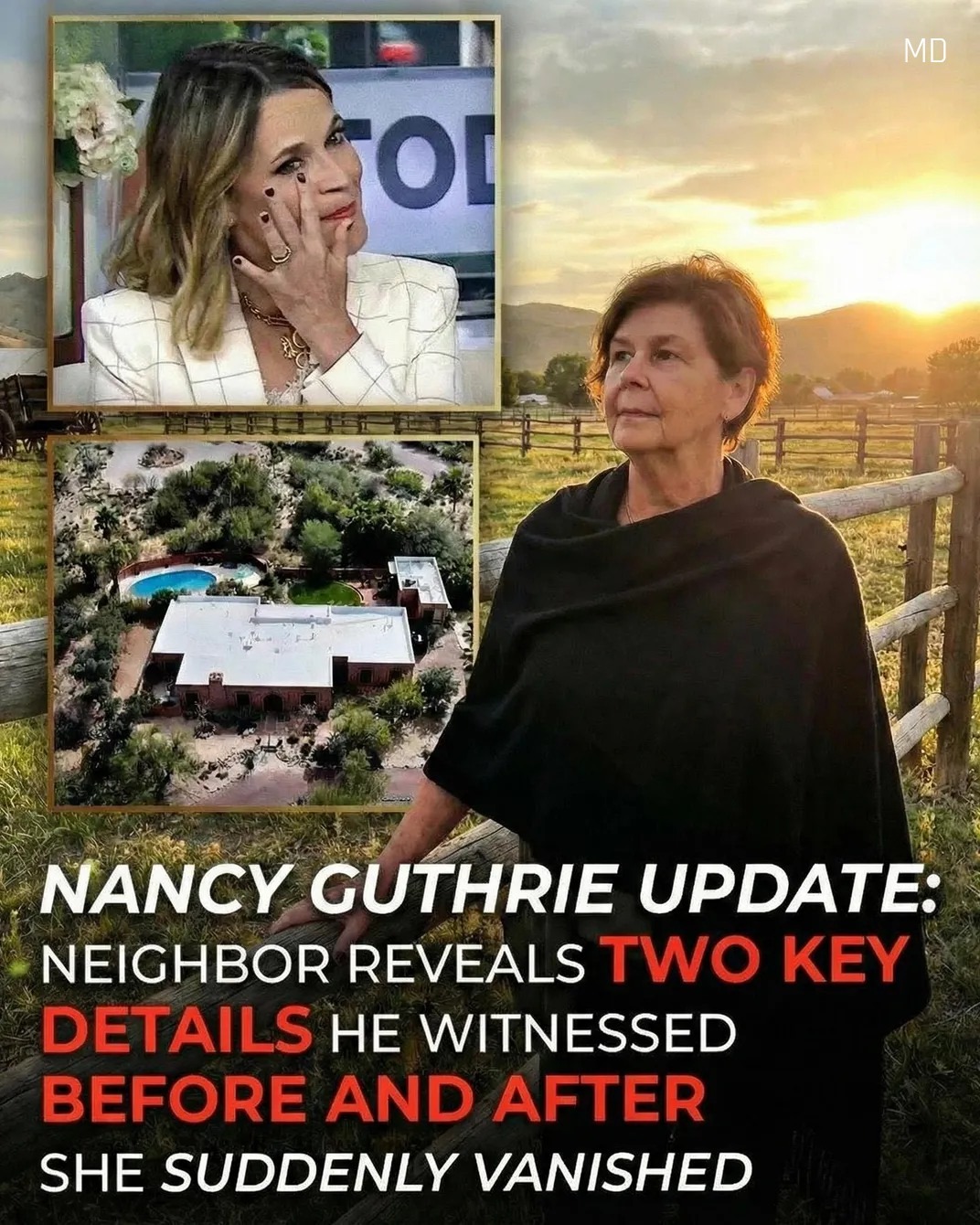
Neighbor Shares What Happened in the Area After Savannah Guthries Mother Went Missing!
The sun-drenched Tucson foothills, a landscape defined by towering saguaros and the hushed reverence of the high desert, have long served as a sanctuary for those seeking a life of quiet stability. In this corner of Arizona, where retirees and families once lived within a predictable rhythm of morning walks and golden-hour sunsets, the name Nancy Guthrie was synonymous with the neighborhood’s gentle character. For years, the community’s greatest disturbances were the occasional crossing of a coyote or the rare summer monsoon. However, that sense of enduring peace was shattered on a weekend that began like any other, replaced by a chilling silence that has left a neighborhood in shock and a nation watching with bated breath.
The transformation of this tranquil enclave into a high-stakes investigative hub happened with a speed that left residents breathless. Neighbors who were accustomed to the solitary sound of the wind through the Palo Verde trees suddenly found their streets lined with marked patrol cars, unmarked federal vehicles, and specialized forensic units. The atmosphere shifted from neighborly concern to an acute, pervasive dread as law enforcement activity escalated. The arrival of investigative teams and the persistent thrum of helicopters overhead signaled to the local community that this was no longer a simple search for a neighbor who had lost her way; it was the beginning of an intense, multifaceted criminal investigation.
Longtime residents recall the jarring sight of forensic technicians in tactical gear moving through the desert brush. Morgan Brown, a nearby resident, observed that the rapid escalation of the police presence served as a grim indicator that authorities were dealing with something far more sinister than a routine missing-person case. Investigators immediately began a granular canvassing of the area, requesting that every resident within a several-mile radius review their home security footage. They were particularly interested in a narrow, overnight window—the precise hours when the light in Nancy’s home usually dimmed, and the time she was last confirmed to be at her residence.
The physical reality of the Tucson terrain only deepened the mystery and the collective anxiety. The landscape surrounding the neighborhood is beautiful but unforgiving, characterized by thick, thorny vegetation, jagged rock formations, and uneven ground that challenges even the most seasoned hikers. Those who knew Nancy well pointed to a heartbreaking detail: she relied on a cane for mobility. To the people who saw her every day, the idea of Nancy wandering deep into the rugged desert on her own was not just unlikely; it was a physical impossibility. This realization forced the community to look at the surrounding wilderness not as a place where she might be found resting, but as a vast, silent witness to something far more calculated.
As the investigation matured, the narrative shifted from a search-and-rescue mission to a forensic reconstruction of a crime. Authorities eventually confirmed what many had begun to fear in their private thoughts: evidence collected from the scene indicated that Nancy did not leave her home voluntarily. Reports of signs of forced entry at the residence turned the investigation on its head, officially reclassifying the case as a criminal matter. While the specifics of the evidence remain closely guarded by detectives to protect the integrity of the pursuit, the involvement of federal authorities suggested a sophisticated level of analysis was being applied. Technical experts began the painstaking process of reviewing communication data and scouring digital footprints, attempting to piece together the movements of an intruder who had managed to slip into one of the most peaceful neighborhoods in the state.
The national spotlight intensified as the identity of Nancy’s daughter became central to the reporting. Savannah Guthrie, a woman whose career is built on delivering the world’s most pressing news to millions of homes, suddenly found herself at the heart of the most devastating story of her life. Traveling to Arizona to be with her family, she stepped into a role no daughter ever wishes to inhabit. She became the voice of a grieving and hopeful family, issuing emotional appeals for information and asking the public for their prayers. Her presence in Tucson brought a human face to the legal proceedings, reminding the public that behind the yellow crime-scene tape and the clinical police reports was a mother, a friend, and a beloved member of a community.
Despite the heavy presence of law enforcement, the emotional toll on the neighborhood has been profound. While officials have been quick to reassure the public that there is no indication of a broader threat to the community, the psychological armor of the Tucson foothills has been pierced. The “forced entry” revelation shattered the illusion of safety that retirees move to the area to find. Now, porch lights remain on throughout the night, and neighbors who once greeted each other with casual waves now speak in hushed tones over backyard fences, sharing the latest updates and searching for any detail they might have missed on the night of the disappearance.
The offer of a significant reward for information has mobilized the public, yet the desert keeps its secrets well. Detectives continue to work around the clock, following leads that stretch across state lines and diving deep into the technical data provided by federal partners. They are searching for the one anomaly—the one car that didn’t belong, the one phone signal that shouldn’t have been there, the one shuttered window that might have caught a reflection. Every tip is being vetted with the knowledge that in a case of this magnitude, resolution often hinges on the most minute observation made by an ordinary citizen.
As the days turn into weeks, the neighborhood remains in a state of suspended animation. The helicopters have largely vanished, and the initial swarm of media trucks has thinned, but the weight of Nancy’s absence is felt in every corner of the street. The community continues to hold onto hope, a fragile but persistent belief that clarity will eventually emerge from the shadows of the foothills. They wait for the moment when the investigation yields a definitive answer, allowing the Guthrie family to find peace and the neighborhood to reclaim the calm that was so violently taken from them.
In the end, the story of Nancy Guthrie’s disappearance is a somber reflection on the fragility of the peace we often take for granted. It is a testament to the resilience of a family in crisis and the tireless dedication of those tasked with finding the truth. As the investigation continues into 2026, the people of Tucson and the millions watching across the country remain united by a singular desire: to see Nancy brought home and to see justice served in the quiet desert she called home. The silence of the foothills is no longer peaceful; it is expectant, waiting for the truth to finally be told.