I Kicked My Pregnant Teen Daughter Out, 16 Years Later, Someone Knocked on My Door and Changed Everything
💔 The Sixteen-Year Shadow: A Mother’s Reckoning
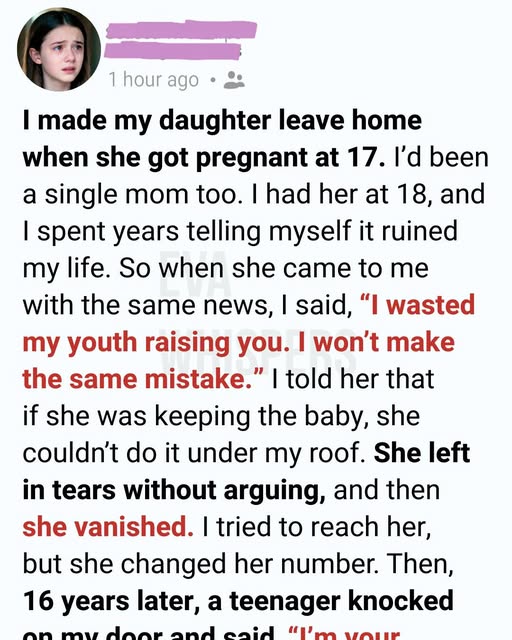
The memory of the doorway, that threshold of unforgivable cruelty, was the one true constant in the quiet, arid landscape of my later life. I had stood there, sixteen years earlier, a mother possessed by a venomous cocktail of regret and fear, and had executed the most savage act of rejection a parent can inflict. My daughter, barely seventeen, stood before me, her teenage frame already carrying the profound, terrifying weight of impending motherhood. Her face was a landscape of tears and vulnerability as she whispered the words: “Mom, I’m pregnant.”
My response was a desperate, corrosive self-defense. I told myself I was teaching discipline, instilling responsibility, perhaps even providing a harsh, necessary form of tough love. But deep beneath those brittle justifications, the truth was a throbbing, unhealed wound. I saw not my child, but the specter of my younger self—the girl of eighteen who had been prematurely plunged into parenthood, a responsibility I felt had relentlessly consumed my youth and stifled my potential. That memory was a stone I had carried for decades, and in that moment, instead of showing compassion, I threw the stone at the one person who least deserved it.
“I wasted my youth raising you,” I spat out, my voice high and shaking with the force of my buried resentment. “I will not, cannot, make that same mistake again. You made your choice. You live with the consequences.”
She didn’t plead, didn’t argue, and didn’t even raise her voice. That absolute lack of resistance was more devastating than any fight could have been. She merely looked at me—her eyes a mirror of my own fear, now streaked with the pain I had inflicted—nodded once, a heartbreaking acceptance of her banishment, and turned away. She walked out of the house, clutching a single, small backpack, disappearing down the street and taking every last sliver of warmth and noise with her.
I stayed rooted in the doorway, waiting for the inevitable return, the tearful surrender, the moment where she would humble herself and allow me to dictate terms. I waited for days, then weeks. She never came back. The silence she left behind was not an emptiness, but a constant, heavy presence, a solid block of absence that filled every room.
The next sixteen years unfolded like a slow, excruciating apology I was too proud to deliver. Birthdays became milestones of regret, each one a stark reminder of the years I had lost and the granddaughter I had chosen not to know. Holidays were unbearable, the forced cheer of relatives and friends only emphasizing the echoing, empty chair at my table. My internal monologue became a relentless cycle of self-flagellation and defense. She hates me, I convinced myself. I deserve this solitude. I made the hard choice. Yet, every night before sleep claimed me, her name was the last, ragged whisper that escaped my lips.
I built a life of routine around the fortress of my solitude, a life that was comfortable but utterly devoid of joy. I had fiercely guarded my freedom, only to find that freedom without love was merely isolation.
Then, one unremarkable Tuesday afternoon, the shattering sound came. A strong, decisive knock on the front door—a sound that, after years of expected silence, felt like a violation of the quiet terms of my existence.
I opened the door to find a tall, lean young man standing on my porch, bathed in the late afternoon sun. He looked to be about sixteen or seventeen, his movements imbued with a youthful confidence I had long forgotten. He smiled, a shy, tentative gesture that somehow felt instantly, deeply familiar.
“Are you… my grandmother?” he asked, the word hanging in the air, piercing the careful armor I had worn for so long. The sound of that word, grandmother, was electric. It connected the past I had rejected to the present I couldn’t comprehend. It meant my daughter had survived me.
My ability to speak failed. He took my shaking hands and gently placed a heavy, linen envelope in them. Inside, printed in elegant gold script, was a wedding invitation. My daughter’s name, paired with a man’s, stood out in bold relief.
“She found a good man,” the young man said, his chest puffing out slightly with pride. “They’re getting married next month. I told her you had to be there.”
As I tried to process the reality of the invitation—the evidence of a life built strong and beautiful without me—he looked directly into my eyes. They were her eyes: gentle, steady, and holding a profound, heartbreaking capacity for understanding.
“Mom says you’re both too proud to take the first step,” he continued, his voice softer now, mature beyond his years. “She says the distance started the day she found out about me… so maybe I can be the reason you find each other again.”
In that instant, the dam I had built around my heart gave way. I pulled him into my arms, holding the tangible, living proof of my daughter’s resilience and kindness, and I wept. They were not tears of guilt alone, but of pure, aching relief. Relief that love had somehow found a way to survive the wasteland of my judgment.
He pulled back and pointed toward a nondescript sedan parked a short distance down the street. “She’s waiting,” he said simply.
The realization jolted me into motion. I didn’t reach for my shoes or my jacket. I ran—a breathless, clumsy sprint across the cold pavement, years of stagnant sorrow propelling me forward.
The car door opened, and she stepped out. My daughter. She looked exactly as I remembered and utterly transformed: her face etched with the wisdom earned through quiet struggle, her posture strong, radiating a deep, hard-won self-possession.
We didn’t need words. The air was too heavy with years and silence to be broken by casual greetings. We simply moved toward each other, meeting in the middle of the street. When we embraced, the years of distance and pain collapsed into one long, shuddering breath. It was an embrace that carried the weight of sixteen years of missed birthdays, unspoken regrets, and silent love.
“Thank you for letting me back in,” I finally managed to whisper into her shoulder, the words thick with tears. “And thank you, most of all, for raising such a kind and thoughtful son. He is the very best of both of us.”
She pulled back slightly, her own face wet, but smiling—a radiant, true smile. “Mom,” she said, her voice clear and resonant, “it’s never too late for us.”
And in that moment, under the indifferent gaze of the suburban afternoon, I finally understood the slow, enduring mercy of time. Forgiveness, I learned, is not about erasing the past, but about letting the love that survived it finally speak. My cruel choice had been a wall, but her resilience and her son’s compassion had become the doorway, allowing grace to finally enter the empty rooms of my heart.