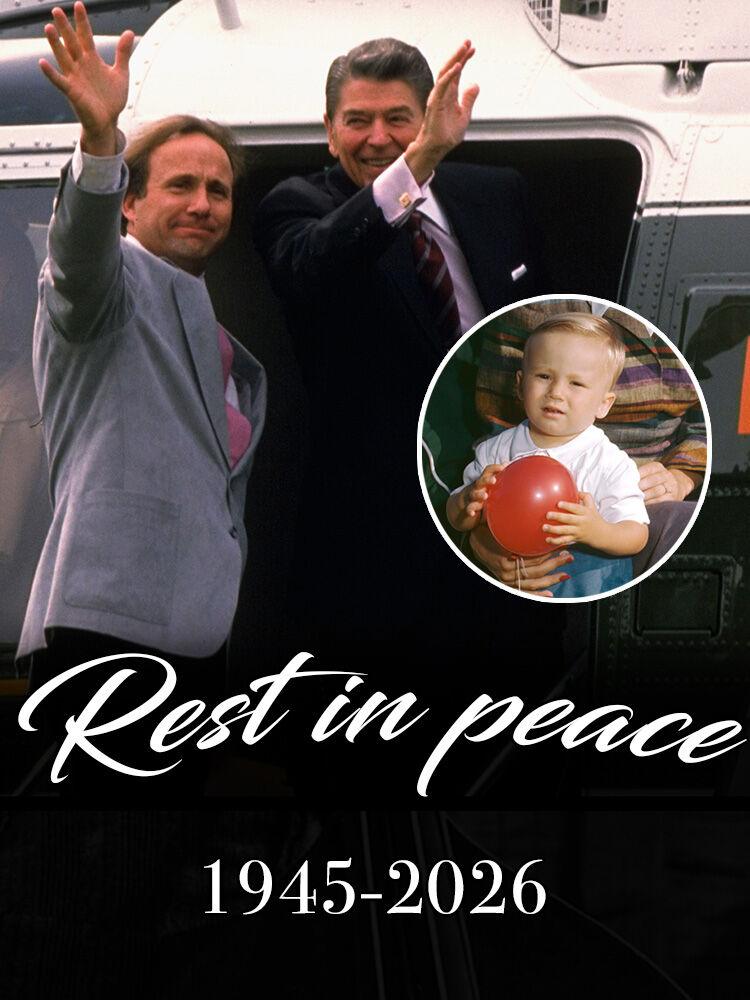
The eldest son of President Ronald Reagan, Michael Reagan, died at 80. Adopted as an infant, he spent his life finding his place in the public eye, overcoming personal challenges, and promoting healing through honesty and faith.
The life of Michael Reagan is a narrative defined by sharp contrasts, forged in the peculiar intersection of Hollywood royalty and the pinnacle of American political power. Born in 1945 and adopted at birth by Ronald Reagan and his first wife, Jane Wyman, Michael was thrust into an orbit of historical significance before he could even grasp the weight of his own name. Yet, his journey reveals that being a Reagan was never merely an inheritance; it was a complex identity that had to be navigated, interrogated, and eventually, reclaimed on his own terms.

In the Shadow of the Great Communicator
For Michael, the Reagan legacy was a double-edged sword. While adoption brought with it a world of opportunity, it also introduced a subtle, enduring burden—the sense that belonging to a family of such public magnitude was a status that had to be continually earned. The foundation of his childhood was further shaken when he learned of his adoption not from his parents, but from his sister, leaving a mark of uncertainty that would follow him into adulthood.
As Ronald Reagan’s career transitioned from the silver screen to the governorship of California and ultimately the White House, Michael often found himself on the periphery of his father’s life. While the world saw a charismatic leader, the son saw the “quiet absences”—the missed birthdays and the fleeting moments at home where history seemed more tangible than paternal intimacy. In Michael’s world, the public duty of the “Great Communicator” frequently overshadowed the private needs of the family, creating a fabric of childhood where legacy often felt more real than affection.
A Nuanced Reclamation of Identity
Despite the emotional distance, Michael Reagan rejected the binary of blind idolization or bitter resentment. Instead, he chose a path of radical honesty. He remained a staunch defender of his father’s political achievements—from Reaganomics to the Cold War—yet he refused to sanitize the personal cost of being the President’s son.
In his memoirs, Michael painted a portrait of Ronald Reagan that was colored by both love and grief. He humanized a national icon by acknowledging the personal imperfections that lived behind the public triumph. This “reverence tempered by realism” became the hallmark of his own voice as a conservative commentator and radio host, proving that loyalty does not require the erasure of one’s own painful truths.
Breaking the Silence: Survival and Vulnerability
Perhaps the most defining chapter of Michael’s public life was his decision to confront his own childhood trauma. By revealing that he had been a victim of sexual abuse, Michael challenged the rigid taboos of masculinity and power, particularly within the conservative circles that served as his primary audience.
He refused to be defined by victimhood. Instead, he framed his disclosure as an act of resilience, demonstrating that acknowledging one’s deepest vulnerabilities could coexist with a career of public advocacy. By speaking his truth, he modeled a form of courage that extended far beyond the political arena, offering a lifeline to other survivors in an era when such conversations were often met with silence.
“Twice Adopted”: The Architecture of Forgiveness
At the core of Michael’s healing was a profound spiritual evolution. He often described himself as “twice adopted”—once through the legal system into the Reagan family, and a second time through a spiritual adoption of faith and grace. For Michael, faith was not a tool to erase the scars of the past, but a framework through which to re-contextualize them.
His approach to forgiveness was a masterclass in nuance. He acknowledged the harm he endured without letting it harden his heart, moving forward with a compassion that refused to be anchored in bitterness. This perspective informed his public career; as a broadcaster, he became a voice that balanced conservative principles with a deep, lived understanding of human fragility.
A Legacy Beyond the Name
Michael Reagan’s life serves as a broader cultural study of the children of the famous. He navigated a world where public perception was frequently prioritized over private reality, and where every move was measured against a towering family shadow. By confronting these pressures with transparency, he modeled a distinct type of courage: the courage to remain an individual in the face of a legend.
Ultimately, Michael Reagan stands as a symbol of resilience. His life proves that while one might be born into a legacy, the truest form of “making it” is the ability to maintain one’s integrity, embrace one’s history, and build a voice that is—above all else—unmistakably one’s own.
The life of Michael Reagan was a masterclass in the delicate art of carving a personal identity out of the granite of a historic legacy. As the son of Ronald Reagan, Michael lived in a world where public expectation often threatened to swallow private truth. Yet, in his 80 years, he transformed the burden of a storied name into a platform for profound introspection, intellectual rigor, and an uncompromising commitment to telling his own story.
Michael’s adult life was not merely lived in the shadow of the presidency; it was a deliberate pursuit of a narrative that was entirely his own. Choosing the arena of media and political commentary, he became a defining voice on conservative talk radio. However, he was far more than a partisan pundit. His credibility was forged in the fire of lived experience—a rare blend of policy analysis and raw vulnerability that humanized the often-sterile world of political discourse.
A Voice for the Vulnerable in Conservative Spaces
Perhaps Michael’s most radical contribution to American culture was his willingness to shatter the glass walls of traditional masculinity and conservative stoicism. By publicly disclosing his experience as a survivor of childhood sexual abuse, he did more than share a personal confession; he broke a profound taboo.
In a movement that often prioritized “strength through silence,” Michael illustrated that true resilience requires honesty. He became an unlikely beacon for mental health awareness, proving that an individual could advocate for national security and personal responsibility while simultaneously acknowledging the deep, lingering echoes of early trauma.

“Loyalty does not require the erasure of one’s own experience,” Michael once reflected.
This philosophy allowed him to serve as a bridge between the rigid political narratives of the day and the messy, human realities of those who followed him. His anecdotes about adoption, neglect, and the pressure of being the “First Son” were not just stories; they were tools for community building, emphasizing that public legacy does not sanitize personal struggle.
The Burden and Beauty of the Reagan Name
Michael spoke with a startling, almost surgical candor about his relationship with his father. He navigated a society obsessed with fame and power by maintaining a clear-eyed perspective: love and admiration for Ronald Reagan’s accomplishments could, and did, coexist with the sharp sting of disappointment and misunderstanding.
He used his influence as a responsibility rather than a luxury. His charitable work—focusing on youth mentorship and advocacy for abuse survivors—reflected a conviction that privilege demands ethical action. Through every lecture and interview, he inspired others to confront their own histories, seek help without shame, and maintain their integrity even when the world’s cameras were fixed upon them.
The Final Reconciliation: Forgiveness and Autonomy
Central to Michael’s worldview was a sophisticated theology of forgiveness. To Michael, forgiving was not an act of condoning harm, but an act of liberation—a way to unburden the soul from the weight of resentment. This moral clarity allowed him to reconcile with his past without becoming embittered by it.
In his final years, Michael reflected on the evolution of the Reagan family with a sense of peaceful agency. He insisted that while identity is partially inherited, it is primarily created. He remained a man who honored his familial and historical connections while fiercely claiming his own moral agency.

A Legacy of Moral Clarity
When Michael Reagan passed away at the age of 80, the tributes that poured in spoke to a man who had successfully navigated the most difficult path of all: living courageously under immense scrutiny. He proved that it is possible to honor your parents while maintaining independent thought, and to participate in the corridors of power without sacrificing your personal truth.
Michael Reagan will not be remembered simply as the son of a president. He will be remembered as a man of intellectual rigor and emotional depth—a man who proved that even in the longest, most storied shadows, an individual can, through grace and resilience, shine with an unmistakable light of their own.