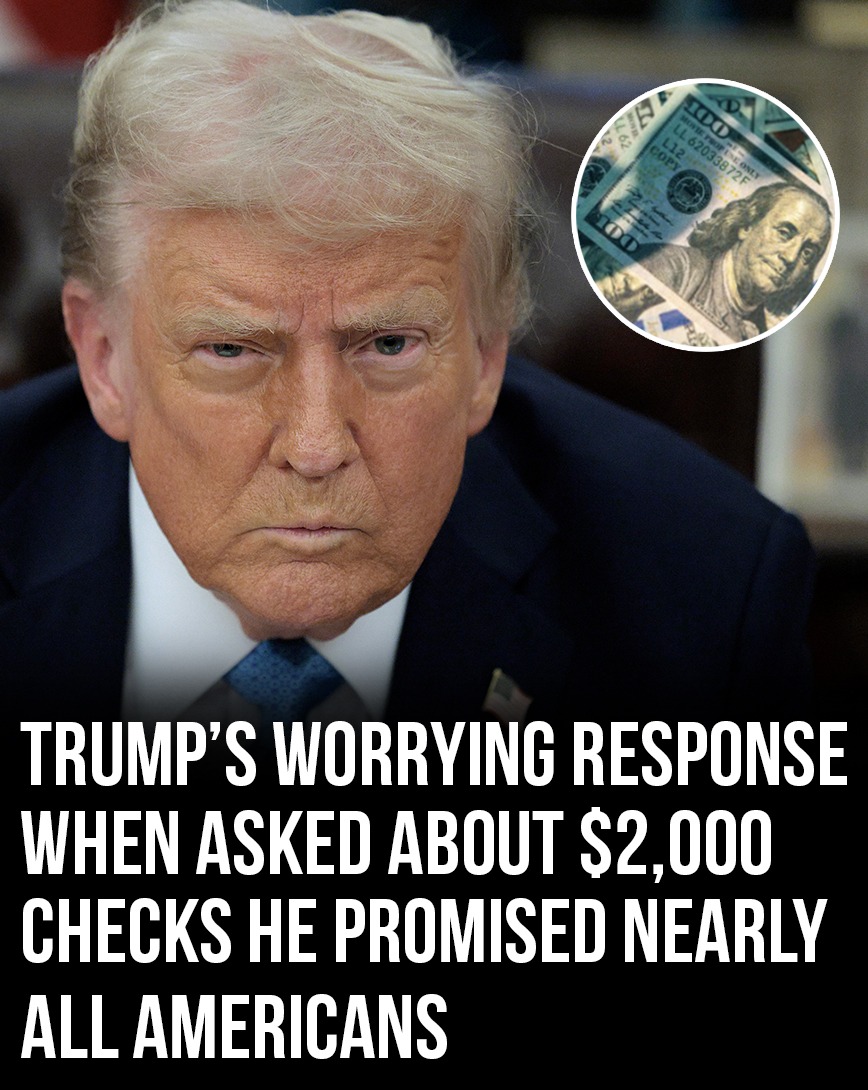
Trump delivers bizarre response when asked about $2,000 checks he promised nearly all Americans
As the 2026 tax filing season officially gets underway this January, a familiar sense of anticipation is sweeping through American households. But this year, the usual talk of refunds is being eclipsed by a far more volatile question: Will there be a fourth stimulus check President Donald Trump has doubled down on a cornerstone campaign pledge to distribute “tariff dividends” of at least $2,000 to middle- and low-income citizens. Billed as a “National Security bonanza,” the plan promises to bypass traditional tax revenue by instead tapping into the hundreds of billions of dollars collected from the administration’s aggressive global trade levies.
However, behind the populist promise lies a complex web of legal uncertainty, fiscal warnings, and a president who, at times, appears to be losing track of the specifics of his own economic “masterpiece.”
The Oval Office “Memory Gap”
In a revealing interview from the Oval Office last week, the President showcased a rare moment of confusion regarding the $2,000 checks—a promise that has been a staple of his Truth Social feed for months. When reporters reminded him of the $2,000 pledge tied to tariff revenue, the President seemed genuinely taken aback.
“I did do that? When did I do that?” he asked.
He quickly pivoted, explaining that he had momentarily confused the proposal with his recently announced $1,776 “Warrior Dividend”—a one-time Christmas bonus for service members that was largely repurposed from existing military housing subsidies. Despite the brief lapse, the President reasserted his commitment to the broader $2,000 payment, though he pushed the timeline back, suggesting the funds would now likely arrive “toward the end of the year.”
“The tariff money is so substantial… that I’ll be able to do 2,000 sometime… toward the end of the year,” he told reporters, citing “substantial” incoming revenue.
The “Trillion-Dollar” Math Problem
The President’s math, however, is facing intense scrutiny from budget hawks and economists. While Trump has claimed on Truth Social that the U.S. is “taking in Trillions of Dollars” from his tariffs, the official ledger paints a leaner picture.
As of late 2025, tariff revenues sat at approximately $216 billion—a record high, but far short of the “trillions” cited by the White House. The non-partisan Committee for a Responsible Federal Budget (CRFB) estimates that a $2,000-per-person dividend would cost the federal government roughly $600 billion.
“Even the most aggressive tariff revenue projections don’t cover the cost of a $2,000 check for every moderate-income American,” one economist noted. “You’re essentially looking at a $400 billion shortfall that would have to be added to the $37 trillion national debt.”
A Divided Administration: Bessent’s “Hidden” Dividend
Treasury Secretary Scott Bessent has been tasked with bridging the gap between the President’s rhetoric and fiscal reality. In an interview with ABC’s This Week, Bessent suggested that the “dividend” might not arrive as a physical check at all.
Instead, the Treasury is looking at “rebranding” the administration’s broader tax agenda—such as the elimination of taxes on tips, overtime, and Social Security—as the promised dividend.
“I haven’t spoken to the president about this yet, but… it could be just the tax decreases that we are seeing,” Bessent said. He later offered a more concrete compromise, suggesting that the average household might see a “very large refund” of $1,000 to $2,000 during this tax season due to changes in withholding and newly passed deductions.
The Inflationary Alarm
Secretary Bessent also issued a subtle warning that has echoed through the halls of Congress: inflation.
“We’re worried about the inflationary effects of distributing this windfall,” Bessent admitted, even going so far as to urge Americans to save any potential dividend rather than spend it immediately. This sentiment has been mirrored by Republican lawmakers who fear that injecting $600 billion into a still-recovering economy could send prices for consumer goods spiraling upward again.
“WE’RE SCREWED”: The Supreme Court Shadow
The ultimate fate of the $2,000 check rests not in the Treasury, but in the hands of the U.S. Supreme Court. The justices are currently weighing the legality of the President’s use of the International Emergency Economic Powers Act (IEEPA) to impose these tariffs without Congressional approval.
If the Court strikes down the tariffs, the administration might not just lose its funding source—it could be forced to refund hundreds of billions of dollars to the companies that paid them. The President’s own assessment of a potential loss was blunt:
”If the Supreme Court rules against the United States of America on this National Security bonanza, WE’RE SCREWED,” he wrote on Truth Social.
As Americans begin filling out their 1040 forms this month, the promise of a “tariff dividend” remains a high-stakes political gamble. For many “moderate-income” families, the question isn’t just when the money will arrive—but whether it actually exists.