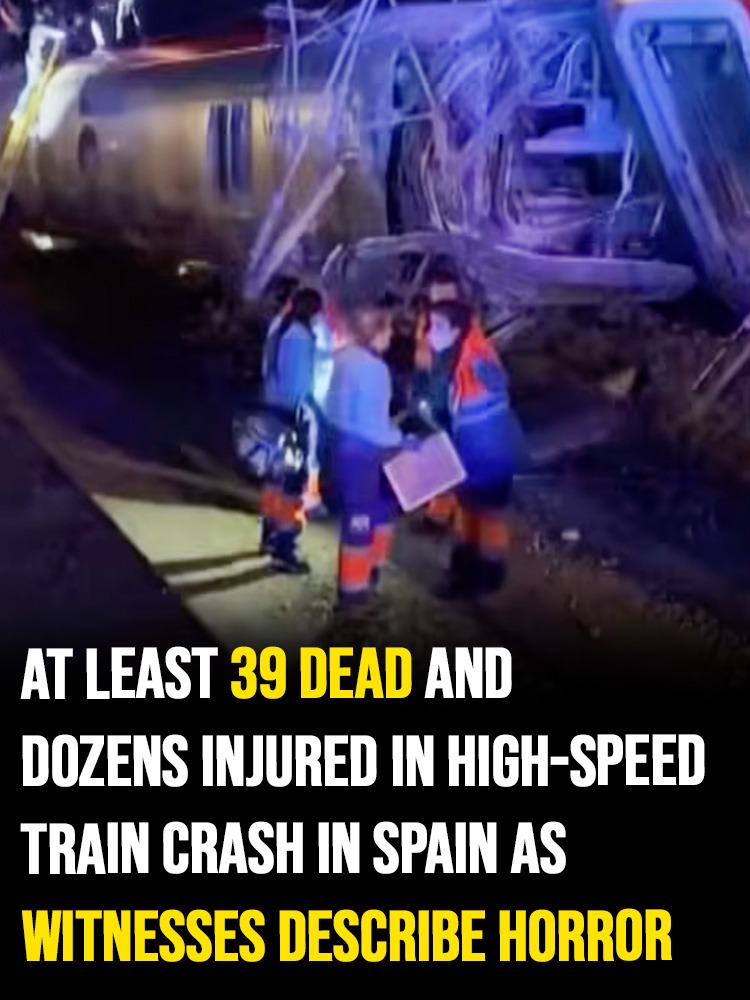
At least 39 dead and dozens injured in high-speed train crash in Spain as witnesses describe horror
A massive recovery operation is underway in the Córdoba province after a catastrophic mid-air derailment and collision claimed at least 39 lives on Sunday night, marking Spain’s deadliest rail disaster in more than a decade.
The tragedy unfolded at approximately 5:50 p.m. GMT, just ten minutes after a high-speed Iryo train departed from Malaga bound for Madrid. According to Adif, Spain’s railway infrastructure authority, the Iryo convoy derailed near the municipality of Adamuz, careening across the median and into the path of an oncoming state-operated Renfe train.
The impact was devastating. The secondary Renfe train was knocked off its axis, plunging into a nearby ditch. Between the two vessels, four hundred passengers were caught in the wreckage. On Monday morning, local authorities confirmed that 122 people had been treated for injuries, with 48 victims—including five children—still hospitalized. Twelve people, including one child, remain in critical condition in intensive care units.

“Like an Earthquake”
Harrowing survivor accounts have begun to emerge as rescue crews work tirelessly around the clock. Salvador Jimenez, a passenger in the lead carriage of the Iryo train, described a sensation of violent instability.
“I was in the first carriage. There was a moment when it felt like an earthquake and the train had indeed derailed,” Jimenez told reporters.
Another passenger, identified only as José, recounted the immediate aftermath to Canal Sur, describing a scene of total pandemonium: “There were people and screaming, calling for doctors.”
Aerial footage and ground-level video from the site show a landscape of twisted metal and tipped carriages. Rescue workers were seen scaled atop the wreckage, scanning for signs of life and pulling survivors through shattered windows and buckled doors.
A “Complicated” Rescue Task
The recovery effort remains a grim and grueling process. Paco Carmona, Córdoba’s chief of fire, explained that the structural damage has created nearly inaccessible pockets where passengers may still be clinging to life.
“There are still people trapped. The operation is concentrating on getting people out of areas which are very narrow,” Carmona told local broadcasters. “We have to remove the bodies to reach anyone who is still alive. It is proving to be a complicated task.”
Spanish Transport Minister Óscar Puente has officially launched a high-level investigation into the collision, characterizing the sequence of events as “extremely strange,” given the safety protocols integrated into Spain’s high-speed rail corridors.

A Nation in Mourning
Spain’s Prime Minister, Pedro Sánchez, addressed the tragedy late Sunday, bracing the public for a long period of mourning.
“Tonight is a night of deep pain for our country due to the tragic railway accident in Adamuz,” Sánchez wrote in a statement on X. “I want to express my most sincere condolences to the families and loved ones of the victims. No words can alleviate such immense suffering, but I want them to know that the entire country stands with them in this extremely difficult moment.”
As the Spanish Civil Guard continues to secure the site, the focus remains on the identification of the deceased and the extraction of those still unaccounted for within the narrow confines of the wreckage.