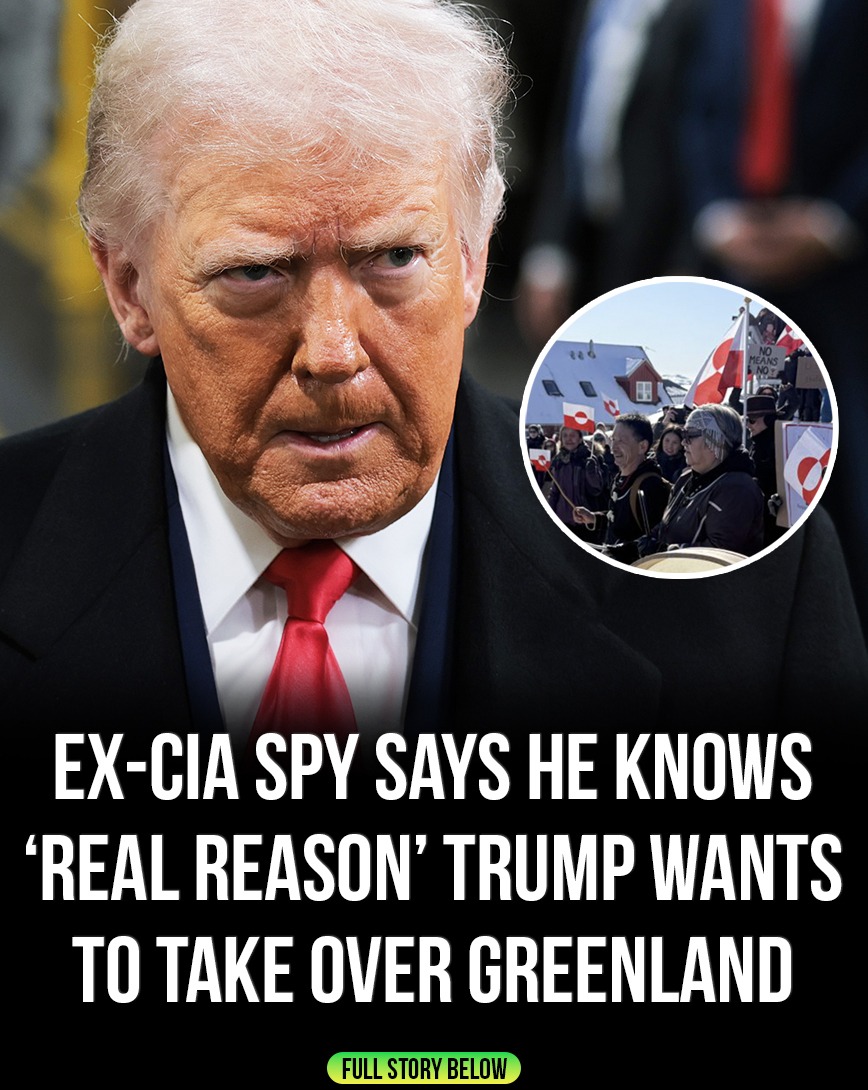
Former CIA spy says he knows ‘true reason’ Trump wants to take over Greenland
President Donald Trump’s fixation with Greenland has transcended the realm of internet memes to become a central, high-stakes pillar of his foreign policy. While the world watches the escalating rhetoric with a mix of confusion and concern, Andrew Bustamante—a former covert CIA operations officer and U.S. Air Force veteran—is stepping forward to deconstruct the real motivations behind what many have termed the most audacious territorial play in modern history. According to Bustamante, the President’s push for the massive Arctic island is not a whimsical distraction but a calculated move aimed at securing American hegemony for the next century.
The New Cold War for the North
The diplomatic friction reached a boiling point this week. President Trump recently threatened to impose significant tariffs on the United Kingdom and seven other European allies unless the U.S. is permitted to negotiate the acquisition of Greenland from Denmark.
The response from London was swift and sharp. In a national press conference, UK Prime Minister Keir Starmer labeled the tariff threats “wrong,” emphasizing that the sovereign right to decide Greenland’s future belongs solely to the people of the territory and the Kingdom of Denmark.
Despite the pushback, Trump has leaned into a strategy of “strategic ambiguity,” warning NATO allies that the U.S. could acquire the island “the easy way or the hard way.” This aggressive posturing comes as public opinion remains skeptical; a recent Reuters/Ipsos poll revealed that only 17% of Americans support the effort to acquire Greenland, with nearly three-quarters of the public opposing any use of military force.
“American Primacy”: The CIA Perspective
Speaking with The Express, Bustamante explained that the “why” behind this obsession is rooted in the essential components of 21st-century power: resources and geography.
“American dominance in the Arctic is critical to American primacy. That’s the argument for Greenland,” Bustamante stated. He identified two primary drivers:
-
Economic Independence: Greenland is a treasure trove of “strategic critical use minerals” and “rare earth minerals.”
-
Military Advancement: These elements are not just for consumer electronics like smartphones; they are fundamental to modern weaponization and military technology.
Bustamante noted that climate change is paradoxically fueling this interest. As global warming melts the ice sheet, Greenland’s vast untouched reserves—including uranium, iron, and potentially oil—are becoming more accessible. “There is a very real American interest in taking some control over the resources that are in Greenland,” he added.
The “Quiet Workaround”
While Trump publicly flirts with military rhetoric, Bustamante suspects a more clandestine strategy may be in play. Recognizing that a forced annexation has no legal precedent and would shatter the NATO alliance, he suggests the U.S. might be looking for an “economic backdoor.”
“I think there’s a very real chance that the United States strikes an economic deal with the independent parties in Greenland that already want independence,” Bustamante theorized. By bypassing Copenhagen and dealing directly with pro-independence factions in Nuuk, Washington could effectively “take control of the parts of Greenland it wants” without a formal declaration of war.
Bustamante warned, however, that this outcome would leave Denmark sidelined and disgruntled. “I don’t see an outcome where Denmark is happy.”
The Shadow of “National Security”
Despite the clear mineral and economic advantages, the White House continues to frame the pursuit as a strictly defensive measure. Vice President JD Vance recently visited Pituffik Space Base (formerly Thule Air Base), the northernmost U.S. military installation, to underscore the island’s role in the “Golden Dome” missile defense program and as a bulwark against Russian and Chinese expansion.
Bustamante believes Trump is masterfully exploiting the news cycle to keep his adversaries off-balance. By demonstrating power in other regions—such as the recent military action in Venezuela—Trump is forcing European allies to wonder if they should simply “kowtow” to his demands to avoid further economic or political fallout.
As the 2026 World Economic Forum in Davos approaches, the “Greenland Saga” shows no sign of fading. Whether through a “hard way” confrontation or a “quiet” economic deal, the battle for the Arctic has officially moved from the fringe to the forefront of global politics.
Do you believe the U.S. should prioritize its own Arctic security even if it means alienating longtime NATO allies? Share your perspective in the comments.