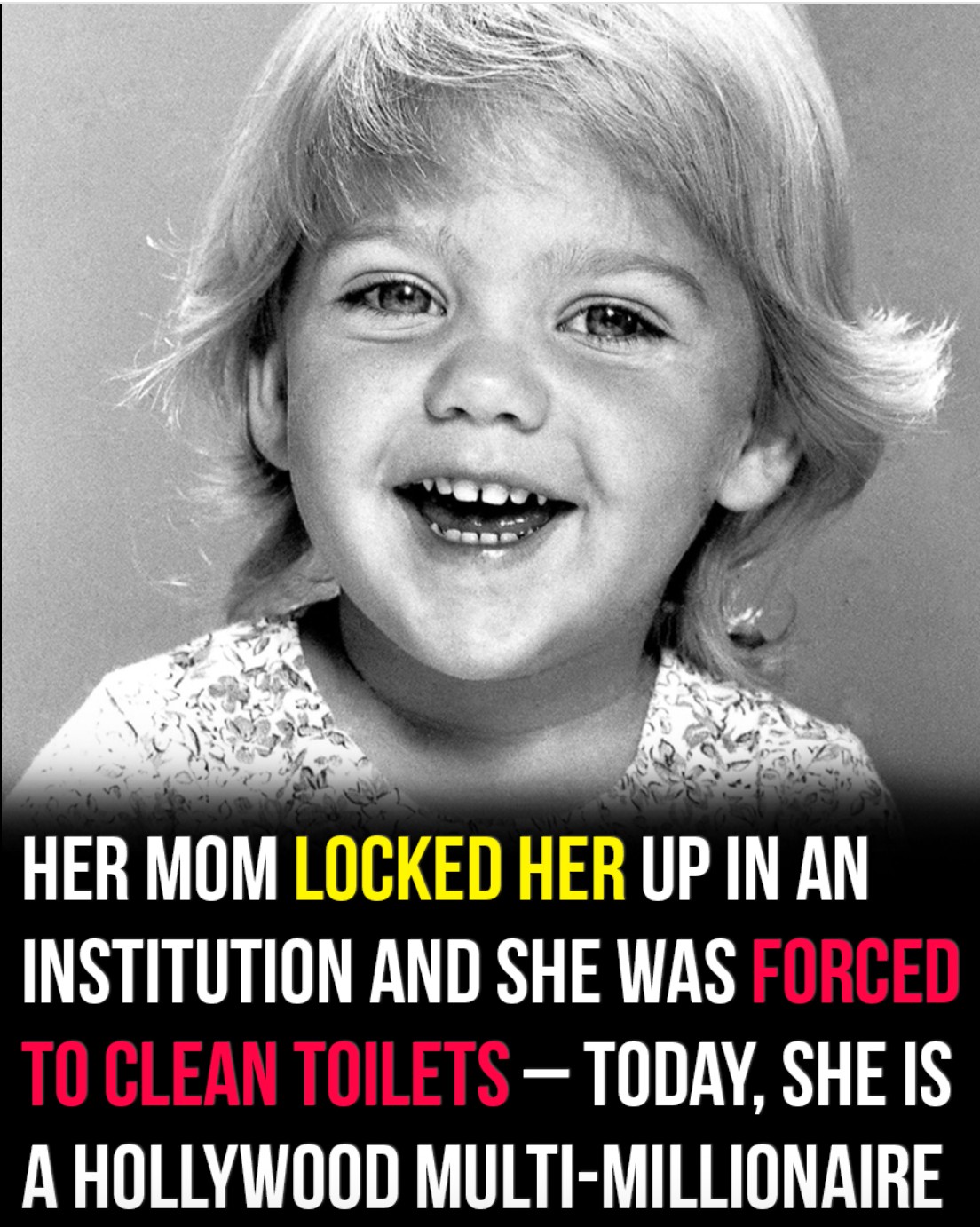
From cleaning toilets and mental institution to Hollywood stardom
In the archives of Tinseltown, few stories are as harrowing—or as ultimately triumphant—as that of Drew Barrymore. Today, she is a celebrated actress, a daytime talk show powerhouse, and a beacon of positivity. But the path she walked to reach this plateau was paved with a degree of trauma that would have dismantled most adults, let alone a child. It is a narrative that sounds like a Hollywood fiction: an eight-year-old with a drink in her hand, a 13-year-old in rehab, and a 14-year-old legally divorcing her own parents.

The Seven-Year-Old Sensation
Barrymore’s descent into the dark side of fame began almost before she could walk. Making her debut in a dog food commercial at just 11 months old, she was a professional before she was a toddler. By the time she was seven, she was a global phenomenon.
Her turn as Gertie in Steven Spielberg’s 1982 masterpiece E.T. the Extra-Terrestrial made her the world’s most famous child. Audiences marveled at her precociousness, notably during a legendary appearance on The Tonight Show Starring Johnny Carson, where she charmed the nation with her wit and a high-pitched scream.
But as the world fell in love with the “cute” little girl who poured Baileys over her ice cream, the reality behind the scenes was fracturing. “I don’t think I understood what was good, or pleasurable, or bad,” she later reflected. “I was probably chasing joy, but I don’t think it was the real joy. I was just too young to know.”
A Dynasty of Dysfunction
To understand Drew’s spiral, one must look at the Barrymore lineage—a dynasty of legendary talent haunted by a “notorious history” of substance abuse. Her father, John Drew Barrymore, was largely an ethereal figure, an alcoholic who was absent for much of her youth.
Left in the care of her mother, Jaid, Drew was thrust into an adult world far too soon. Following her parents’ divorce when she was nine, the nightclub scene became her playground. By nine, she was a regular at the infamous Studio 54, mingling with celebrities and being introduced to a world of drugs and nightly parties.
“I really parented myself,” Barrymore would later say. “I am not mad at my mom or dad. I was more disappointed in my own parenting.”

The Spiral: Alcohol at Nine, Rehab at 13
The timeline of her addiction is staggering. By age 11, she was struggling with alcohol; by 12, she was using marijuana and cocaine. The “party girl” lifestyle eventually took its toll, leading to a suicide attempt at 13 and an 18-month commitment to a psychiatric institution.
It was during this time that Barrymore hit her absolute nadir. “When I was 13, that was probably the lowest,” she admitted. “Just knowing that I really was alone. And it felt… terrible.”
Upon her release, she found a temporary sanctuary with legendary singer David Crosby and his wife, Jan Dance. Crosby, himself a recovering addict, recognized that the teen “needed to be around some people that were committed to sobriety.” Though she still struggled with a rebellious streak and a deep-seated anger, the seeds of a new life were being sown.
“Locked Up” to Legally Emancipated
Perhaps the most surprising chapter of her journey is her perspective on the institution her mother placed her in. While it was a harsh, “boot camp” environment where she was held for a year and a half, Barrymore credits the facility with saving her life.
“My mom locked me up in an institution. But it did give an amazing discipline,” she revealed. “It taught me boundaries. Until that point, I had none.”
By 14, at the suggestion of the facility’s experts, Drew took the radical step of filing for legal emancipation. She walked into a courtroom a child and walked out a legal adult. By 15, she was living in her own apartment, attempting to navigate a world that had already blacklisted her as “damaged goods.”
The Resurrection
Hollywood is famously unforgiving to child stars who stumble, but Barrymore refused to be a cliché. She fought her way back, one small role at a time, eventually founding her own production company and starring in a string of massive hits like Scream, The Wedding Singer, and Charlie’s Angels.
Today, her story serves as a masterclass in resilience. She has broken the cycle of her family’s generational trauma, prioritizing a traditional and stable upbringing for her own daughters. From the “Little Girl Lost” of the 1980s to the “100 Most Influential People” list of 2023, Drew Barrymore’s journey remains one of the most remarkable second acts in history.
The trajectory of a child star usually follows a predictable, often tragic, arc. But for Drew Barrymore, the “Little Girl Lost” who captivated the world in E.T., the story didn’t end in the wreckage of a mid-90s tabloid headline. Instead, it evolved into one of the most sophisticated survival stories in the history of the American film industry.
It is a journey that took her from the heights of Steven Spielberg’s Hollywood to the utilitarian reality of a mop and bucket—and eventually, to a Manhattan penthouse and an $85 million fortune.
The Great Leveler: Cleaning Toilets at 16
By the age of 15, the industry that had once hailed Barrymore as a prodigy had effectively blacklisted her. Deemed “unemployable” due to her highly publicized battles with addiction and her legal emancipation from her parents, the teenager found herself in a stark new reality.
Far removed from the klieg lights, Barrymore spent her mid-teens waiting tables, working odd jobs, and, quite literally, cleaning toilets. It was a period of profound humility that she met without bitterness, often citing her father’s grimly poetic advice: “Expectations are the mother of deformity.”
This era of anonymity served as a crucible for the reinvention that followed in her twenties. This chapter was marked by a technicolor mix of rebellion and self-discovery—including two brief marriages, high-octane appearances like her infamous desk-dance for David Letterman, and a slow, steady climb back up the Hollywood call sheet.

Queen of the “Rom-Com” Era
Barrymore didn’t just return to acting; she redefined the “America’s Sweetheart” archetype for a new generation. Through her production company, Flower Films, she took control of her own narrative, starring in a string of genre-defining hits: The Wedding Singer, Never Been Kissed, and 50 First Dates.
Audiences were transfixed not just by her talent, but by an inherent vulnerability—a “quirkiness” that felt earned rather than manufactured. However, as her career soared toward its peak, a new priority emerged in 2012: motherhood.
The Backlash: “You Can’t Have it All”
In a move that stunned Hollywood, Barrymore pivoted away from leading movie roles to focus on raising her daughters, Olive and Frankie. It was this decision—and her candid explanation for it—that sparked an unexpected controversy.
Barrymore faced significant backlash after suggesting she would rather be at home than on a movie set. Surprisingly, the loudest critics were other women.
“For saying, you can’t have it all,” Barrymore reflected on the criticism. “But that’s not what I meant. I absolutely believe you can do anything you want; I just realized I can’t do everything at once. Trying would mean a poor result, and that really pissed people off.”
Breaking the Generational Cycle
The “upside-down” nature of her own childhood—raised by a violent, alcoholic father and a reckless, “free-spirited” mother—informed her approach to parenting. Drew’s mother, Jaid, was a Hungarian refugee born in a displaced persons camp who struggled with the boundaries of motherhood, often treating her daughter more like a peer in the New York club scene.
Determined to provide the structure she never had, Drew established a home life defined by “strict rules” and screen-free environments. “I didn’t have parents, I was the parent to them,” she once said of her own mother and father. “It was all totally upside-down.”

The $85 Million B-Side
As she approaches her 50th birthday in February 2025, Barrymore is no longer just an actress; she is a mogul. With a net worth estimated at $85 million, her wealth is evenly split between her legendary acting career and a sprawling business empire that includes her talk show, real estate, and various brand ventures.
Now a fixture of Manhattan life, she hosts the nationally syndicated The Drew Barrymore Show, using her platform to preach a philosophy of “intelligent optimism.”
”You know how sometimes you just feel ready? Like, deep in your bones, something shifts… You’re stepping into a whole new season of life,” she wrote in a recent personal essay for Us Weekly. ”That’s me. Right now. Fifty years old. And I have to say… I think I love it here.”
From the “party girl” of Studio 54 to a woman who values her independence above all else, Drew Barrymore’s story is a reminder that a “wild beginning” does not have to dictate a tragic end.