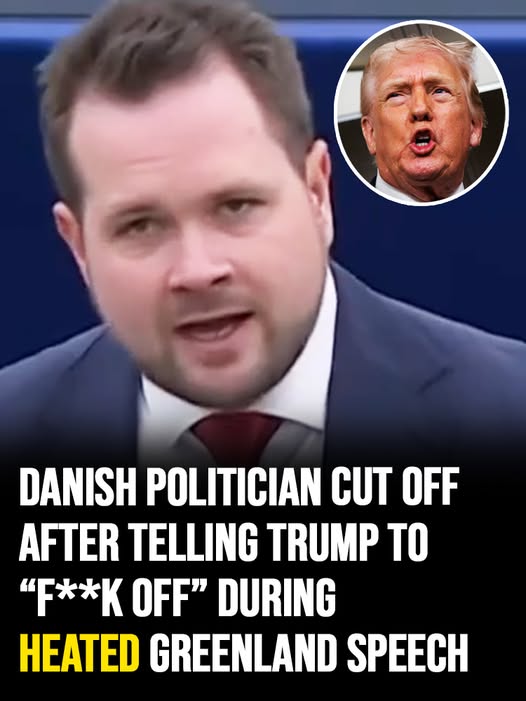
Danish politician cut off after telling Trump to fk off during heated Greenland speech!
The confrontation over Greenland has moved far beyond quiet diplomacy and into open political theater, and few moments captured that shift more vividly than a speech delivered this week in the European Parliament. What began as another debate over sovereignty and security turned into a viral flashpoint when a Danish lawmaker abandoned diplomatic language altogether and told the American president, in blunt terms, to back off.
At the center of the controversy is Donald Trump, whose renewed push to bring Greenland under U.S. control has rattled allies across Europe. Framed by Trump as a matter of “national and world security,” the proposal has revived memories of his earlier interest in acquiring the Arctic territory and amplified fears that Washington is willing to strong-arm partners to secure strategic and economic advantage.
Greenland, an autonomous territory within the Kingdom of Denmark, has suddenly become a geopolitical pressure point. Trump has repeatedly argued that the island’s location and resources make it indispensable to American defense interests, particularly in the context of competition with Russia and China in the Arctic. He has also suggested that Denmark lacks the capacity to protect Greenland adequately, a claim Danish leaders strongly reject.
He began in measured terms, reminding the chamber that Greenland has been part of the Danish realm for centuries and enjoys a defined autonomous status. It is not, he emphasized, an unclaimed territory waiting to be absorbed by a larger power. It is an integrated country with its own people, culture, and political institutions. “Greenland is not for sale,” he said, directing his remarks squarely at the U.S. president.
Then the speech took a sharp turn. Abandoning diplomatic restraint, Vistisen addressed Trump directly and delivered the line that would ricochet across social media within minutes. In plain, unmistakable language, he told the American president to “f— off.” The chamber erupted, and the clip spread rapidly online, hailed by supporters as refreshingly honest and condemned by critics as reckless and unbecoming.
Reaction was immediate and polarized. Many viewers praised Vistisen for articulating what they believed European leaders were thinking but unwilling to say. To them, his outburst captured widespread frustration with what they see as Trump’s bullying approach to allies and disregard for international norms. Others argued that his language undermined the seriousness of Denmark’s position and handed Trump an excuse to dismiss European objections as emotional or unserious.
The presiding officer of the European Parliament moved quickly to intervene. Cutting off Vistisen mid-speech, the speaker reminded him that parliamentary rules prohibit profanity and personal insults, regardless of political passion. “This is against our rules,” the speaker said, stressing that strong feelings do not justify inappropriate language in the chamber. Vistisen was prevented from continuing, and the session moved on, but the damage—or impact—was already done.
The incident highlighted a deeper rift over how Europe should respond to Trump’s confrontational style. Some argue that polite diplomacy has failed and that blunt resistance is necessary to draw clear lines. Others warn that theatrics play into Trump’s media instincts and risk escalating tensions rather than resolving them.
Danish officials have repeatedly stated that Greenland’s future can only be decided by Greenlanders themselves. While Copenhagen recognizes the island’s strategic importance and cooperates closely with the United States on defense, it rejects any suggestion that ownership is negotiable. Greenland’s own leaders have echoed that stance, emphasizing self-determination and warning against becoming a pawn in great-power politics.
Trump’s remarks, and the reaction they provoked, have also strained conversations within NATO. The alliance depends on mutual trust, and public threats against allies test that foundation. European leaders worry that framing security as a transactional favor rather than a shared commitment weakens collective defense at a moment of global instability.
In that context, Vistisen’s outburst can be read as more than a lapse in decorum. It reflects a boiling point reached after months of rhetoric that many Europeans perceive as dismissive and domineering. Whether his words ultimately help or harm Denmark’s case is debatable, but they undeniably crystallized the anger simmering beneath the surface.
As the dust settles, one thing is clear: the debate over Greenland is no longer a hypothetical curiosity. It has become a symbol of broader questions about power, sovereignty, and the future of alliances. Trump’s insistence on framing the issue as a test of loyalty has forced allies to respond, sometimes with restraint, sometimes with open defiance.
The episode in the European Parliament will likely be remembered not just for its language, but for what it revealed. Beneath the shock value was a stark message: Europe is increasingly unwilling to accept being spoken to as subordinate, and patience with coercive diplomacy is wearing thin. Whether that realization leads to renewed dialogue or deeper division remains to be seen, but the clash over Greenland has already reshaped the tone of transatlantic politics.