The Doctor Said My Daughter Might Never Wake Up, My Wife Cried, My Mother-in-Law Called It A Blessing, Then I Found the Note!
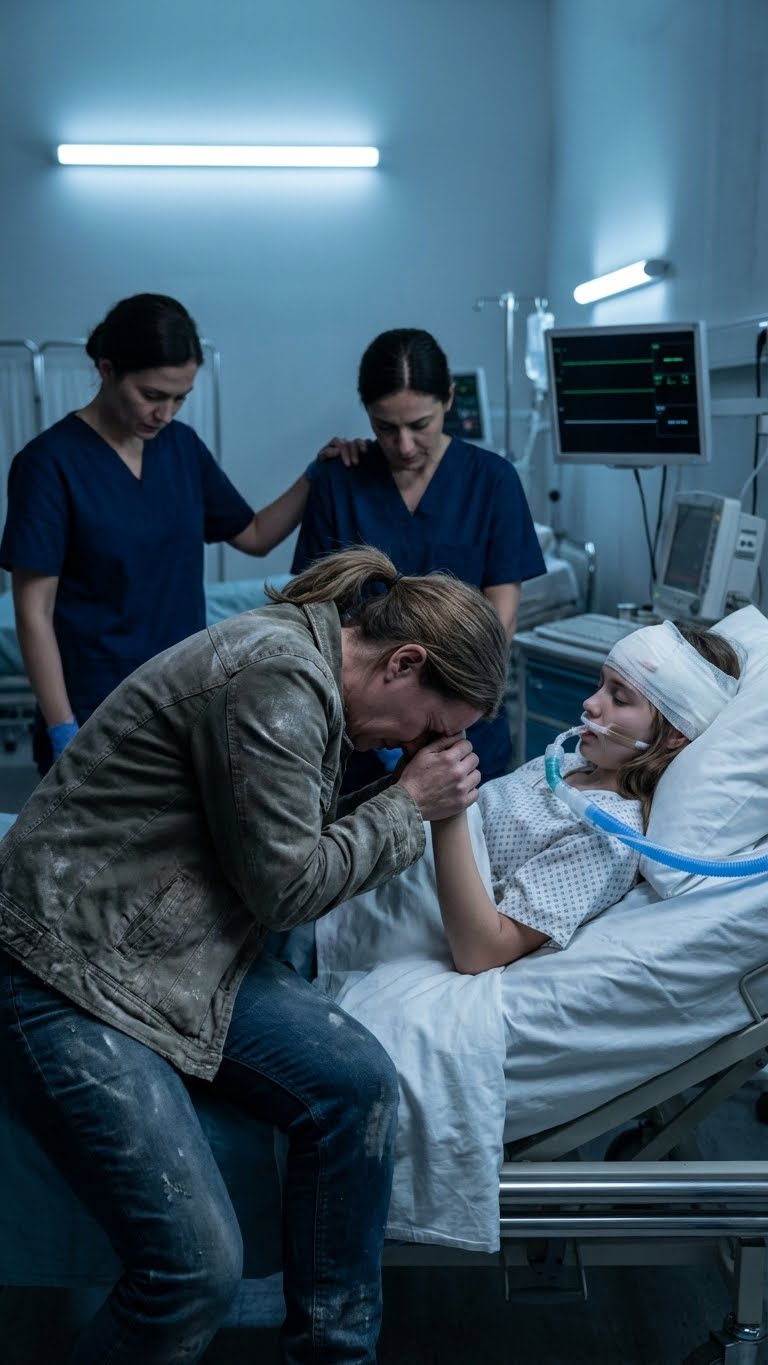
The sterile scent of an Intensive Care Unit is a sensory assault that lingers in the marrow of your bones long after you leave its walls. It is a suffocating mixture of antiseptic, floor wax, and the metallic tang of blood—a scent that marks the terrifying boundary between life and the void. I sat in a rigid vinyl chair, my world reduced to the four corners of my daughter Lily’s hospital bed. Her tiny hand, usually so full of motion and heat, felt like a carved piece of alabaster within my own.
The rhythmic beep-hiss-beep of the ventilator was the only clock that mattered now. Dr. Aris stood at the foot of the bed, his face a practiced mask of professional sorrow. I had seen him offer this look to other families in the waiting room, but I never imagined I would be the one receiving it.
“The cranial trauma is extensive, Mr. Reynolds,” he whispered, his voice barely audible over the hum of the machinery. “The intracranial pressure remains high despite the shunts. We have to be realistic. There is a strong possibility she may never wake up.”
The words felt like a physical blow, a sudden vacuum of air in the room. Beside me, my wife, Megan, collapsed against the cold metal railing. The sound she made wasn’t a cry; it was a jagged, visceral mourning that sounded like her soul was being shredded. I reached out to comfort her, but my hand froze mid-air.
Behind Megan stood the other two pillars of our supposed family circle: my mother-in-law, Carol, and my younger brother, Jason. Carol stood with her arms crossed, her posture as stiff as a gravestone. Her eyes were dry, fixed not on her granddaughter’s bruised face, but on the glowing green lines of the heart monitor. When she spoke, the temperature in the room seemed to drop ten degrees.
“Maybe this is a blessing in disguise,” Carol murmured, her voice devoid of even a trace of warmth. “She’s always been… difficult. A spirit that refused to be broken. A life lived in that state of defiance is a burden on everyone involved.”
My head snapped up, my grief momentarily eclipsed by a surge of pure, unadulterated disbelief. “What did you just say?”
Before Carol could retort, Jason shifted his weight, refusing to meet my eyes. “She’s got a point, Mark. You know how Lily is. Some kids are just built for drama; they create chaos for attention. It’s a tragedy, of course, but maybe this is just nature’s way of settling a troubled soul.”
I stared at my own brother, seeing for the first time the nervous twitch in his jaw and the way his hands were shoved deep into his pockets, as if hiding something. These were the two people who had been watching Lily when she “fell.” They were the ones who told the paramedics she had tripped in a fit of hysterics.
I turned back to Lily, a protective rage crystallizing in my chest. I squeezed her hand, silently begging for a miracle. That was when I felt it. It wasn’t the responsive squeeze of a child waking from a nightmare; it was a texture. Something dry, thin, and crinkled was tucked into the tight curl of her palm.
Shielding my movements from the two vultures near the door, I gently pried back her thumb. Hidden in her fist was a small, crumpled scrap of paper, torn jaggedly from a notebook. My heart hammered a frantic rhythm against my ribs as I slid it into my pocket. I waited until the whispering between Carol and Jason grew louder, then I stood up.
“I need air,” I said, my voice sounding like it was coming from a great distance. “I can’t listen to the machines anymore.”
“Don’t be long,” Jason warned, his voice tinged with an odd, sharp anxiety. “We need to stick together for Megan’s sake.”
“Right,” I replied, the word tasting like ash. “For Megan.”
I didn’t stop until I reached my car. In the flickering light of the parking garage, I unfolded the note. The handwriting was shaky, the letters pressed so hard into the paper they had nearly torn through.
“Dad, if something happens to me, check the camera I hid in my room.”
The world tilted. The “accidental” fall was no longer a tragedy; it was a crime. I drove home in a state of hyper-focused dissociation, red lights and sirens blurring into a smear of color. Our suburban home, once a place of piano practice and laughter, now looked like a mausoleum.
I sprinted to Lily’s room. She was a child who loved puzzles and spy novels, a girl who understood secrets better than the adults around her. I began a frantic search, tearing through stuffed animals and bookshelves. Panic began to claw at my throat—had they found it? Had they cleaned the room before the ambulance arrived?
I stopped and forced myself to think like her. I looked at the antique nightstand I had refinished for her. I remembered the “secret” compartment beneath the bottom drawer where she used to hide her Halloween candy. I knelt, pulled the drawer out, and reached into the dark cavity.
My fingers brushed cold plastic. I pulled out a tiny, black motion-activated camera—one I had bought years ago to watch our dog. Lily had repurposed it.
I ran to my office, my hands trembling so violently I could barely plug the USB cable into my laptop. When the folder opened, I saw dozens of clips, but the last one was timestamped at 3:45 PM—exactly twenty minutes before the 911 call.
I clicked play.
The video showed Lily sitting on her rug, hugging her knees, whispering, “Please go away, please go away.” Then, the door was kicked open. Carol marched in, her face a distorted mask of cruelty I had never seen. “Stand up!” she barked. “Stop acting like a wounded animal. It’s pathetic.”
Lily scrambled up, sobbing. “Grandma, please. I’ll be good.”
“Good?” Carol laughed, a sound that made my skin crawl. “You’re a liar. You tell your father we’re mean to you. You try to drive a wedge between me and Megan.”
Then Jason walked into the frame, casually folding a leather belt between his hands—a silent, terrifying threat. “She needs discipline, Mom. Mark is raising a brat. Look at her, playing the victim.”
On the screen, Carol lunged. She grabbed Lily by the arm, her nails digging into the child’s skin. “You’re going to learn respect,” she hissed.
“Let me go!” Lily screamed, struggling with everything she had.
“Jason, help me hold her,” Carol commanded.
My brother stepped forward, pinning Lily’s other arm. Two adults against one terrified child. In a desperate bid for freedom, Lily stomped on Jason’s foot. He yelled and recoiled. In that moment of chaotic frustration, Carol didn’t just push Lily—she threw her.
Lily flew backward, her feet catching on the edge of the rug. The camera captured the sickening, hollow thud as the back of her head struck the sharp oak corner of the nightstand. She hit the floor and went instantly limp.
The silence on the recording was absolute. Carol didn’t scream. She didn’t call for help. She stood over the body of her granddaughter, adjusted her blouse, and turned to Jason. “She fell,” Carol said, her voice cold and calculated. “She was having an episode, she ran, and she tripped. Do you understand?”
I stared at the frozen frame of the video, the silent room on the screen reflecting the silent room I sat in. The grief was gone, replaced by a cold, crystalline purpose. They were still at the hospital. They were still standing over my daughter, playing the role of the grieving family.
I closed the laptop and picked up my phone. I didn’t call Megan. I called the lead detective on Lily’s case.
“Detective,” I said, my voice steady and sharp. “I have the ‘blessing’ my mother-in-law was talking about. I’m coming down now.”