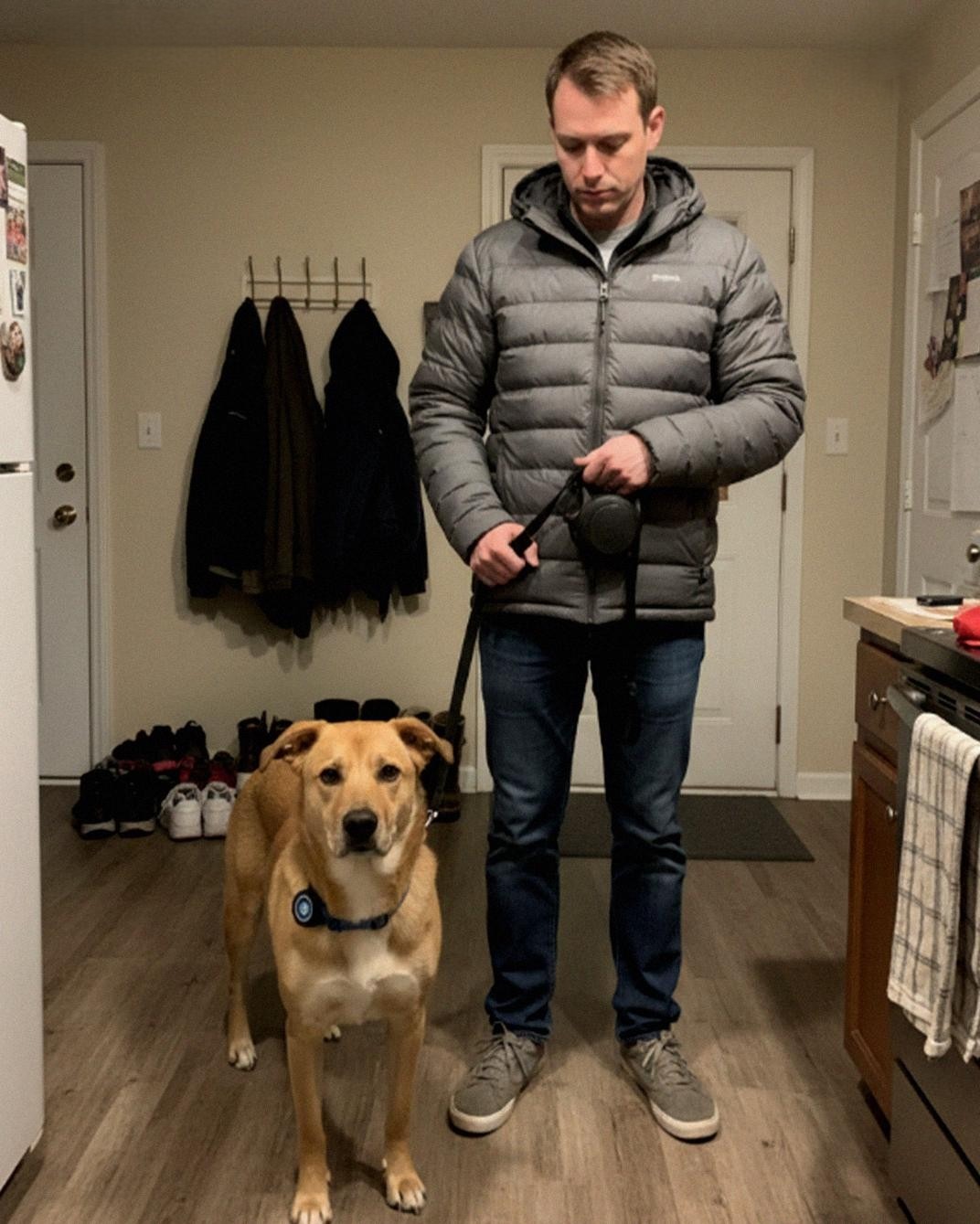
My Husband Started Taking Our Dog on 3-Hour Walks Every Night – One Night I Checked the Dogs GPS Collar, and My Stomach Dropped!
Trust is the foundation of any long-term marriage, but even the strongest foundations can be shaken by the unexplained. My husband, James, and I had built a life over nine years that was defined by a comfortable, predictable chaos. We were in the thick of the “young children” years—our seven-year-old daughter was already practicing her teenage eye-rolls, and our five-year-old son lived in a permanent state of pretend, convinced he was a dinosaur. Between half-eaten snacks, endless laundry, and the nightly negotiations over bedtime, I felt like I was managing a small, loud corporation.
When James first started lobbying for a dog, my answer was a firm, repeated “no.” I loved animals, but my plate was already overflowing. I knew how these things went: the kids promised to help, the husband promised to handle the dirty work, and eventually, I’d be the one scrubbing muddy paw prints off the carpet at 11:00 PM. But James was relentless. He promised to take full responsibility for feeding, training, and—most importantly—the walks. When the kids joined the campaign with puppy drawings and persuasive school essays, I finally caved.
We adopted Daisy, a soulful rescue mutt with floppy ears and a tail that could clear a coffee table in one wag. To my surprise, James kept his word. He became the primary caretaker, transforming the nightly walks into a rigid, almost sacred routine. “See?” he’d say with a triumphant grin as he clipped on her leash. “Told you I’d handle it.”
For several months, our new life with Daisy was harmonious. Then, a scare changed everything. During a routine walk, Daisy slipped her collar and bolted into the darkness. We spent two frantic hours scouring the neighborhood with flashlights, our children sobbing on the porch. When we finally found her shivering under a porch three streets over, James seemed to have driven us straight to the spot by sheer intuition. “Just a lucky guess,” he muttered at the time, but the look in his eyes was haunting. He seemed more than just worried; he seemed desperate.
Determined never to feel that helplessness again, I secretly ordered a high-tech GPS tracker for Daisy’s collar. I didn’t tell James, mostly because I didn’t want to admit how paranoid the incident had made me. But as the weeks went by, it wasn’t Daisy’s behavior that became concerning—it was my husband’s.
The walks, which used to take thirty minutes, began to stretch into marathons. One hour turned into two, then three. James wouldn’t return until close to midnight, his shoes caked in mud and his expression distant. When I questioned him, he’d simply shrug and say, “She has a lot of energy, Nora. It helps me clear my head.”
Clearing one’s head is one thing, but disappearing for three hours every Tuesday, Thursday, and Saturday night is another. The children stopped asking where he was; they just accepted that Daddy was out with the dog. But a cold knot of suspicion began to tighten in my stomach. In the quiet hours of the night, my mind wandered to the darkest clichés of marriage: the hidden phone, the secret apartment, the “other” woman.
One Tuesday night, the house was unnaturally still. I woke up at 1:00 AM to find James’s side of the bed cold. He hadn’t just gone for a walk; he had vanished into the early morning hours. Heart pounding, I grabbed my phone and opened the GPS app. The red dot didn’t blink at the local park or the usual walking trails. It was across town, idling at a specific residential address—the very same street where we had found Daisy months ago.
The betrayal felt like a physical weight in my chest. I threw on a jacket, grabbed my keys, and drove through the silent, amber-lit streets. I prepared myself for the worst: I expected to see James’s car parked outside a stranger’s home, a confirmation of the affair I was now certain he was having. When I arrived at the small, weathered cottage, my hands were shaking so hard I could barely hold the steering wheel.
I called his cell phone. Through the thin walls of the cottage, I heard it ringing. He answered, his voice breathless and calm. “Hey, babe. Just circling the block near home. We’ll be back soon.”
The lie was the final blow. I was standing ten feet from where he was, and he was telling me he was in our neighborhood. I pushed open the front door, which was unlocked, and stepped into a dimly lit hallway. “James?” I called out, my voice cracking.
He froze in the hallway, looking like he’d seen a ghost. Daisy was by his side, tail wagging in greeting. “Nora? What are you doing here?” he gasped, his face draining of color.
“I could ask you the same thing,” I replied, my eyes darting toward the back of the house. Before he could respond, a soft, elderly voice drifted from a nearby room. I pushed past him, bracing for a confrontation with a mistress, but what I saw stopped the breath in my lungs.
An elderly woman sat in a rocking chair, and a toddler played with blocks on the floor. The room smelled of lavender and old paper. The woman, Carla, looked at me with a mixture of kindness and confusion. “You must be the wife,” she said softly.
James stepped into the room behind me, his shoulders slumped in defeat. “I’m sorry, Nora. I was going to tell you, eventually.”
The truth was far from the sordid affair I had imagined. A few months ago, James had been involved in a near-fatal accident. He had stepped into the street while distracted by a phone call, and Carla—a stranger passing by—had lunged forward and shoved him out of the path of a speeding car. James walked away unhurt, but the impact had sent Carla to the pavement, exacerbating an old hip injury. In the aftermath, James learned that Carla lived alone, raising her three-year-old grandson, Oliver, after his parents were killed in a car crash.
“I couldn’t just leave her,” James explained, his voice thick with emotion. “She saved my life. But you were recovering from heart surgery at the time, and I didn’t want to tell you I’d almost been killed. I didn’t want to add to your stress.”
He had adopted Daisy as a cover—a reason to be out of the house for hours so he could come here to cook meals, clean the house, and play with Oliver. He had been quietly paying back a debt of life that he felt he could never truly settle. Daisy hadn’t “run away” to this street by accident; she had escaped his car during one of his visits, and James had known exactly where to find her because she had become a regular guest at the cottage.
The relief that washed over me was so intense it felt like grief. I realized then that my husband wasn’t a liar in the way I feared; he was a man so burdened by gratitude and protection for his family that he had carried the weight of a secret life alone.
“I thought you were leaving us,” I whispered, burying my face in his chest.
“Never,” he promised, holding me tight.
The following week, the secret ended, and a new chapter began. The “three-hour walks” became family outings. We brought groceries, I helped Carla with her physical therapy exercises, and our children became the siblings Oliver never had. We realized that sometimes, the things we fear most in our relationships are actually the most beautiful parts of the people we love, hidden under a layer of misguided protection. Daisy still leads the way every time we visit, knowing that this house isn’t just a destination—it’s the place where our family became whole again.