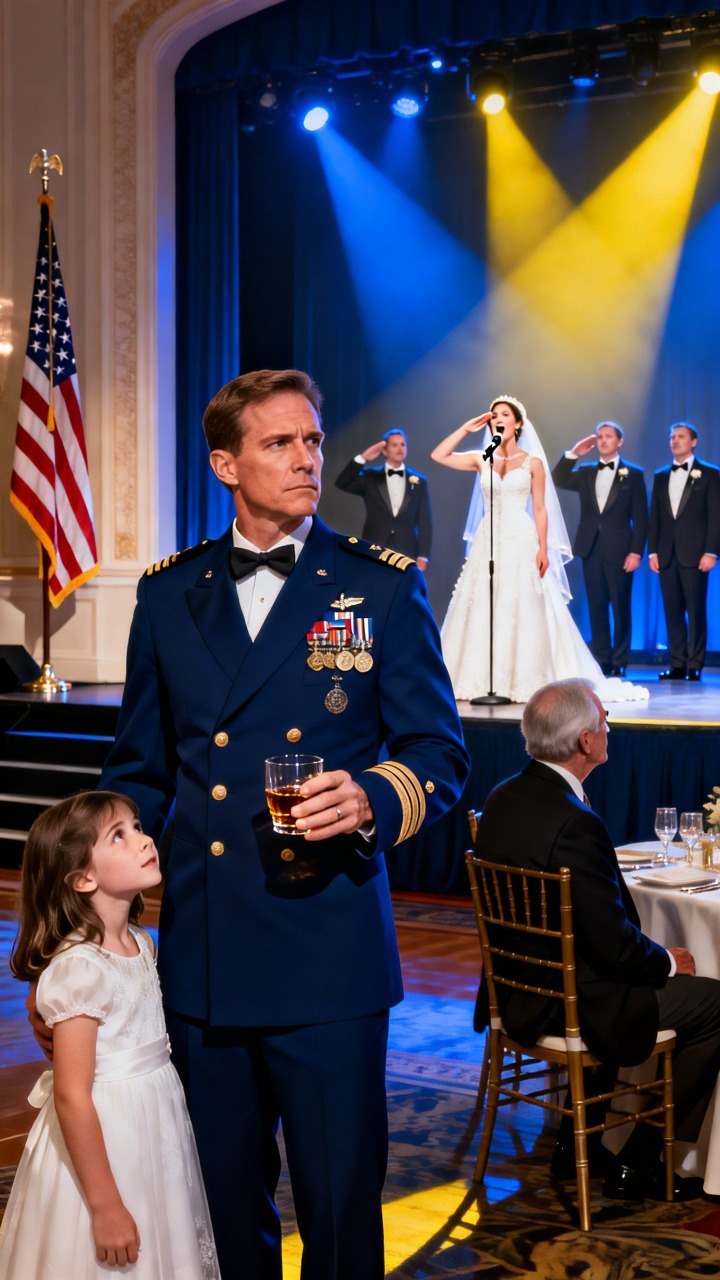
Please raise your glasses to the man who paid for this wedding, Major General Davis
The Grand Ballroom of the Pierre Hotel was a masterclass in performative wealth. It smelled of imported white lilies, roasted duck, and the sharp, metallic tang of desperation—a scent I had encountered in war zones and destabilized capitals, but rarely on Fifth Avenue.
I stood in the shadow of a massive marble pillar, nursing a glass of sparkling water. My back was to the wall, a survival habit forged over twenty years of ensuring no one could approach me unseen. My suit was a charcoal gray bespoke piece from Savile Row, but I had ordered it devoid of labels or flair. To the untrained eye, I was a boring accountant or perhaps an overqualified security guard. This was intentional. In my world, being memorable was a liability; in this room, it was an invitation for mockery.
In the center of the ballroom, beneath a crystal chandelier the size of a mid-sized sedan, my father, Robert Davis, was performing his favorite role: the Titan of Industry. At sixty-five, he laughed too loudly and gestured too grandly, radiating the confidence of a man who owned the world. He didn’t know that three months ago, the bank had initiated foreclosure on his ancestral estate. He didn’t know his shipping logistics company was a hollow shell, bled dry by arrogance and insolvency. And he certainly didn’t know that the $2.4 million wire transfer that had halted the sheriff’s sale just seventy-two hours before the gavel fell had come from a shell company called Vanguard Holdings—my company.
Robert walked past my pillar, his eyes sliding over me as if I were a smudge on the expensive silk wallpaper. Then, the recognition hit him, followed quickly by his habitual contempt. He stepped out of his circle of admirers and leaned in close.
“Try not to eat too much, Thomas,” he whispered, his smile fixed for the benefit of the room. “We’re paying per head, and frankly, you’re not worth the plate.”
I looked at him, noticing the broken capillaries in his nose and the flickering fear behind his eyes. He was a man drowning who thought he was waving. “Good evening, Robert,” I said, my voice as neutral as a dial tone.
“Don’t call me that here,” he hissed. “You’re a guest by Michael’s pity alone. If it were up to me, you’d still be in whatever gutter you crawled into after you ran away to play soldier.”
I didn’t blink. I didn’t defend myself. I simply watched him walk away, knowing that I owned the plate, the wine, the roof, and the very air he was breathing. I was here for Michael, my younger brother. He was ten when I was thrown out at eighteen for refusing to join the family business and enlisting in the Army instead. To Robert, service was for the desperate; for a Davis to enlist was a social suicide. But Michael had kept the bridge open through secret emails, and today he was marrying Sophia—a woman with steel in her spine and eyes that saw through the Davis facade.
As the wedding photographer gathered the family for the official portrait, Michael spotted me and waved enthusiastically. I hesitated, feeling like a ghost they hadn’t quite managed to exorcise, but I stepped forward for my brother. I didn’t get far. My Aunt Linda, a woman who measured human soul in stock options, intercepted me with the speed of a viper in silk. She placed a hand on my chest—not to guide me, but to shove.
“Step aside, Thomas,” she chirped, her laughter brittle. “We’re taking the family portrait. We only want the successful people in the shot. It’s for posterity. We don’t need a reminder of… well, your choices.”
Michael tried to protest, his face flushing with anger. “Aunt Linda, stop. He’s my brother.”
“He’s a grunt, Michael,” Robert cut in, speaking to the air as if I were a bad smell. “He chose to carry a rifle instead of a briefcase. Let him stand in the back where he belongs.”
I caught Michael’s eye and gave a subtle shake of my head. Don’t ruin your night. I retreated back into the shadows of the pillar. I watched the flash-bulb pop, capturing the Great Davis Lie: wealthy, united, and perfect. I felt no hurt—you cannot be hurt by people you do not respect. I simply continued my Intelligence Preparation of the Battlefield, analyzing the enemy’s collapsing supply lines and delusions of grandeur.
As the speeches began, Sophia, the bride, marched toward the stage. She didn’t look like a woman at a party; she looked like a commander entering a briefing room. She stopped in front of me, her appraising gaze cool and sharp.
“Are you leaving?” she asked quietly.
“It’s best,” I replied. “I don’t want to cause a scene.”
“You aren’t the one causing scenes,” she said, a dangerous glint in her eyes. “Stay. Please.”
She ascended the stage and tapped the microphone. The feedback whine silenced the room. Robert leaned back, swirling his scotch and whispering to Linda, “Wait until she thanks us for the venue. I told everyone I pulled strings to get this date.”
On stage, Sophia took a breath that seemed to fill the room. “I want to thank you all for being here,” she began. “But there is a lot of deception in weddings. We pretend things are perfect. We pretend we have resources we don’t. We pretend we did things we didn’t.”
The clinking of silverware stopped. Robert’s smile faltered.
“I come from a military family,” Sophia continued, her voice sharpening. “My grandfather taught me that stolen valor is a sin. He taught me that claiming credit for another soldier’s work is the lowest form of cowardice. And he taught me that the loudest man in the room is usually the weakest.”
I reached for the brass handle of the exit. My instincts, honed by years as the “Gray Man” in the highest corridors of the Pentagon, were screaming at me to vanish. I commanded thousands of troops and managed budgets larger than small nations; I didn’t want this spotlight.
“I believe in honor,” Sophia said, her voice rising to fill every corner of the ballroom. “And I believe credit should go where it is due. Thomas, don’t move.”
The room turned as one. They saw the solitary man in the plain gray suit by the door. Robert stood halfway up, his face reddening. “Sophia? What is this? That’s just Thomas. Ignore him.”
“Please raise your glasses,” Sophia announced, her voice ringing like a bell, “to the man who paid for this wedding. The man who saved the Davis estate from bankruptcy three months ago. And the highest-ranking officer this city has ever produced.”
She held the salute, her eyes locked on mine.
“Major General Thomas Davis.”
The gasp was a physical wave. Robert choked on his scotch, the liquid spraying across his shirt. “Major… General?” he sputtered. “He’s a grunt! He washes trucks!”
“He commands the 10th Mountain Division, Robert,” a guest at a nearby table—Judge Harrison—whispered in a voice trembling with awe. “That’s two stars. He answers to the President. Good God, man, do you have any idea who you’ve been talking to?”
I let go of the door handle and stood straight. I didn’t need to say a word. The silence of the room was my victory. Robert looked at me, then at the ballroom I had bought for him, and for the first time in my life, he looked exactly as he was: small.