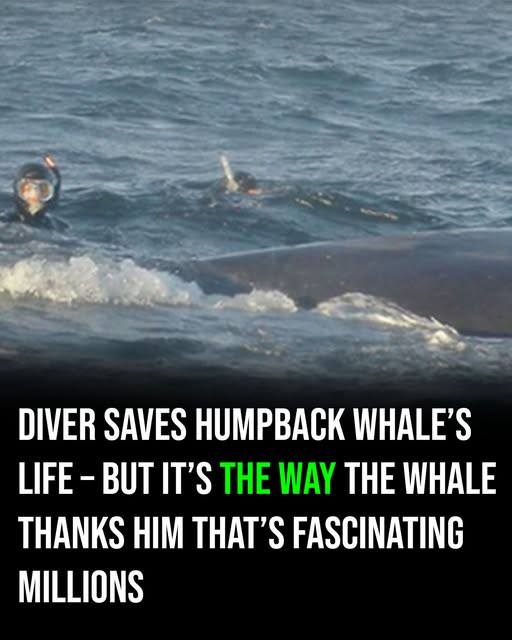
After a Diver Saves a Whale, the Incredible Reaction Goes Viral
Thirty miles off the jagged coastline of San Francisco lie the Farallon Islands—a place mariners call the “Devil’s Teeth.” To a casual observer, the islands are a hauntingly beautiful tableau of mist-shrouded rocks and sun-dappled waves. But for those who navigate these waters, the beauty is a secondary concern. The Pacific here is cold, dark, and notoriously unpredictable, governed by tides that can humble the most seasoned captain.
It was against this unforgiving backdrop, on a seemingly routine September morning, that the ocean staged a life-or-death drama that would test the limits of human courage and interspecies connection.
James Moskito, a veteran marine conservationist, began his day with the rhythmic discipline of his trade: scanning the horizon for signs of human impact on the islands’ vibrant ecosystem. The Farallons are a sanctuary for hundreds of species, from migrating gray whales to elusive orcas. For Moskito and his team, the mission is simple in theory but perilous in practice: monitor, document, and—when necessary—intervene.

A Gaze of Distress
The day’s rhythm shattered when Moskito spotted an anomaly near a slight swell to the east. A dark, rounded shape hovered at the surface. While most cetaceans maintain a cautious distance from vessels, this creature was stationary. As the team’s boat drew closer, Moskito locked eyes with a massive humpback whale. One eye remained fixed above the waterline, watching him with a deliberate, haunting intensity.
Moskito didn’t see curiosity; he saw exhaustion. He knew the signs of a creature that had reached the end of its strength.
The reality was grimmer than they had imagined. A 30-ton humpback was effectively anchored to the seafloor. A massive iron anchor, weighing nearly 3,000 pounds, had become ensnared in its tail flukes. Worse, nearly a mile of heavy-gauge chain was wrapped in tight, constricting loops around the animal’s peduncle, cutting into the soft tissue and dragging the whale back into the depths every time it struggled to surface for air.
The Frigid Intervention
The physics of the situation were catastrophic. To approach a panicked animal of that scale is to invite disaster; a single flick of a tail, even an entangled one, can splinter a boat or kill a diver instantly. Yet, as the team conducted a rapid risk assessment, Moskito realized that hesitation was a death sentence for the whale.
He suited up as the Pacific hovered at a bone-chilling 50 degrees Fahrenheit. The currents were shifting, tossing their small craft like a cork. Moskito entered the water with measured, deliberate strokes, avoiding any sudden splashes that might signal aggression.
As he descended, the scale of the “prison” became clear. The anchor’s flukes had dug deep into the whale’s flesh, and the chain had created a complex web of tension points. But as Moskito moved closer, the whale remained eerily still. Its eye followed his every movement. In that frigid silence, an unspoken pact was formed—a profound, silent acknowledgment of intent.

Steel Against Bone
The rescue was a grueling, multi-hour marathon of precision. Armed with specialized heavy-duty cutters designed to slice through steel while protecting the animal’s skin, Moskito and his team began the work of liberation.
The process was agonizingly slow. Every cut of the heavy chain had to be calculated to avoid a “snap-back” effect from the tension. Hours passed. Moskito alternated between the depths and the surface, his muscles cramping in the cold, his breath coming in ragged gasps. Throughout the ordeal, the whale was a “cooperative patient.” It surfaced when it needed to breathe but never thrashed, maintaining a surreal stillness that witnesses later described as a fragile balance of trust.
At one point, a particularly stubborn segment of twisted chain groaned under the pressure of the cutters. Moskito worked the tool into position, his lungs burning. With a final, metallic snap, the tension gave way. The 3,000-pound anchor, once a lethal tether, finally slid away, disappearing into the dark abyss of the Pacific.
The Final Acknowledgment
The whale was unbound, but it did not immediately flee. In a moment that transcended scientific explanation, the massive humpback circled back. It brushed gently against Moskito’s body—a 30-ton “thank you” delivered in the cold San Francisco mist.
There were no dramatic displays, no breaches—only a quiet, profound connection that lingered long after the mist cleared. With a gentle flick of its now-free tail, the humpback descended into the depths, leaving a team of exhausted humans standing on a small boat, forever changed by a silent gaze in the Devil’s Teeth.
The ripples from the rescue near the Farallon Islands extended far beyond the immediate spray of the Pacific. In the weeks following the event, local news bureaus broadcasted the details of the operation, framing it as a masterclass in maritime skill, physical danger, and raw compassion. Viral footage and high-resolution photography soon flooded social media, providing a visceral sense of the humpback’s staggering 30-ton scale and the Herculean human effort required to unshackle it.
Yet, as a journalist who has covered the intersection of human activity and the natural world for a decade, I’ve found that the story’s true power didn’t lie in its cinematic drama. Instead, it resonated because of its profound intimacy. It laid bare the sophisticated intelligence of marine life, the invasive reach of industrial debris, and the quiet, almost invisible heroism of those who meet fear with empathy.
A Critical Intervention in a Vulnerable Corridor
The scientific community was quick to contextualize the event. Dr. Emily Harding, a marine biologist specializing in the Farallon ecosystem, emphasized that the operation’s success hinged on psychological nuance as much as physical strength. “What makes this rescue extraordinary is the understanding that James and his team demonstrated,” Harding noted. “Approaching a distressed whale is inherently high-risk. The patience and care they exhibited were the true factors that ensured the animal’s survival.”
Unfortunately, this humpback’s plight was not a statistical anomaly. The incident shines a harsh light on the “ghost gear” crisis—abandoned fishing equipment and lost maritime anchors that act as lethal traps for marine mammals. Humpback whales are particularly at risk, given their migration routes often overlap with high-density shipping lanes.
For these creatures, entanglement is a slow-motion catastrophe. It limits mobility, prevents feeding, and leaves them defenseless against predators and infection. In this landscape of environmental hazards, every successful rescue is more than a humanitarian gesture; it is a vital defensive action for the survival of the species.

The Philosophy of the Rescue
For James Moskito, the experience was a collision of professional duty and personal revelation. Reflecting on the encounter in subsequent interviews, his tone was one of profound humility. “Being in the water with that whale, seeing its exhaustion, feeling its trust—it was humbling,” he remarked. “You realize that courage isn’t about force. It’s about entering the unknown calmly, listening, and choosing empathy over fear.”
This ethos has since become a cornerstone for conservation training worldwide. The Farallon rescue is now used as a case study, demonstrating the mental resilience and specialized knowledge of animal behavior required for extreme-environment operations. It underscores a philosophical pivot in conservation: that in life-or-death stakes, patience and respect are as formidable as any mechanical tool.
Recovery and the Path Forward
The post-script to the rescue offered the best possible news. In the ensuing days, scientists utilized visual confirmation and tracking data to monitor the whale’s trajectory. The reports were unanimous: the animal had successfully returned to its normal migration patterns and was feeding in safer waters. Photographs captured by local observers documented a healthy dorsal fin and flukes—scars remained, but the resilience of the species was on full display.
“We were exhausted—physically, mentally, and emotionally,” Moskito recalled of the team’s return to shore. “But there was a sense of something deeper—an acknowledgment that the work matters in a tangible way. That whale’s life was saved, and in those moments, everything else fades.”
Today, the “Farallon Whale” has moved from the headlines into the curriculum. Environmental organizations and schools share the narrative to foster a sense of individual responsibility and empathy for the ocean’s inhabitants. The islands themselves, though remote, have become a microcosm of the global challenge: a fragile ecosystem under the constant pressure of human impact, requiring a new generation of dedicated stewards.
Ultimately, the story of James Moskito and the humpback whale is a testament to the power of deliberate, patient action. It serves as a reminder that bravery doesn’t always roar; sometimes, it is a quiet, steady hand in cold water, proving that one person’s resolve can change the course of a life—even one that weighs thirty tons—forever.