I Adopted Four Siblings Who Were Going to Be Split Up – a Year Later, a Stranger Showed Up and Revealed the Truth About Their Biological Parents
The silence in my house used to be a physical weight. It had been two years since the screech of tires and a doctor’s hollow apology in a hospital hallway ended the world I knew. My wife, Lauren, and our six-year-old son, Caleb, were gone, taken by a drunk driver in an instant. For a long time, I existed in the wreckage. I stopped sleeping in our bedroom, opting for the couch where the hum of the television could drown out the sound of my own breathing. I went to work, I ate takeout, and I stared at the wall. People told me I was strong, but I wasn’t. I was just a ghost haunting my own life.
Then came the night that changed everything. It was 2:00 a.m., and I was doing the usual aimless scroll through social media when a local news share caught my eye. It was a photo of four children sitting on a wooden bench, huddled so close they looked like a single unit. The caption was a desperate plea from the child welfare system. Four siblings—Owen, nine; Tessa, seven; Cole, five; and Ruby, three—needed a home. Their parents were dead, and no extended family could take them. Because of their number, the system was preparing to do the unthinkable: split them up.
The phrase “likely be separated” hit me with the force of a physical blow. I looked at the photo again. Owen had a protective arm around Tessa; Ruby was clutching a worn teddy bear, leaning into Cole. They didn’t look like they were waiting for a miracle; they looked like they were bracing for an impact. I read the comments—hundreds of “praying for them” and “so heartbreaking,” but not a single person offering to take all four.
I couldn’t sleep. Every time I closed my eyes, I thought about those kids being led into different cars, going to different houses, losing the only thing they had left in the world: each other. By morning, my decision was made. I called the agency.
The caseworker, Karen, was skeptical when I walked into her office. I was a single man, a widower still wearing the shadow of grief. But I told her plainly, “They’ve already lost their parents. They shouldn’t have to lose each other, too. If the only reason they’re being separated is that nobody wants four kids, then I want them.”
The process was grueling. There were background checks, home visits, and sessions with a therapist who asked how I was handling my grief. I told her the truth: I was handling it badly, but I was still standing, and I had a house that was far too quiet for one person.
The first meeting was in a sterile visitation room. The children sat on a couch, a wall of suspicion and fear. Ruby hid her face; Cole stared at my shoes; Tessa looked at me with pure defiance. Owen, however, watched me with the eyes of someone much older than nine. He asked the only question that mattered: “Are you the man who’s taking us?”
“If you want me to be,” I replied.
“All of us?” Tessa whispered.
“All of you,” I said firmly. “I’m not interested in just one.”
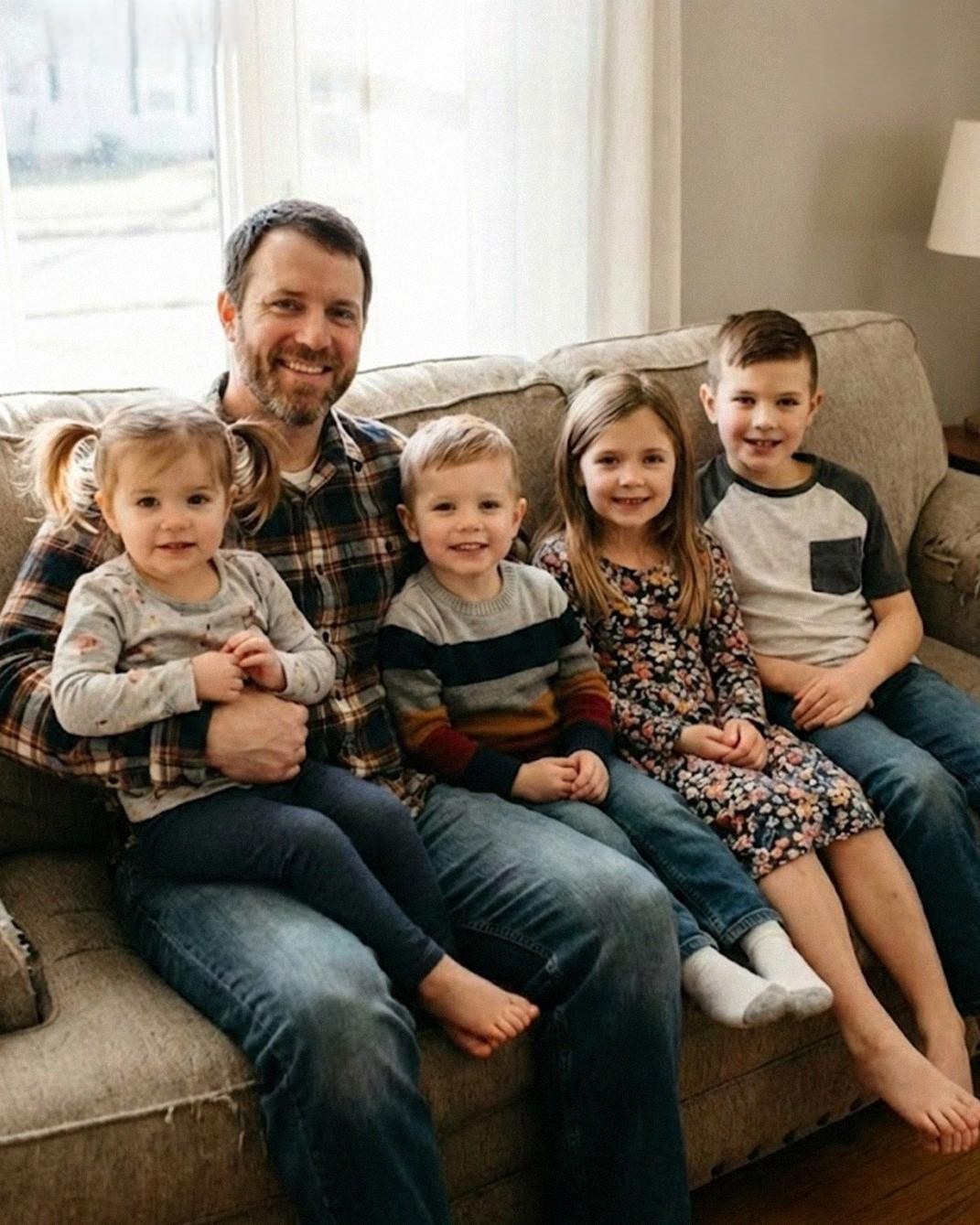
When they finally moved in, the silence I had lived in for two years was shattered. My house became a chaotic symphony of slamming doors, spilled juice, and the thunder of footsteps. It wasn’t easy. Ruby cried for her mother in the middle of the night, and I would sit on the floor by her bed until dawn. Cole threw tantrums, shouting that I wasn’t his real dad. Tessa hovered like a sentry, guarding her siblings, waiting for me to fail or give up. Owen tried to carry the weight of the world on his small shoulders until he eventually collapsed into tears, finally allowing himself to be a child.
Slowly, the friction began to smooth into a rhythm. We burned pancakes together. I learned how to braid hair and step over Legos without swearing. The backpacks by the door and the muddy sneakers in the hallway became the new landmarks of my life. I wasn’t replacing Lauren and Caleb, but I was honoring them by giving these children the family they were about to lose.
A year after the adoption was finalized, a woman named Susan arrived at my door. She was an attorney representing the children’s biological parents. She sat at my kitchen table, pushing aside a stray crayon to lay out a folder of documents. She explained that before their deaths, the parents had prepared a will. They weren’t wealthy, but they were diligent. They had placed their small home and a modest savings account into a trust for the children.
“You are the legal guardian and trustee,” Susan explained. “The assets are for their future. But there is a specific clause I thought you should see.”
She pointed to a paragraph written in the parents’ own words. It stated, with heartbreaking clarity, that their children were never to be separated. They had anticipated the failures of the system and had pleaded, from beyond the grave, for someone to keep their family together.
As I read the words, my eyes blurred. While the state was preparing to parcel these children out like unclaimed property, their parents had been fighting for them. I had fulfilled a dying wish I didn’t even know existed.
That weekend, I drove the kids to the address Susan had given me. It was a small, beige bungalow on the other side of town. As we pulled into the driveway, the car went silent.
“I know this house,” Tessa whispered.
“The swing!” Ruby shrieked, pointing to the backyard.
I unlocked the door, and they flooded inside. It was empty of furniture, but full of ghosts. Cole found the wall where their heights were marked in faint pencil. Owen stood in the kitchen, touching the countertop where his father used to make breakfast. They moved through the rooms with a sense of belonging that was both beautiful and devastating to witness.
Owen eventually came back to me, looking up with that same serious expression he’d had the day we met. “Why are we here?”
I knelt so I was at eye level with him. “Because your mom and dad loved you very much. They saved this house for you. And they wrote down that they wanted you to stay together, no matter what. I didn’t know that when I found you, but they did.”
“Do we have to live here now?” he asked, a hint of anxiety in his voice. “I like our house. With you.”
“No,” I promised him. “We’re staying where we are. This is for your future. But it’s proof that you were always supposed to be a team.”
Ruby climbed into my lap, and Cole started asking about ice cream. The heavy, somber moment broke into the usual chatter of a family of five. As we left the little bungalow and headed back to the car, I realized that my life hadn’t just changed direction—it had been saved.
I am not their first father, and I will never try to erase the man who came before me. But I am the man who saw a photograph at 2:00 a.m. and refused to let the world break them apart. I lost my family once, and in the wreckage of that loss, I found a way to keep another one whole. Every night, when I hear the house full of life and the kids calling out “Goodnight, Dad,” I know that we were all exactly where we were meant to be. Together.