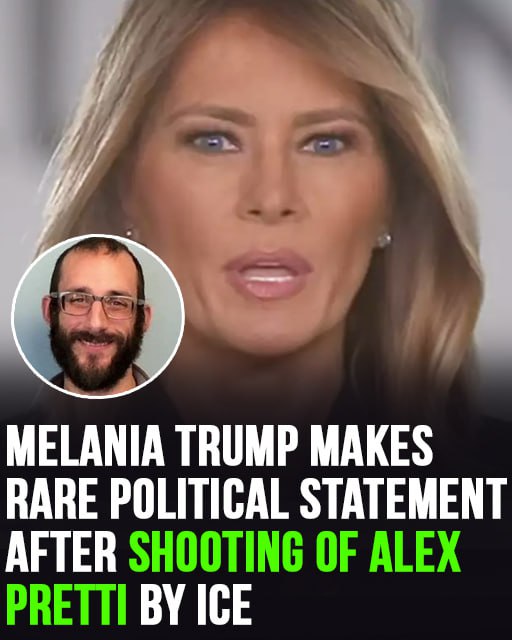
Melania Trump breaks silence on Alex Pretti shooting with rare plea to the US
Melania Trump rarely steps into the center of national political controversy, but the fatal shooting of Alex Pretti forced an unusually public response. In the aftermath of a deadly encounter involving federal agents in Minnesota, the former First Lady broke her silence with a message that emphasized unity, restraint, and peace at a moment when public anger and mistrust were rapidly escalating.
Pretti, a 37-year-old intensive care nurse and military veteran, was killed during an encounter with agents from U.S. Immigration and Customs Enforcement and U.S. Border Patrol on Saturday, January 7. According to early official statements, the shooting was framed as a response to an imminent threat. Those claims, however, began to unravel almost immediately as video footage surfaced online.
Multiple recordings from bystanders appeared to contradict the Department of Homeland Security’s initial account. In the videos, Pretti’s firearm remains holstered throughout the confrontation. Reports indicate he was legally carrying the weapon under a valid permit and that it was only removed after agents restrained and disarmed him. Moments later, he was shot. The footage spread rapidly, igniting public outrage and raising serious questions about the use of force and the accuracy of official statements.
The incident came less than a month after another fatal encounter involving federal agents, the killing of Renee Good, which had already left the public on edge. Together, the two cases intensified scrutiny of federal law enforcement practices and sharpened concerns about accountability, transparency, and political rhetoric surrounding these deaths.
As criticism mounted, several prominent figures aligned with the Trump administration took an aggressive tone. White House adviser Stephen Miller publicly labeled Pretti a “domestic terrorist,” a description echoed by Gregory Bovino. The language drew immediate backlash, with critics arguing it appeared designed to justify lethal force rather than clarify the facts.
Public reaction was swift and intense. Protests erupted across Minnesota, particularly in Minneapolis, where demonstrators accused federal authorities of excessive force and deliberate misinformation. Calls for independent investigations grew louder, and civil rights organizations demanded transparency regarding the chain of events that led to Pretti’s death.
As the unrest continued, the White House adjusted its tone. Press Secretary Karoline Leavitt referred to the shooting as a “tragedy,” marking a noticeable shift from earlier statements that implied Pretti was responsible for his own death. Donald Trump also stated that his administration would formally review the incident, a move seen by some as an attempt to ease mounting political pressure.
It was against this backdrop that Melania Trump addressed the situation during an appearance on Fox & Friends. Her decision to speak publicly was notable, given her long-standing reluctance to engage directly with politically charged crises. Rather than focusing on the details of the shooting or assigning blame, she centered her remarks on de-escalation.
“We need to unify. I’m calling for unity,” she said, emphasizing that communication was underway between federal authorities and local leaders. She referenced her husband’s conversations with Minnesota’s governor and mayor, stressing cooperation aimed at preventing further unrest. Her message culminated in a clear appeal: opposition to violence in all forms and a call for peaceful protest.
The remarks were widely interpreted as an effort to lower the temperature at a moment when tensions were threatening to spiral further out of control. Supporters viewed her statement as a calming presence, while critics argued that calls for unity rang hollow without a full acknowledgment of responsibility or accountability.
At the same time, the federal response intensified. President Trump announced the deployment of his so-called “border tsar,” Tom Homan, to Minnesota. Homan was tasked with overseeing a federal initiative labeled Operation Metro Surge and reporting directly to the president. Supporters claimed the move would restore order and reinforce law enforcement authority. Opponents warned it risked escalating tensions and deepening divisions between federal agencies and local communities.
The strongest rebuke of the administration’s narrative came from Pretti’s family. In an emotional public statement, they rejected claims that he posed a threat and condemned what they described as deliberate falsehoods spread after his death. They portrayed Alex as someone driven by a desire to help others, both through his work in intensive care and his military service.
“Alex wanted to make a difference in this world,” the family said. “His last thought and act was to protect a woman.” They accused federal officials of smearing his name to justify his killing, pointing to video evidence that showed him holding a phone in one hand while raising the other in an apparent attempt to shield a woman who had been pushed to the ground. According to the family, he was pepper-sprayed and shot while unarmed and compliant.
Their statement added emotional weight to a case already fraught with controversy and grief. For many observers, it underscored the human cost behind political talking points and sharpened demands for an independent investigation.
As inquiries continue and protests persist, Melania Trump’s call for unity sits uneasily within a deeply polarized national climate. To some, her words represent a rare attempt to cool tempers without inflaming partisan divides. To others, they highlight the gap between rhetoric and action in a moment that demands accountability as much as calm.
The case of Alex Pretti has become more than a single incident. It is now a symbol in a broader national reckoning over law enforcement authority, political language, and the erosion of public trust. Whether unity is achievable under these conditions remains uncertain. What is clear is that the questions raised by his death will not fade quickly, and the outcome of ongoing investigations may shape the next chapter in an already volatile debate about justice, power, and responsibility in America.