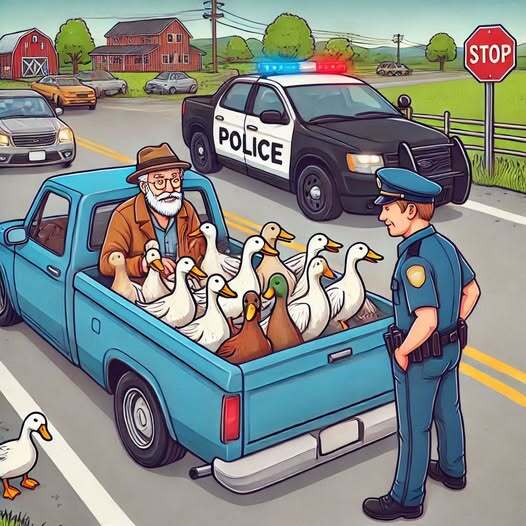
A policeman pulls over an old man driving a pickup truck!
The following collection of narratives explores the lighthearted and often ironic nature of human interactions, focusing on those moments where authority meets the unexpected with humorous results. Through the lens of these two distinct encounters, we see how misunderstandings and hidden truths can transform a standard police stop into a lasting local legend.
In a quiet, sun-drenched downtown district, where the pace of life usually moved with the rhythm of a slow-turning clock, Officer Miller prided himself on maintaining an orderly beat. He believed he had seen every possible iteration of traffic violation, from the mundane to the bizarre. However, nothing in his training manual had prepared him for the sight of a weathered, vintage pickup truck cruising down the boulevard with a cargo bed overflowing with dozens of white ducks. The ducks weren’t crated or restrained; they were simply standing in the back, shifting their weight as the truck turned and occasionally letting out a chorus of enthusiastic quacks that echoed off the storefront windows.
Miller signaled the driver to pull over. The truck came to a rattling halt, and an elderly gentleman with a shock of white hair and a mischievous twinkle in his eye leaned out the window. Miller, trying to maintain a professional demeanor despite the absurd audience peering at him from the truck bed, cleared his throat. He informed the driver that a bustling downtown was no place for a mobile poultry farm and that the presence of the flock was creating a significant distraction for other motorists. With a firm but fair tone, the officer gave a direct order: “Sir, you need to take these ducks to the zoo immediately. They belong in a proper habitat, not in traffic.” The old man nodded solemnly, promised to comply, and tipped his hat before pulling away.
Satisfied that the situation had been handled, Officer Miller returned to his patrol. Yet, the following afternoon, his jaw dropped when he saw the same familiar truck rolling down the very same street. The ducks were all still there, packed tightly into the bed, but Miller had to rub his eyes to believe what he was seeing. Every single duck in the flock was wearing a tiny, perfectly fitted pair of dark sunglasses.
Incensed by what he perceived as blatant defiance, Miller flipped on his lights and sirens. He marched up to the driver’s side and exclaimed, “I thought I told you yesterday to take these ducks to the zoo!” The old man beamed at the officer with a look of pure contentment. “I did, Officer! We had a marvelous time yesterday at the zoo. The little rascals enjoyed it so much that today, I decided to take them to the beach!” In that moment, the officer realized that the old man’s interpretation of “taking them to the zoo” had been a matter of recreation rather than relocation, turning a stern directive into a permanent vacation for a very lucky flock of waterfowl.
While the story of the ducks became a favorite at the local precinct, another tale of a police stop in a neighboring small town carried a much sharper edge of irony. This town was the kind of place where everyone knew everyone else’s business, but Officer Higgins was a relatively new recruit, eager to prove his commitment to the letter of the law. He had staked out a prime spot on Main Street, determined to catch any motorist bold enough to exceed the modest speed limit.
His opportunity arrived in the form of a sedan zipping past him at a clip that was clearly inappropriate for the residential stretch. Higgins gave chase and pulled the car over. The driver, a young man dressed in a sharp, somewhat rumpled tuxedo, looked frantic. As Higgins approached the window, the man began to speak. “But Officer, I can explain—”
Higgins, who had decided that morning to adopt a “no-nonsense” persona, snapped back, “Just save it. I’ve heard every excuse in the book.” The man tried again, his voice rising in desperation. “Please, it’s really important. I just wanted to say—”