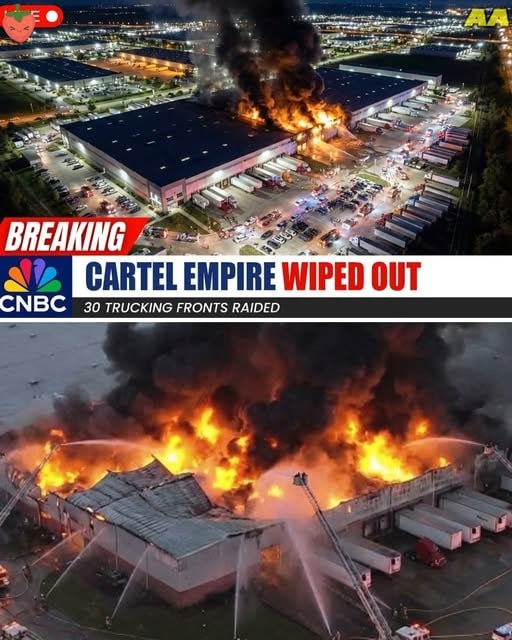
Federal Investigation Exposes Vast Criminal Logistics Network Spanning North America
In the early hours of the morning, a series of coordinated federal actions unfolded across multiple U.S. states, quietly marking one of the most significant law enforcement operations in recent history. While much of the country slept, investigators from multiple federal agencies executed a long-planned operation that would expose an intricate and deeply embedded criminal logistics network operating under the guise of legitimate commerce.
What initially appeared to be routine enforcement activity soon revealed something far more complex: a sophisticated system connecting organized motorcycle groups with international criminal syndicates, functioning not as isolated actors, but as integrated partners in a cross-border supply chain.
Officials say the implications of this discovery may reshape how organized crime is understood and investigated in North America.
A Quiet Neighborhood, an Unexpected Discovery
The investigation first drew public attention following enforcement activity at a residential property in Clovis, California. According to federal authorities, the home belonged to an individual previously known to law enforcement for affiliations with an outlaw motorcycle organization.
What agents uncovered inside was not merely evidence of local criminal activity, but documentation and materials pointing toward a much broader operation—one that stretched far beyond state lines and involved layers of coordination previously underestimated.
Investigators described the find as “pivotal,” providing a missing link in a puzzle that had been forming for years.
A Warehouse That Wasn’t What It Seemed
Thousands of miles away, in the industrial outskirts of the Midwest, federal agencies were already moving on another target: a freight and logistics facility registered as Iron Freight Logistics.
On paper, the business appeared ordinary. It maintained licenses, employed drivers, filed tax documents, and transported commercial goods such as automotive components and industrial materials. To neighboring businesses, it looked no different from countless other warehouses dotting America’s transportation corridors.
But according to investigators, this facility was anything but ordinary.
Behind its legitimate operations, authorities allege, Iron Freight Logistics served as a central coordination point for the movement of illegal goods across the United States and into Canada.
Years of Surveillance and Analysis
Officials emphasize that the operation did not materialize overnight. It was the result of years of surveillance, financial analysis, intercepted communications, and collaboration between multiple federal agencies.
For a long time, investigators believed that outlaw motorcycle groups and international criminal organizations operated separately, occasionally overlapping but largely independent.
That assumption, authorities now say, was incomplete.
“What we found was not a loose association,” one federal official stated. “It was a structured partnership built on logistics, trust, and shared profit.”
The Evolution of Organized Crime
Historically, motorcycle gangs have been associated with regional criminal activity—small-scale trafficking, extortion, and localized violence. International cartels, on the other hand, were believed to rely on their own internal distribution networks.
The investigation revealed a shift.
According to law enforcement analysis, these motorcycle groups had gradually evolved into professional logistics providers. Rather than acting as street-level distributors, they allegedly managed transportation, storage, and routing—services critical to large-scale operations.
“They weren’t just moving goods,” an investigator explained. “They were managing risk, schedules, and supply chains.”
A Network Built on Appearances
One of the most concerning aspects of the case, officials say, is how effectively the operation blended into legitimate commerce.
The logistics company maintained compliance with regulatory agencies, passed inspections, and conducted routine business with reputable firms. Trucks bore legal registration, drivers carried valid credentials, and shipping manifests appeared legitimate.
This level of integration made detection exceptionally difficult.
“Everything looked normal,” said a federal analyst. “That was the point.”
What Authorities Recovered
During enforcement actions, authorities reported the seizure of large quantities of illegal substances, unregistered weapons, and significant amounts of currency. Officials declined to provide precise figures during the early stages of the investigation, citing ongoing legal proceedings.
They did, however, confirm that the scale of the seizure was measured in tons, not smaller units, underscoring the magnitude of the operation.
Additionally, dozens of commercial vehicles were taken into custody, many of which had been structurally modified in ways that raised serious safety and legal concerns.
Not Just Smuggling—Systematic Operations
What set this case apart, officials noted, was not simply the presence of illegal goods, but the organizational sophistication behind their movement.
Investigators described:
-
Coordinated shipping schedules designed to avoid patterns
-
Use of legitimate freight routes to minimize scrutiny
-
Compartmentalized operations where participants knew only their specific roles
-
Financial structures designed to obscure the origins and destinations of funds
In many ways, authorities said, the operation mirrored the efficiency of major commercial delivery services—minus the legality.
The Role of International Criminal Organizations
Federal officials confirmed that multiple international criminal syndicates were linked to the network. While names were referenced in court documents, agencies emphasized that their focus remained on the structural collaboration rather than sensational labels.
“These groups recognized the value of outsourcing logistics,” said a senior official. “They didn’t need to reinvent transportation when a ready-made network already existed.”
A Shift in Legal Classification
Perhaps the most consequential revelation emerged from internal documentation recovered during the operation. According to officials familiar with the matter, the alliance between domestic criminal groups and international syndicates had triggered a significant policy shift.
For the first time, authorities confirmed that certain organized crime entities involved in the network had been designated under a new legal framework typically reserved for foreign threats.
This classification allows expanded investigative tools, enhanced penalties, and broader international cooperation.
“The rules changed,” one official said. “Not overnight, but definitively.”
Why This Matters to the Public
While the investigation may sound distant to everyday life, officials stress its direct relevance to public safety.
Illegal trafficking networks contribute to:
-
Community harm through substance abuse
-
Increased violence tied to organized crime
-
Economic distortion through money laundering
-
Exploitation of legitimate industries and workers
By dismantling the logistical backbone of such operations, authorities believe they have disrupted not just a single network, but a model increasingly used by organized crime.
Economic Implications
The seizure of a functioning logistics brand carries implications beyond criminal justice.
By removing trucks, registrations, and business licenses from circulation, authorities effectively shut down a platform that could not be easily replaced.
“This wasn’t just about stopping shipments,” said an economic crimes expert. “It was about removing infrastructure.”
Rebuilding such a system, officials note, would take years—if it happens at all.
Cooperation Across Borders
The operation also highlighted unprecedented cooperation between U.S. and international partners. Agencies in Canada and Mexico worked alongside American investigators, sharing intelligence and aligning enforcement efforts.
This level of coordination, officials say, reflects the reality of modern organized crime: borderless, adaptive, and deeply embedded in global trade routes.
What Happens Next
As of publication, multiple suspects are in custody, and investigations remain ongoing. Prosecutors are expected to pursue charges related to financial crimes, trafficking, conspiracy, and regulatory violations.
Authorities caution that additional arrests may follow as evidence continues to be analyzed.
“We’re not done,” a spokesperson said. “This is one chapter in a much longer effort.”
A New Era of Enforcement
Experts believe this case may serve as a blueprint for future investigations. Rather than focusing solely on street-level activity, agencies are increasingly targeting the infrastructure that enables large-scale operations.
“The real power isn’t always where people expect it,” said a criminologist familiar with the case. “It’s in logistics, finance, and organization.”
Long-Term Impact on Organized Crime Strategies
Law enforcement analysts believe the exposure of this logistics-based criminal model will have lasting consequences far beyond the immediate arrests and seizures. Organized crime groups, once confident in the invisibility of legitimate-looking freight operations, are now being forced to reassess their strategies.
According to officials familiar with the investigation, transportation and logistics have quietly become one of the most valuable assets in modern criminal enterprises. Unlike street-level operations, logistics networks allow illicit activity to scale rapidly while maintaining distance between leadership and enforcement risks. The dismantling of Iron Freight Logistics demonstrated just how vulnerable these systems can be once identified.
Experts suggest that criminal groups may now attempt to fragment their operations further, relying on smaller, decentralized transport arrangements. However, this approach comes with its own risks, including higher exposure, increased errors, and reduced efficiency.
“This case will change how these networks operate,” said a former federal investigator. “When you take away infrastructure, you take away stability. That’s hard to replace.”
Increased Scrutiny on the Freight Industry
In the aftermath of the operation, federal regulators are also expected to increase oversight of freight and logistics companies nationwide. While officials stress that the vast majority of transportation businesses operate lawfully, the case has highlighted how criminal actors can exploit gaps in monitoring and compliance systems.
Industry leaders have already begun discussions with regulators about enhanced verification processes, improved data sharing, and advanced tracking technologies designed to detect irregular shipping patterns without disrupting legitimate commerce.
“The goal isn’t to burden honest businesses,” one official explained. “It’s to prevent abuse while protecting the integrity of supply chains that millions of people rely on every day.”
A Signal to Future Investigations
Ultimately, authorities say this operation sends a clear message: large-scale criminal activity can no longer rely on blending into ordinary economic systems without consequence. The focus of enforcement is shifting from isolated actors to the structural foundations that support them.
As investigations continue and court proceedings unfold, officials believe the case will be studied for years to come—not just for what it stopped, but for how it reshaped the fight against organized crime.
Conclusion: Disrupting the Invisible Backbone
What began as routine investigative work ultimately revealed a hidden architecture of organized crime—one that relied less on intimidation and more on efficiency, planning, and legitimate appearance.
By dismantling that architecture, authorities believe they have struck a blow not just against one network, but against a growing trend in criminal operations worldwide.
The full impact of this operation may not be felt immediately. But for now, officials say, a critical pipeline has been closed—and the message is clear:
Illicit activity thrives on invisibility. When exposed, it falters.