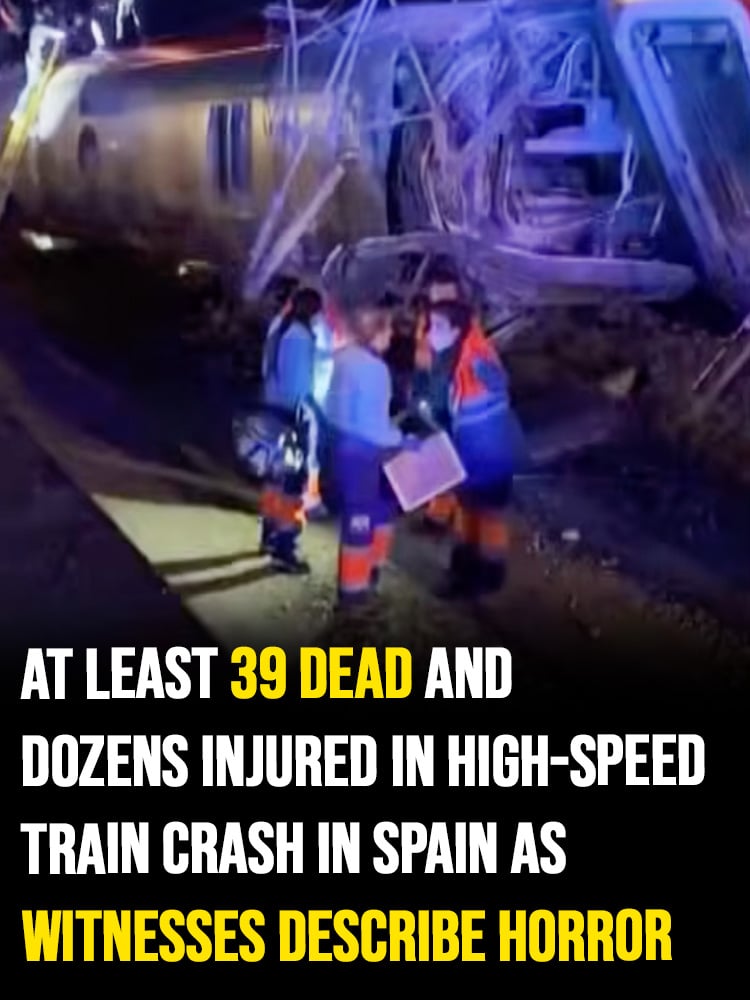
Spain Reels After High-Speed Rail Collision Claims 39 Lives and Injures Scores, Survivors Recall a Night of Fear
What was meant to be an uneventful weekend trip across southern Spain became a moment of national mourning when a high-speed passenger train derailed and collided with another service near the town of Adamuz in the province of Córdoba. The devastating crash, which occurred late on a Sunday evening, left at least 39 people dead and more than a hundred others injured, according to official figures released by emergency authorities. Many of the injured remain hospitalized, with several reported in critical condition.
Passengers who boarded the train earlier that day had no reason to expect anything unusual. Families returning home, students preparing for the week ahead, tourists enjoying Spain’s rail network, and workers commuting between cities filled the carriages. The route between Málaga and Madrid is among the country’s most frequently used high-speed corridors, widely considered safe, efficient, and reliable. For many travelers, rail travel is the preferred option, offering speed, comfort, and peace of mind.
That sense of security was shattered in a matter of seconds.
The moment everything changed
Survivors recount hearing a sudden, overwhelming noise—described by some as a deep rumble, by others as a violent jolt—just before the train began to shake uncontrollably. Lights flickered, luggage flew from overhead racks, and passengers were thrown from their seats. Within moments, the train left the tracks.
Investigators believe the initial derailment caused one of the train’s carriages to cross onto the adjacent rail line, where it collided head-on with an oncoming train traveling in the opposite direction. The impact was catastrophic. Several cars were crushed or forced off the rails, while others twisted at unnatural angles before coming to rest in a ditch beside the tracks.
Inside the carriages, confusion and fear took over.
Many passengers described struggling to understand what had happened. Floors were no longer level, windows were shattered, and the air was filled with dust and the sound of alarms. Mobile phones stopped working as power systems failed. In the darkness, people called out for family members, friends, and strangers alike, trying to determine who was injured and who was able to move.
A night of fear and uncertainty
Emergency services were alerted within minutes, but reaching the crash site proved challenging. The accident occurred in a relatively remote area surrounded by farmland, requiring responders to navigate narrow roads and uneven terrain. Firefighters, paramedics, police officers, and civil protection units from across the region were mobilized, along with military emergency teams.
As night fell, powerful floodlights illuminated the wreckage. Rescue workers moved carefully between damaged carriages, listening for voices and signs of life. In some cases, passengers had managed to help one another escape through broken windows or damaged doors. In others, people were trapped inside crushed compartments, unable to move.
Rescue personnel later spoke of the emotional toll of the operation. The confined spaces, unstable metal, and sheer number of victims made the task extraordinarily difficult. Teams worked methodically, prioritizing those who were alive while ensuring their own safety. Specialized equipment was used to cut through twisted steel, allowing medics to reach those who needed urgent care.
Throughout the night, ambulances transported the injured to hospitals in Córdoba, Jaén, and Madrid. Doctors and nurses, many of whom were called in from home, worked tirelessly to treat patients suffering from fractures, head injuries, and other trauma.
Families wait for news
Outside hospitals, scenes of quiet anguish unfolded. Family members gathered in waiting areas, checking phones repeatedly, hoping for updates. Some had already received calls confirming their loved ones were safe. Others waited for hours without information, fearing the worst.
Authorities set up emergency hotlines and family assistance centers to help relatives locate passengers and receive official updates. Counselors and psychologists were also made available to support those struggling with shock and anxiety.
For many families, the uncertainty was almost as painful as the confirmed losses. Officials urged patience, explaining that the identification process would take time due to the scale of the disaster and the condition of the wreckage.
A nation in mourning
As daylight broke, images of the crash site spread across Spain and beyond. News broadcasts showed derailed carriages lying at sharp angles, rescue teams continuing their work, and officials holding press conferences to address the nation.
Spain’s prime minister described the incident as “a night of profound sorrow for our country,” offering condolences to the families of the victims and expressing gratitude to the emergency responders who worked through the night. Flags were lowered at government buildings, and a national day of mourning was announced.
Messages of sympathy poured in from international leaders, transportation authorities, and rail operators across Europe. Many praised Spain’s emergency services for their rapid response and professionalism under extremely difficult circumstances.
Survivors speak out
In the days following the crash, survivors began to share their experiences. Some recalled helping fellow passengers despite their own injuries, offering water, reassurance, or a steady hand in the darkness. Others spoke of the lingering emotional impact—the sounds, the fear, the sense of helplessness that remained long after they left the train.
One passenger described the moment after the train came to a halt as “completely silent for a second, then filled with voices.” Another said they initially thought the train had simply braked suddenly, only realizing the severity of the situation when they saw the damage around them.
Mental health professionals emphasized that such reactions are normal following a traumatic event. Authorities encouraged survivors to seek counseling if they experienced ongoing distress, sleep disturbances, or anxiety about traveling again.
Investigating the cause
Spanish rail authorities and independent investigators launched a full inquiry into the crash. Early efforts focused on securing the site, preserving evidence, and recovering data from onboard recording systems. Investigators are examining several possible factors, including track conditions, signaling systems, train speed, and mechanical performance.
Officials cautioned against speculation, stressing that a thorough investigation would take time. High-speed rail systems are complex, with multiple layers of safety designed to prevent precisely this kind of accident. Understanding how those systems failed—or were overridden—will be critical to preventing future tragedies.
Rail unions and safety advocates called for transparency throughout the investigation, urging authorities to release findings as soon as they are verified. They also emphasized the importance of learning from the disaster rather than assigning blame prematurely.
Spain’s rail safety record
Spain is home to one of the largest high-speed rail networks in the world, often cited as a model for efficiency and safety. Millions of passengers use the system every year, and serious accidents are rare. The last rail disaster of comparable scale occurred more than a decade ago, making this incident particularly shocking for both the public and industry experts.
Transportation analysts note that while rail travel remains one of the safest modes of transportation overall, no system is entirely risk-free. Continuous investment in infrastructure, training, and technology is essential to maintaining high safety standards.
In the wake of the crash, the transport ministry announced a temporary review of high-speed rail operations nationwide. While services resumed on unaffected lines, additional inspections were ordered as a precautionary measure.
Community response and support
The town of Adamuz, located near the crash site, quickly became a focal point for relief efforts. Local residents offered food, water, and shelter to stranded passengers and emergency workers. Community centers and schools were opened to accommodate those displaced by the accident.
Volunteers organized blood donation drives, and hospitals reported an outpouring of support from citizens eager to help. Social media was filled with messages offering accommodation, transportation, and emotional support to those affected.
Local officials expressed pride in the community’s response, noting that moments of crisis often reveal the strength and compassion of ordinary people.
The road to recovery
For survivors, recovery will be both physical and emotional. Some face months of rehabilitation, while others grapple with psychological scars that may take longer to heal. Support services are expected to remain available in the coming weeks, with authorities emphasizing that no one should feel pressured to “move on” too quickly.
Families who lost loved ones now face the painful process of mourning and remembrance. Memorial services are planned in several cities, and a national ceremony is expected to honor the victims and recognize the efforts of first responders.
Looking ahead
As Spain begins to process the magnitude of the tragedy, questions remain about how such an accident could occur and what lessons can be learned. Investigators, engineers, and policymakers will spend months reviewing data, conducting tests, and making recommendations aimed at improving safety.
For now, the focus remains on supporting those affected and ensuring that accurate information reaches the public. Officials continue to urge compassion, patience, and respect for the victims and their families.
The crash near Adamuz will be remembered as one of the darkest moments in Spain’s modern rail history. Yet amid the grief, stories of courage, solidarity, and resilience have emerged—reminders that even in the face of sudden loss, humanity endures.