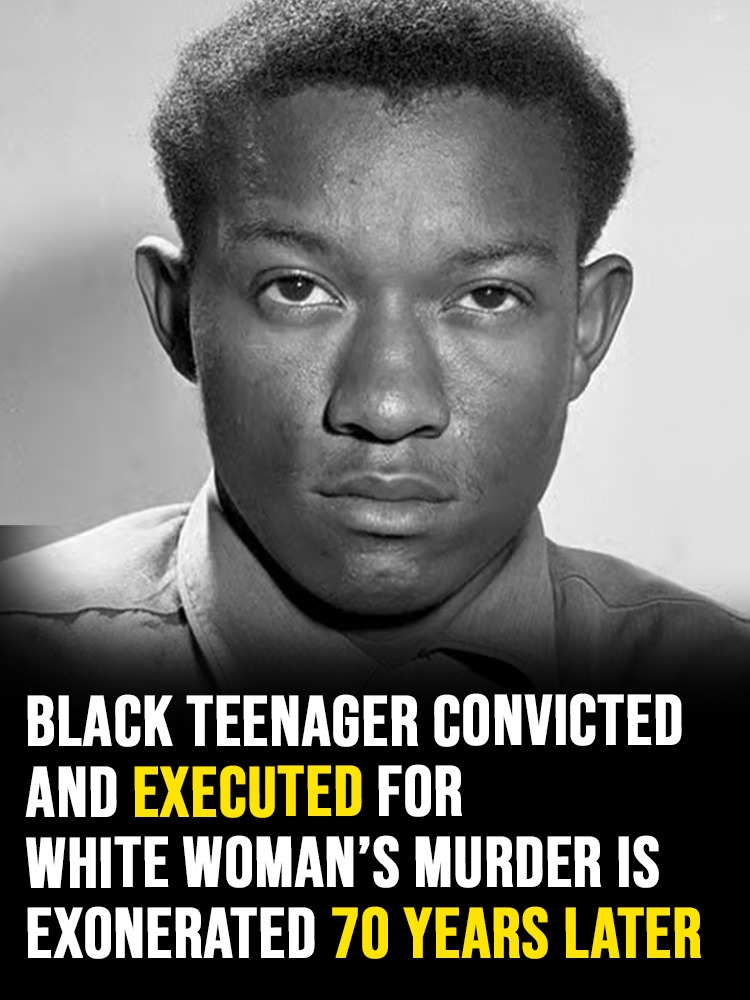
Black teenager convicted and executed for white womans murder is exonerated decades later!
The pursuit of justice is often described as a marathon, but in the case of Tommy Lee Walker, it was a relay race spanning seven decades, passed through the hands of grieving descendants and civil rights advocates until the truth finally crossed the finish line. On Wednesday, January 21, 2026, the Commissioners Court of Dallas officially exonerated Tommy Lee Walker, a Black man who was executed in 1956 for a crime he did not commit. This landmark resolution, arriving seventy years after his death, serves as a sobering reminder that while the legal system can be final, it is not always infallible.
The tragedy began in 1953 near the Dallas Love Field airport. Venice Parker, a white store clerk, had just finished her shift at a nearby toy store and was waiting for a bus when she was brutally sexually assaulted and stabbed. A passing driver discovered her and rushed her to the hospital, but her injuries were catastrophic. Before she succumbed to her wounds, a police officer claimed she identified her attacker as a Black man. Because of the severity of the cuts to her throat, Parker was physically unable to speak, a fact that later cast significant doubt on the validity of the officer’s testimony.
In the racial climate of 1950s Texas, the pressure to find a suspect was immense. Tommy Lee Walker, then just nineteen years old, was arrested four months later by Will Fritz, the Chief of the Dallas Police Homicide Bureau. Historical records and research by the Innocence Project have since noted that Fritz was alleged to have ties to the Ku Klux Klan, a detail that colors the aggressive nature of the investigation.
Walker’s arrest was fundamentally flawed from the start. He possessed an airtight alibi: on the night of the murder, he was at the hospital attending the birth of his first and only child. More than ten eyewitnesses were prepared to testify that he was nowhere near the scene of the crime. Despite this, Walker was subjected to hours of relentless interrogation. He was stripped down emotionally and physically, threatened with the electric chair, and denied basic protections. Exhausted and terrified, he was eventually coerced into signing a confession.
During the trial, the prosecution’s case rested almost entirely on this forced statement. There was no forensic evidence linking Walker to Venice Parker, no DNA—which did not exist as a legal tool at the time—and no circumstantial evidence that placed him at the bus stop. Even the two witnesses who claimed to have seen him in the general area that night admitted they had not witnessed any struggle or crime. Walker took the stand in his own defense, recanting the confession and describing the duress under which it was obtained. He told the court, “I feel that I have been tricked out of my life.”
The jury, however, remained unmoved. Walker was convicted and sentenced to death. On May 12, 1956, at the age of twenty-one, Tommy Lee Walker was led to the electric chair. His final words were not a plea for mercy, but a steadfast proclamation of his innocence. He died a convicted murderer in the eyes of the law, leaving behind a young son, Edward Smith, who would grow up in the shadow of a state-sanctioned injustice.
The path to exoneration was paved by the relentless work of the Innocence Project and the Dallas County District Attorney’s office under John Creuzot. By re-examining appellate court decisions and historical records, investigators were able to highlight the systemic failures that led to Walker’s execution. The modern review made it clear that the evidence against him was non-existent and the confession was a product of coercion.
The most poignant moment of this seventy-year journey occurred during the adoption of the exoneration resolution. In a room filled with the heavy weight of history, two men met for the first time: Edward Smith, the son of the man wrongfully executed, and Joseph Parker, the son of the woman whose murder started it all. In an act of profound grace and moral clarity, Joseph Parker stood beside Edward and affirmed what the evidence now makes undeniable: Tommy Lee Walker was an innocent man.
District Attorney John Creuzot released photos of the meeting, capturing a moment that transcended generations of racial tension and personal grief. “Justice does not expire with time,” Creuzot stated, emphasizing that the state has a moral obligation to correct its errors, no matter how much time has passed or how many of the original participants are gone. The resolution adopted by the Commissioners Court officially acknowledged the “irreparable harm” caused to Walker, his family, and the broader community.
The exoneration of Tommy Lee Walker is part of a larger, necessary movement to address the historical injustices of the American legal system. According to the Death Penalty Information Center, since 1973, at least 196 people have been exonerated from death row in the United States after being found innocent. Walker’s case is particularly tragic because his exoneration came too late to save his life, placing him among a smaller, grimmer group of individuals posthumously cleared of crimes for which they were executed.
This case also sheds light on the “confession culture” of mid-century policing, where the goal was often a signed statement rather than a thorough investigation. In the 1950s, the lack of forensic technology meant that a confession was the “gold standard” of evidence, even when obtained through methods that would be considered torture today. Walker’s case proves that a signature on a page is no substitute for the truth.
As Edward Smith finally saw his father’s name cleared, the resolution provided a measure of peace, though it could never replace the father he lost on the day he was born. The story of Tommy Lee Walker is a testament to the endurance of the human spirit and the necessity of vigilantly guarding the rights of the accused. It stands as a reminder to the citizens of Dallas and the world that the pursuit of truth is a sacred duty. While the electric chair took Tommy Lee Walker’s life in 1956, the light of justice finally restored his dignity in 2026. The ledger is finally balanced, and a man who spent his last breath declaring his innocence can finally rest in a peace that is recognized by the law he once feared.