A Cop Said Native People Shouldn’t Be Driving — He Didn’t Know My Camera Was Recording
I knew something was wrong the moment I saw the flashing lights behind me.
Not because I had been speeding.
Not because I had run a red light.
Not because I had done anything wrong.
I knew because I had been watching my speedometer for the last ten miles.
Forty-three miles per hour.
The speed limit was forty-five.
My seat belt was on.
My phone was untouched in the cup holder.
Both hands were on the steering wheel.
And still, the red and blue lights followed me.
For a few seconds, I hoped the officer was trying to pass.
Then the siren chirped.
Once.
Short.
Sharp.
For me.
My stomach tightened.
I turned on my signal and slowly pulled onto the shoulder.
It was just after sunset.
The road was almost empty.
There were trees on both sides, a gas station maybe half a mile behind me, and nothing but darkness ahead.
I put the car in park.
Then I remembered something.
My camera.
A small dashboard camera sat behind my rearview mirror.
I had installed it months earlier after someone hit my parked car and denied doing it.
Normally, I forgot it was even there.
That night, a tiny red light was blinking.
Recording.
I had no idea that little red light was about to become the most important thing in my car.
My name is Lena.
I’m a Native American woman.
And this is the story of the traffic stop I still think about every time I see flashing lights in my mirror.
I was driving home after visiting my aunt.
Nothing unusual had happened that day.
We drank coffee.
We talked too long.
She packed food for me even though I told her I didn’t need any.
By the time I left, the sun was beginning to disappear.
I remember calling my mother before starting the car.
“I’m heading home.”
“Drive carefully.”
“I always do.”
She laughed.
“No, you don’t.”
“Yes, I do.”
“Text me when you get home.”
“I will.”
That was it.
A completely normal conversation.
Twenty minutes later, I was sitting alone on the side of a dark road with a police cruiser behind me.
I lowered my window halfway.
Then I placed both hands where they could be seen.
I waited.
The driver’s door of the cruiser opened.
An officer stepped out.
He walked slowly toward my car.
Flashlight in one hand.
The light swept across my back window.
Then across the driver’s side.
Then directly into my face.
I squinted.
“Good evening, officer.”
He didn’t respond to the greeting.
“License and registration.”
“Of course.”
I reached slowly toward my bag.
His voice immediately sharpened.
“Keep your hands where I can see them.”
I froze.
“My license is in my bag.”
“Then tell me before you reach.”
“Okay.”
I put my hands back on the wheel.
“My bag is on the passenger seat. May I get my license?”
He stared at me for a second.
“Slowly.”
I reached over, opened my wallet, removed my license and handed it to him.
He looked at it.
Then at me.
Then back at the license.
“Where are you coming from?”
“My aunt’s house.”
“Where?”
I told him.
“Where are you going?”
“Home.”
He looked through the window toward the back seat.
There was nothing there except a jacket and the container of food my aunt had given me.
“Is this your vehicle?”
“Yes.”
He looked at the registration.
Then back at me.
“You sure?”
That question caught me off guard.
“Yes. I’m sure.”
He leaned slightly closer to the window.
“What’s with the attitude?”
I stared at him.
“I don’t have an attitude.”
He gave a short laugh.
“Right.”
My heart started beating faster.
I still didn’t know why I had been stopped.
So I asked.
“Officer, can I ask why you pulled me over?”
He didn’t answer.
Instead, he looked at my earrings.
Small beaded earrings my grandmother had given me.
Then at the woven pattern on my jacket.
Then at my face.
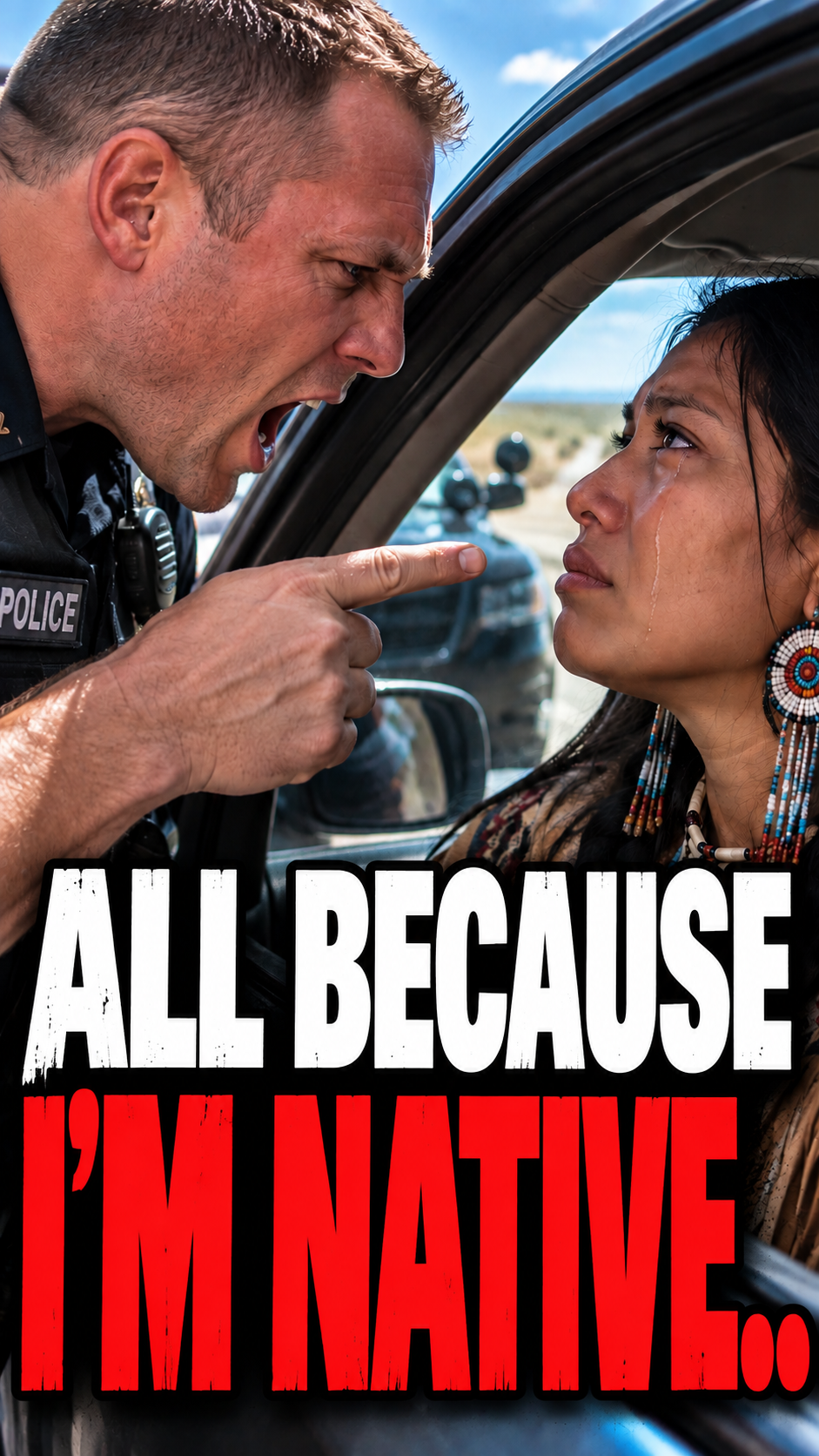
“You Native?”
For a moment, I thought I’d misheard him.
“Excuse me?”
“Are you Native?”
I paused.
“Yes.”
He nodded slowly.
Not like he had learned something interesting.
More like something had just been confirmed.
“Thought so.”
I felt the atmosphere change.
“Why does that matter?”
He looked at me.
“I ask the questions.”
I tightened my hands around the steering wheel.
“Okay.”
He looked again at my license.
Then he said:
“People like you really shouldn’t be driving around out here this late.”
For a second, I didn’t understand what he meant.
“People like me?”
He didn’t answer.
I asked again.
“What does that mean?”
He leaned closer.
“You heard me.”
My heart dropped.
I looked straight ahead.
I could see the tiny reflection of the dashboard camera in the windshield.
Red light.
Blinking.
Recording.
I didn’t say anything.
The officer tapped my license against the side of the door.
“You got something to say?”
“No.”
“Good.”
He started walking back toward his cruiser.
Then stopped.
He turned around.
“Stay in the vehicle.”
“I wasn’t planning to leave.”
He stared at me.
“What did you say?”
My stomach twisted.
“Nothing.”
“No. You said something.”
“I said I wasn’t planning to leave.”
He walked back toward my window.
His voice was different now.
“Step out of the vehicle.”
My entire body went cold.
“Why?”
“Step out.”
“Officer, I haven’t done anything.”
“I’m not asking again.”
I looked at the empty road.
No cars.
No witnesses that I could see.
Just me.
Him.
And the blinking red light.
I unlocked the door.
“Slowly.”
I opened the door and stepped out.
The air was cold.
I kept my hands visible.
The officer pointed toward the front of my car.
“Stand there.”
I did.
He shined the flashlight across me.
“Anything on you?”
“No.”
“Weapons?”
“No.”
“Drugs?”
“No.”
“Anything illegal in the vehicle?”
“No.”
“You seem nervous.”
“I am nervous.”
“Why?”
I couldn’t believe the question.
“Because I’m standing on the side of the road and I still don’t know why you stopped me.”
He stepped closer.
“You’re making this difficult.”
“How?”
“Your attitude.”
“I’ve answered every question.”
He stared at me.
Then he looked toward the inside of my car.
“Mind if I take a look?”
“Yes.”
He raised his eyebrows.
“Yes?”
“Yes, I mind.”
For the first time, he looked surprised.
“Why?”
“Because you haven’t told me why I was stopped.”
He smiled.
It wasn’t friendly.
“If you’ve got nothing to hide, what’s the problem?”
“I didn’t say I had anything to hide.”
“Then let me look.”
“No.”
Silence.
He stepped closer.
“Listen carefully.”
I didn’t move.
“You don’t want to turn a simple traffic stop into something bigger.”
My hands started shaking.
I put them together so he wouldn’t notice.
“Then please tell me what traffic violation I committed.”
His face changed.
“What?”
“What did I do?”
He stared at me.
“Don’t play games with me.”
“I’m not.”
“Were you speeding?”
“No.”
“You sure?”
“Yes.”
“Maybe you crossed the center line.”
“I didn’t.”
“Maybe your taillight is out.”
“It was working when I left.”
He looked at me for several seconds.
Then said:
“You people always think you know everything.”
There it was again.
You people.
I swallowed.
“What people?”
He gave me a look that told me exactly what he meant.
But he didn’t say it.
Not yet.
Instead, he walked toward the rear of my car.
He shined his flashlight at my license plate.
Then at the taillights.
Both were working.
I watched him see it.
He said nothing.
Then he returned.
“Get back in the car.”
I did.
He kept my license.
Then walked back toward his cruiser.
I immediately looked at the camera.
Still recording.
My hands were shaking so badly I could barely hold my phone.
I wanted to call my mother.
But I was afraid he would return and accuse me of doing something with the phone.
So I left it untouched.
I whispered to myself:
“Stay calm.”
Not because I thought I was wrong.
Because I wanted to get home.
Five minutes passed.
Then ten.
The cruiser remained behind me.
Its lights continued flashing through my windows.
Red.
Blue.
Red.
Blue.
Every few seconds, I checked the mirror.
The officer was sitting inside.
I couldn’t tell what he was doing.
Finally, his door opened.
He walked back toward me.
This time, he had a piece of paper.
He handed me my license.
“I’m giving you a warning.”
“For what?”
He paused.
“Unsafe driving.”
“What unsafe driving?”
His jaw tightened.
“Do you want the warning or do you want a citation?”
“I want to know what I did.”
“You were drifting.”
“No, I wasn’t.”
“Are you calling me a liar?”
My stomach dropped again.
“No.”
“Sounds like you are.”
I looked down at the paper.
There was no clear explanation that matched what he had initially implied.
I looked back up.
“Officer, respectfully, I don’t understand.”
He leaned toward my window.
“Maybe you should stay closer to where you belong.”
Everything inside me went silent.
I stared at him.
“What did you say?”
He looked directly at me.
“You heard me.”
“No. I want you to say it again.”
That was the moment he made his biggest mistake.
He smiled.
Then he said:
“You Native girls come out here thinking the rules don’t apply to you.”
I felt sick.
“I wasn’t breaking any rule.”
He shook his head.
“People like you shouldn’t be driving at all if you can’t follow simple instructions.”
There it was.
Clear.
Direct.
And recorded.
Every word.
I looked toward the windshield for half a second.
His eyes followed mine.
He noticed the camera.
The smile disappeared.
“What is that?”
I didn’t answer.
He leaned closer.
“Is that a camera?”
My heart started pounding.
“Yes.”
His entire posture changed.
“Is it recording?”
I looked at the blinking red light.
“Yes.”
For the first time that night, he said nothing.
Then:
“Turn it off.”
“No.”
His eyes narrowed.
“Turn the camera off.”
“Why?”
“Because I’m telling you to.”
I kept both hands on the wheel.
“I’m not touching it.”
He stepped back.
“Give me the camera.”
“No.”
His voice rose.
“Ma’am, don’t make this worse.”
“I haven’t done anything.”
“Hand me the camera.”
“No.”
He reached toward the open portion of my window.
I instinctively pulled back.
“Don’t touch my camera.”
“Then turn it off.”
“No.”
For a moment, neither of us moved.
Then headlights appeared behind the cruiser.
Another police vehicle.
My heart sank.
I thought things were about to get worse.
A second officer stepped out.
He approached.
“Everything okay?”
The first officer turned toward him.
“Yeah. She’s being difficult.”
I immediately spoke.
“I’ve cooperated with everything he’s asked.”
The first officer looked at me.
“Stay out of this.”
The second officer looked between us.
Then toward my dashboard.
He saw the camera.
“What happened?”
I said:
“I still don’t know why I was stopped.”
The first officer interrupted.
“Unsafe driving.”
I looked at the second officer.
“He told me people like me shouldn’t be driving.”
Silence.
The second officer looked at him.
“What?”
“He asked if I was Native. Then he told me people like me shouldn’t be driving.”
The first officer shook his head.
“That’s not what I said.”
My fear disappeared for one second.
Because I knew something he had apparently forgotten.
I pointed toward the windshield.
“The camera heard what you said.”
Both officers looked at it.
The second officer’s face changed.
“It’s recording?”
“Yes.”
The first officer immediately said:
“She was argumentative from the beginning.”
I looked at the second officer.
“Watch the recording.”
The first officer stepped closer.
“You’re not giving anybody anything right now.”
The second officer raised his hand.
“Hold on.”
Then he looked at me.
“Ma’am, stay in the vehicle.”
I nodded.
The two officers walked toward the cruisers.
I couldn’t hear everything.
But I could see them arguing.
The first officer gestured toward my car.
The second officer shook his head.
At one point, the first officer looked directly toward the camera.
Then away.
After several minutes, the second officer returned alone.
His tone was completely different.
“Ma’am, do you have your license back?”
“Yes.”
“Registration?”
“Yes.”
“Okay.”
He paused.
“You’re free to leave.”
I looked at him.
“That’s it?”
He didn’t answer immediately.
Then he said:
“If you have concerns about what happened during this stop, there is a formal complaint process.”
I looked toward the first officer.
He was standing beside his cruiser.
Watching us.
“I have more than concerns.”
The second officer nodded.
“I understand.”
“No, I don’t think you do.”
He waited.
“He didn’t know that camera was recording until the end.”
The officer looked at the dashboard camera.
Then back at me.
“Keep the footage.”
Four words.
Keep the footage.
I did.
I drove away slowly.
I made it maybe two miles before pulling into a brightly lit gas station.
I parked.
Turned off the engine.
Then I started shaking.
Not little tremors.
My whole body.
I couldn’t put the key back into the ignition if I wanted to.
I called my mother.
She answered immediately.
“You home?”
I couldn’t speak.
“Lena?”
I tried.
Nothing came out.
“Lena, what’s wrong?”
Then I started crying.
She stopped asking questions.
“Where are you?”
I told her.
“Stay there.”
“Mom—”
“Stay there. I’m coming.”
Twenty minutes later, she pulled into the gas station.
The moment she opened my door, I fell into her arms.
She held me like I was a child again.
“What happened?”
I told her.
Every word.
When I got to the part about the camera, she pulled away.
“You recorded it?”
“The dashcam did.”
“Everything?”
“I think so.”
We sat inside my car.
I opened the camera app.
Found the file.
And pressed play.
There I was.
Sitting behind the wheel.
The officer approaching.
“License and registration.”
We watched.
My mother didn’t speak.
Then the question:
“You Native?”
My mother’s face changed.
We kept watching.
“People like you really shouldn’t be driving around out here this late.”
My mother inhaled sharply.
Then later:
“You Native girls come out here thinking the rules don’t apply to you.”
And finally:
“People like you shouldn’t be driving at all…”
My mother reached over and paused the video.
For several seconds, she said nothing.
Then:
“Save this.”
“I will.”
“No.”
She looked directly at me.
“Save it somewhere else. Right now.”
So I did.
I copied the footage to my phone.
Then to cloud storage.
Then sent it to my mother.
Three copies.
Because suddenly I understood something.
Without that video, the story could become:
His word against mine.
With the video, the words belonged to him.
The next morning, I barely slept.
Every time I closed my eyes, I saw the flashing lights.
I kept hearing:
People like you.
People like you.
People like you.
Around 9 a.m., I called the department.
I asked how to file a formal complaint.
The woman on the phone transferred me.
Then transferred me again.
Eventually, I spoke with a supervisor.
He asked me to explain what happened.
I did.
His first response was cautious.
“Do you know the officer’s name?”
“Yes.”
“Do you have the warning he issued?”
“Yes.”
“Are there witnesses?”
I paused.
“Yes.”
“Who?”
“My camera.”
Silence.
“You have video?”
“And audio.”
Another pause.
“How much?”
“The entire stop.”
His tone changed.
“Can you preserve the original file?”
“I already have.”
He asked me to come in.
I almost said no.
The thought of walking into the same department terrified me.
But my mother came with me.
So did my aunt.
I wasn’t walking in alone.
We sat in a small room.
A supervisor entered with another official.
They asked permission to view the footage.
I opened my laptop.
Pressed play.
Nobody spoke.
They watched the officer approach.
They watched him question me.
They heard him ask if I was Native.
They heard the comments.
They heard him ask me to turn off the camera.
Then came the moment the second officer arrived.
They watched the first officer deny saying what the recording had already captured.
The supervisor paused the video.
He looked at the other official.
Then at me.
“Can you send us a copy?”
“Yes.”
He nodded.
“This will be reviewed.”
I stared at him.
“That’s all?”
“At this stage, yes.”
I felt anger rising.
“Do you know what would’ve happened if I didn’t have that camera?”
He didn’t answer.
“I’d be sitting here telling you what he said, and he could tell you I misunderstood him.”
The supervisor remained silent.
“He denied it while the camera was still recording.”
“I saw that.”
“Then you understand why I’m not comfortable hearing ‘we’ll review it.’”
He nodded slowly.
“I understand.”
I looked him directly in the eyes.
“I want the entire stop reviewed. Not just the worst sentence.”
“It will be.”
“I want you to look at why I was stopped.”
He wrote something down.
“I want you to look at why he asked about my identity.”
Another note.
“I want you to look at why he wanted my camera turned off after he noticed it.”
Another note.
“And I want you to listen to the way he spoke before and after he realized there was a recording.”
The room was silent.
Then the supervisor said:
“We will.”
Days passed.
I kept thinking about the stop.
But something else bothered me.
The moment before he noticed the camera.
That was the real moment.
Because until then, he thought the conversation belonged only to us.
He thought there would be no record.
No audience.
No replay button.
Then he saw the blinking light.
And everything changed.
His voice.
His posture.
His words.
Suddenly, the camera mattered.
That tiny red light did what I couldn’t do by myself.
It created a record.
Later, I was informed that the complaint had triggered an internal review.
I was told the officer’s conduct during the stop, including his statements and the basis for the traffic stop, would be examined.
I wasn’t given every detail.
Personnel processes aren’t always public.
But I knew the footage could no longer be dismissed as a misunderstanding.
It existed.
I watched it.
My mother watched it.
The department watched it.
The officer’s own words were there.
And that mattered to me more than any dramatic confrontation.
Because I didn’t need to exaggerate.
I didn’t need to guess what he meant.
I didn’t need to reconstruct the conversation from memory.
The camera had done that for me.
For weeks afterward, whenever I drove at night, I kept checking the mirror.
If headlights stayed behind me too long, my stomach tightened.
If I saw a police cruiser, I checked my speed three times.
Forty-four.
Forty-three.
Forty-four.
I knew I wasn’t doing anything wrong.
But that didn’t stop the feeling.
One evening, my mother called while I was driving.
“You okay?”
“Yeah.”
“You sound weird.”
“There’s a police car behind me.”
“Are the lights on?”
“No.”
“Then breathe.”
I laughed nervously.
“I’m trying.”
The cruiser eventually turned onto another road.
Nothing happened.
But my hands were sweating.
That’s what people don’t always understand about experiences like that.
The stop ends.
Your body doesn’t always get the message.
A few months later, my aunt asked why I still kept the dashcam.
I looked at her.
“Seriously?”
She laughed.
“Okay. Stupid question.”
Now I check that camera every time I start the car.
Not because I expect something bad to happen.
Because I learned the value of having an accurate record when two people remember the same moment differently.
And sometimes I think about what would’ve happened without it.
What if there had been no camera?
I could’ve filed the same complaint.
I could’ve repeated every sentence perfectly.
I could’ve described the road, the officer, the flashlight, the warning.
But there would’ve always been room for someone to say:
Maybe that’s not exactly what happened.
Maybe she misunderstood.
Maybe the officer meant something else.
Maybe emotions affected her memory.
The recording removed the “maybe.”
The part that hurt most wasn’t being pulled over.
Police officers conduct traffic stops every day.
It wasn’t being asked for my license.
It wasn’t being nervous.
It wasn’t even standing beside my car in the cold.
It was realizing that the conversation changed after he learned I was Native.
It was hearing “people like you.”
It was being told where I supposedly belonged.
And it was watching his behavior change the moment he realized somebody besides me might eventually hear his words.
I don’t know what was in his mind before he approached my car.
I won’t pretend I do.
I only know what he said.
And because of that camera, I don’t have to ask anyone to take my word for those statements.
They were recorded.
My mother asked me later:
“If you could go back, would you have said something different?”
I thought about it.
Maybe I would’ve stayed completely silent.
Maybe I would’ve asked fewer questions.
Maybe I would’ve called someone immediately.
But then I realized something.
I hadn’t insulted him.
I hadn’t threatened him.
I hadn’t tried to drive away.
I hadn’t refused to identify myself.
I had asked one basic question:
Why did you stop me?
I don’t regret asking.
The warning stayed folded inside my glove compartment for a long time.
I could’ve thrown it away.
I didn’t.
Every time I opened the compartment, I saw it.
Eventually, my mother asked:
“Why are you keeping that?”
I told her:
“To remind myself.”
“Of him?”
“No.”
I looked toward the little camera behind the mirror.
“To remind myself that I wasn’t imagining it.”
She nodded.
Then she said something I’ll never forget.
“You never needed a camera to know what happened.”
I know.
But sometimes the world does.
This is a fictional dramatized story created for storytelling.
But its central point is simple:
One traffic stop can be remembered two different ways.
A recording doesn’t have feelings.
It doesn’t get embarrassed.
It doesn’t become intimidated.
It doesn’t forget the exact sentence someone used.
It simply preserves what happened in front of it.
That night, the officer thought he was speaking to one Native woman alone on a dark road.
He didn’t realize there was another witness sitting silently behind my windshield.
A witness with a blinking red light.
A witness that remembered every word.
And by the time he noticed it…
it was already too late.