They Said the Government Owned Our Land
They Said the Government Owned Our Land — But We Never Gave It Away
They arrived just after sunrise.
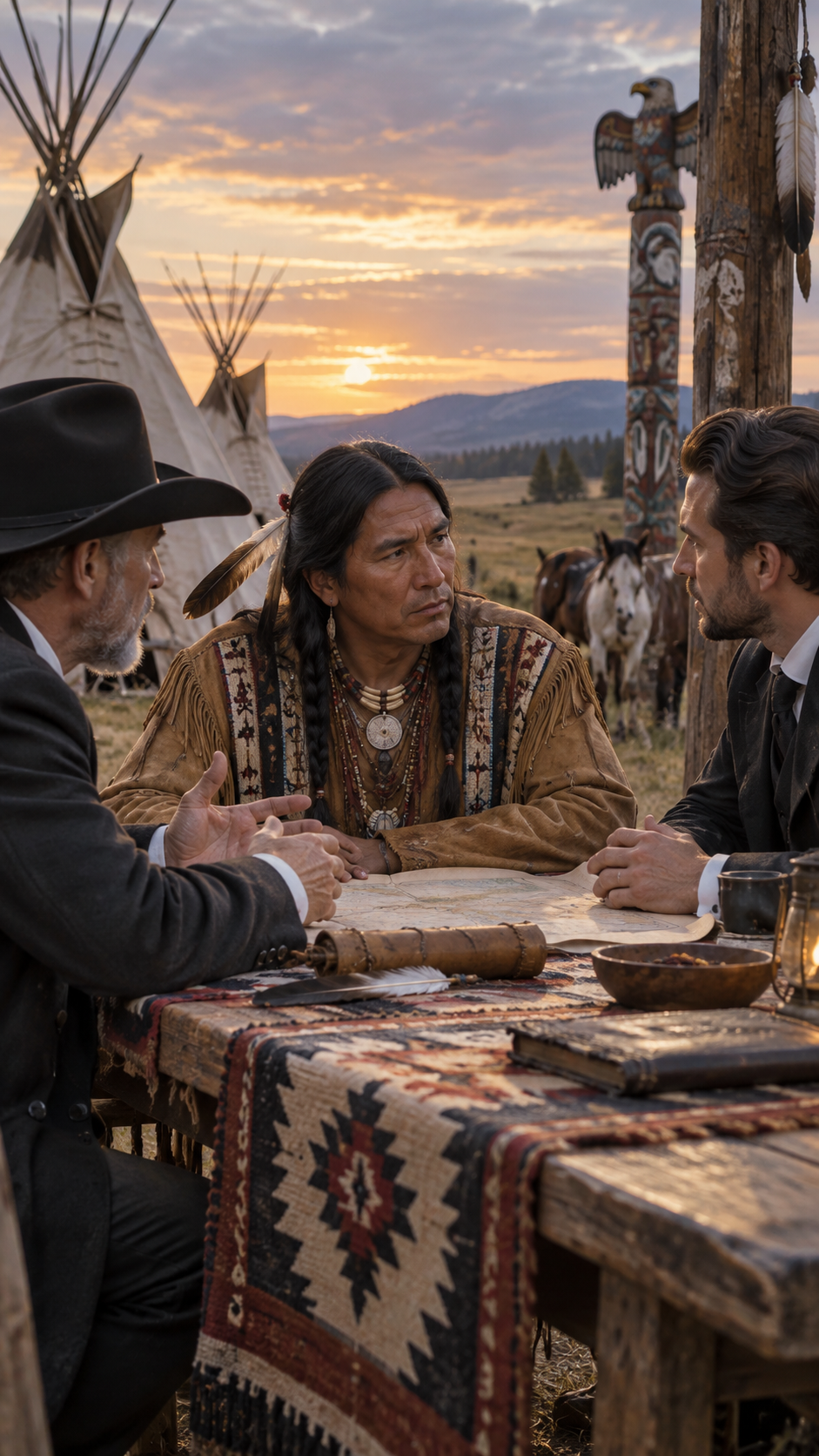
Two government officials rode into our land carrying leather bags filled with papers, maps, and documents covered in signatures none of us recognized.
Nobody had invited them.
Nobody had been told they were coming.
My family watched from behind me as the two men walked toward our table. Our children stopped playing. The older people came out of their homes. Within minutes, nearly everyone was standing nearby.
One of the officials unfolded a large map across the wooden table.
He placed his finger directly over the place where we were standing.
“The government has made a decision,” he said.
I waited.
He continued.
“This territory now belongs to the government.”
For a moment, I thought I had misunderstood him.
I looked behind me.
I could see the river where my father had taught me to fish.
Beyond it were the trees where I had hunted with my brothers.
Farther up the hill were the graves of people whose names I had known since childhood.
Our children were standing on the same ground their grandparents had walked on.
And this stranger had just crossed hundreds of miles to tell us that none of it belonged to us anymore.
I looked back at him.
“Did the government buy this land?”
He hesitated.
“No.”
I looked at the second official.
“Did our people sell it?”
“No.”
“Did we trade it?”
Again:
“No.”
I stared at both men.
“Then how can they own it?”
Neither answered.
The wind moved across the field.
Behind me, nobody spoke.
The younger official finally pointed toward the map.
“These boundaries have been recognized by the government.”
I looked down.
Someone had drawn straight lines across mountains, rivers, hunting grounds and villages.
To them, they were borders.
To us, they were lines drawn through our lives.
I asked him another question.
“Who gave you permission to draw those lines?”
He didn’t answer.
Instead, the older official opened his leather bag and removed another document.
“This has already been decided.”
He pushed it toward me.
At the bottom was an empty space.
A place for my signature.
That was when I understood why they had really come.
They weren’t there to negotiate.
They weren’t there to ask what we wanted.
They wanted my signature so they could return home and say we had agreed.
I picked up the document.
I began reading.
The more I read, the stranger it became.
The paper described the surrounding territory, the river, the forest and the hills.
But something was missing.
Us.
There was almost nothing about the families who lived there.
Nothing about the children.
Nothing about our homes.
Nothing about the generations buried there.
On their paper, our homeland looked almost empty.
I placed the document back on the table.
“You wrote about the land,” I said.
The official nodded.
“But you forgot the people living on it.”
His expression changed.
“This isn’t about individuals.”
I looked behind me at the crowd.
“Those are not individuals?”
He didn’t respond.
I pointed toward an elderly woman standing behind me.
“She was born here.”
Then toward another man.
“His father was born here.”
Then toward the children.
“And they were born here.”
I turned back toward him.
“How many generations does a family have to live somewhere before you admit it is their home?”
The younger official became uncomfortable.
The older one remained calm.
He pushed the document toward me again.
“You need to understand something. The government considers this matter settled.”
I didn’t touch the paper.
“Settled with whom?”
Silence.
“Because nobody here settled anything with you.”
His voice became firmer.
“You are being offered the right to remain on designated land.”
That sentence hit harder than anything else he had said.
I almost laughed.
“Offered?”
He looked confused.
I pointed toward the ground beneath our feet.
“You came here to offer us permission to live on our own land?”
Nobody behind me moved.
The official took a breath.
“The government is giving your people land that will be recognized as yours.”
I looked at him for several seconds.
Then I asked:
“Giving us?”
“Yes.”
“How can you give me something that you never received from me?”
Again, silence.
The younger official looked down at the table.
The older man didn’t.
He had clearly had conversations like this before.
He began explaining laws, boundaries and government authority.
But every answer created another question.
If they hadn’t bought the land…
If we hadn’t sold it…
If we hadn’t traded it…
If we hadn’t surrendered it…
Then when exactly had it become theirs?
Finally, I asked him directly.
“If I refuse to sign this paper, does the land remain ours?”
His face changed.
That was the question he didn’t want me to ask.
He slowly shook his head.
“No.”
I looked at the document.
Then at him.
“So my signature doesn’t matter?”
“It would make the transition easier.”
“For who?”
He didn’t answer.
I pushed the paper across the table.
“You didn’t come here for an agreement.”
The men remained silent.
“You came here for permission to say there was an agreement.”
The crowd behind me began murmuring.
The official stood.
“You should think carefully about what you’re doing.”
“I have.”
“There could be consequences.”
“For refusing to give away something that was never yours?”
His jaw tightened.
Then he said something I would remember for the rest of my life.
“Whether you sign or not, the government considers the decision final.”
Everything became quiet.
Even the children seemed to understand that something had changed.
I looked down at the map again.
The lines suddenly made sense.
Those lines weren’t showing us what they wanted.
They were showing us what they had already decided.
Our conversation was only theater.
The decision had been made somewhere far away by people who had never walked beside our river, never slept beneath these trees and never buried someone they loved in this ground.
I folded the document.
For a moment, the officials probably thought I was going to sign it.
Instead, I handed it back.
“No.”
The older official stared at me.
“No?”
“I will not sign.”
He looked toward the people standing behind me.
“Do they understand what you’re risking?”
I turned around.
There were mothers holding children.
Old men who could barely stand.
Young men staring angrily at the strangers across the table.
I knew exactly what was at risk.
That was the point.
I turned back.
“They understand what you’re taking.”
The official collected his papers.
Before leaving, he stopped beside me.
“You cannot stop what is coming.”
I looked at him.
“Maybe not.”
Then I looked at the map still lying on the table.
“But you will never use my name to say I agreed to it.”
They left before sunset.
For a while, nobody moved.
Then one of the children walked toward the table.
He looked at the map and asked me a question I wasn’t prepared for.
“Are they taking our home?”
I wanted to tell him no.
I wanted to tell him that nobody could simply arrive with paper and take away the place where he had been born.
But after what I had just heard, I couldn’t promise him that.
So I told him something else.
“A piece of paper can say many things.”
I pointed toward the river.
“But that river remembers who lived beside it.”
Over the following days, word spread.
Other families came to speak with us.
Some had received similar documents.
Others had been told they would have to move.
Some were afraid to resist.
Others were furious.
But almost everyone asked the same question:
How can somebody claim ownership of land they never bought from you?
Weeks later, the officials returned.
This time, they weren’t alone.
More men came with them.
More documents.
More maps.
The tone was different.
There was less talk about agreement.
More talk about deadlines.
We were told where our people would be permitted to live.
We were told where we could hunt.
Where we could travel.
What boundaries we were expected to respect.
Every new rule carried the same strange assumption:
That someone far away had authority over a place they had never called home.
I asked again:
“Who agreed to this?”
Nobody gave me a name.
They spoke about government.
They spoke about law.
They spoke about progress.
But whenever I asked the simplest question—
“When did we give you this land?”
—the conversation stopped.
Years later, I would still remember that first morning.
Not because of the maps.
Not because of the documents.
Not even because of the threats.
I remembered the silence after I asked:
“Did they buy it?”
“No.”
“Did we trade it?”
“No.”
“Did we give it to them?”
“No.”
Then the question that nobody sitting across from me could answer:
“Then how can they own it?”
Maybe that was why the question made them uncomfortable.
Because underneath all the papers, signatures, borders and official words was something incredibly simple:
We had been living there before they arrived.
We were living there when they drew their maps.
And we were still standing there when they came to tell us that the ground beneath our own feet belonged to somebody else.
They wanted my signature.
They never got it.
And whatever their documents would later say, nobody would ever be able to truthfully say:
We gave our land away.
Fictional dramatization inspired by historical conflicts involving Indigenous peoples, land and government authority.